What is shockwave therapy?
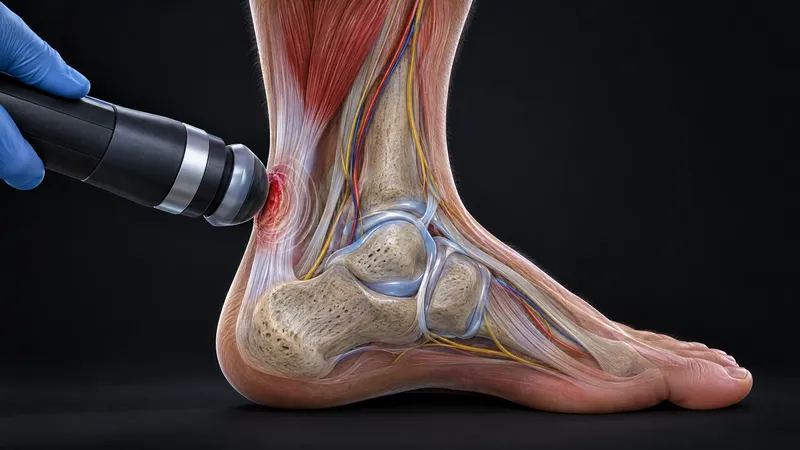
Shockwave therapy delivers rapid pulses of pressure into tissue from an applicator held against your skin. Its full name is extracorporeal shockwave therapy, or ESWT. "Extracorporeal" just means "from outside the body": the applicator stays on the surface, and nothing is inserted.
Despite the name, what's delivered is pressure. The two main types of machine differ in where that pressure is strongest 5:
- Focused shockwave starts wide and converges, reaching its maximum pressure at a specific depth inside the tissue.
- Radial shockwave is strongest right at the applicator, where it touches your skin. The pressure spreads out from there as it travels deeper.
That can sound like a technical detail, but it matters when you read about results. Studies use different machine types, energy settings and session schedules. A 2022 best-practice review names that variability in how treatment is delivered as a reason the research evidence conflicts 5. So when you read that shockwave did or didn't work, it's fair to ask which type was used, and for which tendon.
What is shockwave therapy useful for?
Shockwave is mostly used for long-standing tendon and soft-tissue pain in the lower limb, and that's where most of the research sits. Conditions it has been studied for include:
- Plantar fasciitis: pain under the heel. Australian Government health guidance lists shockwave among the options for it, as something your doctor may suggest and a specialist can perform 1. If you're not sure your heel pain is plantar fasciitis, our guide to heel pain causes can help you narrow it down.
- Achilles tendinopathy: pain in the big tendon at the back of your ankle. This can be in the middle of the tendon (mid-portion) or where it attaches to the heel bone (insertional) 4. One UK public hospital uses shockwave for Achilles tendon problems as well as heel pain 2.
- Patellar tendinopathy: pain in the tendon just below the kneecap 3,4.
- Proximal hamstring tendinopathy: pain where the hamstring tendon attaches high up, near the sitting bone 4.
- Greater trochanteric pain syndrome: pain over the outside of the hip 4.
- Shin splints, known clinically as medial tibial stress syndrome 4.
Being studied for something isn't the same as working for it. That's the next question.
Does shockwave therapy actually work?
It depends on which tendon. A 2023 systematic review found high-quality evidence that shockwave has a large effect on pain and function in plantar fasciitis. The same review found low-to-moderate quality evidence of a negligible effect for patellar and Achilles tendinopathy 3. So the answer to "does it work?" is another question: for what?
Here's how the research breaks down by condition.
| Condition | What the research found | Strength of evidence |
|---|---|---|
| Plantar fasciitis | A large effect on pain and function 3 | High 3 |
| Patellar tendinopathy | A negligible effect on pain and function 3. Focused shockwave was no better than a placebo version in the short and mid term 4 | Low to moderate 3; moderate 4 |
| Achilles tendinopathy, mid-portion | A negligible effect overall 3. Roughly comparable to eccentric (lengthening) strength exercise, and better than wait-and-see at four months 4 | Low to moderate 3; low 4 |
| Achilles tendinopathy, insertional | Better than eccentric exercise at four months 4 | Low 4 |
| Proximal hamstring tendinopathy | Radial shockwave did better than conservative treatment at short, mid and long-term follow-up 4 | Moderate 4 |
| Greater trochanteric pain syndrome | Less effective than a steroid injection in the short term, but better in the mid and long term 4 | Low 4 |
Before you lean on any single row, three things are worth knowing.
The quality is uneven. In the 2017 review behind most of those rows, 13 of the included studies had a high risk of bias, largely because of how they were designed, blinded and reported. Its overall conclusion was modest: there is low-level evidence that shockwave may be effective for some lower limb conditions 4. Where a row says "low", treat it as a weak signal, not a finding to plan around.
A placebo beat it once. For Achilles tendinopathy, the 2023 review found that a placebo outperformed shockwave for improving function, though not for pain 3. Against eccentric exercise, shockwave's short-term effect on the Achilles was small and inconclusive 3.
The guidelines don't agree. Published clinical guidelines conflict on how useful shockwave is for Achilles tendinopathy and plantar fasciitis 3. A 2022 best-practice review also says more high-level evidence is still needed comparing shockwave with placebo versions of the treatment 5.
You'll also see success rates quoted. One UK public hospital reports that its own audit of heel-pain patients shows a success rate of around 75 to 80% 2. That's a real figure from a real service. But it's a hospital measuring its own results, not a controlled trial. Read it as a sense of what's possible for heel pain, not as a promise for your tendon.
This is why we don't treat shockwave as a default add-on for every sore tendon. For plantar fasciitis that hasn't settled, there's good evidence behind it. For a sore patellar tendon, the evidence says it's unlikely to add much. That's a conversation to have at an assessment, before you commit to a course. Our shockwave therapy page explains how we approach it.
Why it isn't a replacement for loading work
Look at what shockwave keeps being measured against in the research: exercise. Specifically, progressive tendon loading such as eccentric strength work, where the muscle works while lengthening under control. For mid-portion Achilles pain, shockwave came out roughly comparable to that exercise, not clearly better 4. For the Achilles overall, its short-term effect compared with eccentric exercise was small and inconclusive 3.
Put plainly, the evidence doesn't support swapping your exercises for a machine. We treat shockwave as something that can be added to a loading program when the program alone hasn't been enough. The loading is the foundation of the plan either way. It's also where most of the work goes in sports physiotherapy: getting you back to running, jumping or a full day on your feet in graded steps, not one hopeful leap.
If your "program" so far has been a sheet of generic stretches, fix that before adding anything else. An exercise program built around the specific tendon, and what you need it to do, is a different thing entirely.
What a session involves
It starts with an assessment, not a machine. At Well Motion, the first step is working out what's irritated. Then we look at whether it's a condition where shockwave has real evidence behind it. If it isn't, we'll tell you.
The course. One UK hospital's heel-pain service generally gives three separate treatments, about a week or two apart 2. A 2025 international expert consensus recommends three to five sessions, one to two weeks apart 6. The exact number depends on the condition and how you respond.
No numbing. Local anaesthetic usually isn't used, because numbing the area may make it harder to direct the treatment to the most painful spots 5.
The results come later. In that hospital's experience with heel pain, most people start to notice less pain around 6 to 12 weeks after the final treatment 2. If you don't feel much difference at the end of your last session, that's expected. It isn't the verdict.
How painful is shockwave therapy?
It's uncomfortable, and it helps to know that going in. The hospital service above says plainly that treatment "can be uncomfortable for some people", and suggests bringing music to listen to during it 2. Because no anaesthetic is used, what you feel is the treatment itself 5.
Most people find it's the kind of discomfort you can get through with a bit of warning. Tell whoever's treating you how it feels as you go. Pain during and after treatment is a recognised effect, and it's covered with the other side effects below 2.
What should you not do after shockwave therapy?
For the first day or two, avoid high-impact exercise and don't stretch the treated area. One UK hospital's aftercare advice after heel treatment is 2:
- rest the foot for around 24 hours
- avoid impact sport such as running, and long walks, for 24 to 48 hours
- no stretches for 24 to 48 hours
- normal day-to-day activity, including light walking, is fine
Your own aftercare may differ depending on which area was treated, so follow what your physio gives you.
About anti-inflammatories. Some services ask patients to come off anti-inflammatory medicines such as ibuprofen, naproxen and diclofenac before treatment, after discussing it with a clinician 2. Current anti-inflammatory use is also one of the things clinicians weigh up before starting 5. Don't stop any medication on your own because of something you've read. Raise it with your GP or pharmacist, and tell us what you're taking at your assessment.
What are the negative side effects of shockwave therapy?
Shockwave is generally considered a safe therapy 5, and most side effects are local and temporary. Across hospital and clinical sources, they include 2,5:
- pain during and after treatment, which in rare cases persists or gets worse 2
- redness, swelling and bruising where the applicator was used
- numbness, tingling or altered sensation in the area
- headache or migraine 5
The serious one is rare. Tendon or ligament rupture has been reported, but it's very rare and normally associated with a recent steroid injection into the same area 2. That link is one reason a recent injection appears in the next section.
Who should not get shockwave therapy?
Shockwave isn't suitable for everyone. Hospital and clinical sources agree it shouldn't be used where there's 2,5:
- an active infection in the area
- a cancer or malignant tumour in the treatment area
- a pacemaker or other implanted device in the treatment field 2,7
Other situations where it isn't used, or needs real caution:
- Pregnancy 5,7
- Severe blood vessel disease or circulation problems 7
- Directly over major nerves or the lungs, at higher energy levels 5
- A recent steroid injection to the same area. One hospital service sets this at within the last 11 weeks 2
- Unstable epilepsy or neurological conditions, or a risk of shingles 2
- Children and teenagers. One hospital service doesn't treat under-18s 2, and growing bones (open growth plates) are a recognised caution 5
- A significant bleeding or clotting disorder, which is a caution at higher energy levels 5
Some things aren't an automatic no, but they do change the plan. These include taking blood thinners or having an established tear in the tendon 2, or a joint replacement 7. Tell us about any of these at your assessment. It's much better to know before we start.
Is shockwave the right next step for you?
If it's plantar fasciitis and your symptoms have lasted longer than eight weeks, Australian health guidance says to see your doctor 1. You can also book an assessment with our physio, and we'll refer you on if it needs a doctor. Most heel pain starts with simpler measures: rest, ice, supportive shoes, heel pads or orthotics, and supportive taping 1. Steroid injections and surgery are described as rare, and usually kept for the most severe cases 1. Those are a doctor's call, not something physiotherapists prescribe or perform.
For other tendons, the right next step depends on which tendon it is, how long it's been sore, and what you've tried so far. If the answer is "a few weeks of rest and some stretches", a structured loading program is where we'd start. If you've done that properly and you're still stuck, particularly with heel pain, shockwave is a reasonable conversation to have.
You can read how we approach it, and who it suits, on our shockwave therapy page.
FAQs
How long do shockwave treatments last?
People usually mean one of two things by this. A course typically runs three to five sessions, spaced one to two weeks apart 2,6. As for when the benefit arrives: in one hospital's heel-pain service, most people start to notice less pain about 6 to 12 weeks after the final treatment 2. How long it lasts varies by condition. For proximal hamstring tendinopathy and greater trochanteric pain syndrome, studies found benefits still present at long-term follow-up 4. No single figure applies to every tendon.
Is shockwave therapy better than massage?
The research reviewed for this article doesn't compare shockwave and massage head to head, so we can't tell you one beats the other. What shockwave has been compared against is exercise, steroid injection, standard conservative care and simply waiting, and the results change from one condition to the next 4. Shockwave and hands-on treatment like manual therapy are different tools doing different jobs. The useful question is which one your problem needs.
How much does a session of shockwave therapy cost?
It depends on the clinic and on how many sessions your course needs. A course is usually three to five sessions, not one 2,5, so ask about the cost of the whole course before you commit, not just a single session. For how it works here, see our shockwave therapy page, or book an appointment and ask at your assessment.