Shockwave therapy.
The most promising option in the 2025 review, with some trials showing improvements in pain and function lasting up to six months 4. The same caveats about small, variable trials apply.
It hurts to sit down. Not your whole back, just one small spot at the very bottom of your spine, right above your buttocks. Getting out of a chair is worse again. Maybe you landed hard on your backside a few weeks ago, maybe it started after having a baby, or maybe it crept in over months of long drives and hard seats.
That spot is your tailbone, and pain there has a name: coccydynia.
Your coccyx is small, but it does a real job. It anchors a number of muscles, ligaments and tendons, and it forms one leg of a tripod with your two sit bones, which together take your weight when you're seated 3. So when the tailbone is irritated, sitting is exactly when you feel it.
Most cases start with some kind of strain on that area 5:
Being overweight or underweight can contribute, as can a joint between the sacrum and coccyx that moves too much or too little 2. Wear in that joint, infection and the shape of the coccyx itself are other possible factors 3. And sometimes no cause is found at all 2,5.
Coccydynia is around five times more common in women than men, partly because of childbirth 5. Obesity is also a recognised risk factor 3.
Muscles can matter as much as bone. In some people, tension or spasm in levator ani, one of the pelvic floor muscles, can aggravate the joint and keep the pain going 5.
Pain often flares when you open your bowels 2, and sometimes in the days before your period 5.
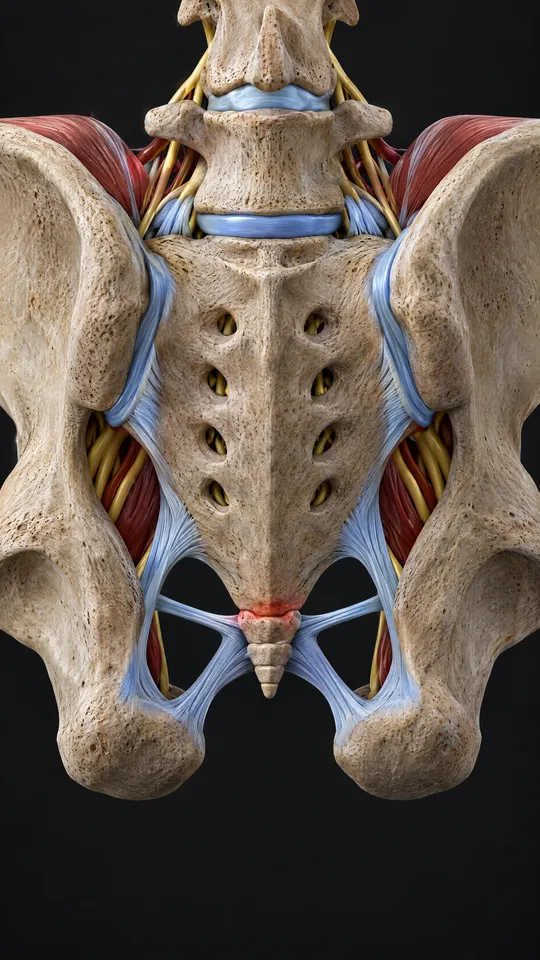
Not all pain felt around the tailbone comes from the tailbone.
True coccydynia stays local. The pain sits over the coccyx itself, and the tailbone is tender when pressed 3. People usually describe a sharp, shooting pain, or sometimes an ache 5.
Referred pain reaches the area from somewhere else, such as a nerve root in the lower spine. It usually comes without that tell-tale tenderness over the tailbone 3. If that sounds more like you, start with the Lower Back section of our Injury Finder instead.
An assessment also checks for a pilonidal cyst, an infection in the soft tissue near the coccyx 3. None of this can be reliably sorted out at home.
You usually won't need a scan for this 1. The diagnosis comes from your history and a physical check. Expect questions about a recent fall or a slow build-up with no obvious trigger, and about what happens when you sit for a while, lean back in a chair or stand up from one 3. Then the tailbone itself is pressed. Tenderness right over the coccyx is the hallmark sign, and pain referred from elsewhere usually doesn't have it 3.
X-rays, CT and MRI are kept for ruling out a fracture, an infection or a tumour 1. If the joint above the tailbone seems too loose or too stiff, X-rays taken in more than one position can show how it moves 3.
We start by confirming it's the tailbone and not referred pain, and by checking for anything that needs a doctor first. Then we look at what's loading it in your week.
Now the honest part. A 2025 review of nine trials (532 people) concluded that physiotherapy's effectiveness for coccydynia "remains uncertain" 4. Several trials carried a moderate-to-high risk of bias, and three were rated low quality 4. Manual therapy worked best for recent-onset pain, and its effect faded over time 4. In an earlier study it helped only about a quarter of people at six months and at two years 7. What's well established is that most tailbone pain settles with conservative care 1,3. Our job is to help you through that as comfortably as possible, and to spot the minority who need something else.
The most promising option in the 2025 review, with some trials showing improvements in pain and function lasting up to six months 4. The same caveats about small, variable trials apply.
Kinesiology tape eased how much pain people felt, but made little difference to what they could actually do 4. A comfort measure, not a fix.
An ice pack for 20 to 30 minutes at a time, or a heat pack, can take the edge off 2.
Physiotherapists don't prescribe or give any of these. Anti-inflammatories may help short term, and laxatives can help when opening your bowels hurts 2; ask your GP or pharmacist. If self-care and physiotherapy don't help, a doctor may offer a corticosteroid and local anaesthetic injection 2. Surgery to remove the coccyx is considered only when other treatments have failed 2. The best chance of success comes from combining physical therapy, changes to how you sit and work, and medical care where needed 3.
Tailbone pain shows up when you sit, so The Well Motion Recovery Path™ is measured here in sitting. You move up a phase when you can sit for longer in comfort, not when a date arrives.
How long it usually takes. Tailbone pain usually settles within weeks to months 1. Conservative care succeeds in about 90% of cases, a figure from a 2014 review article, not a trial 3. A minority develop longer-lasting pain 3, and for them the plan shifts to chronic pain management.
No study has tested how to stop tailbone pain coming back, so each of these goes after a known cause:
Tailbone pain often gets better on its own 1. See your doctor urgently if 1:
It's also worth a GP visit if the pain hasn't improved after a few weeks of home care or is affecting your daily life 2. A small number of people develop longer-term pain 3; our chronic pain management approach is built for that.
None of this is meant to alarm you. For most people, tailbone pain is a sore, frustrating problem that gets better.
We start by listening: how it began, what makes it worse, and what it's stopping you from doing. Then we examine the area, explain what we find in plain English, and agree a plan with you. Your first visit is 40 minutes at Engadine and 30 minutes at our other clinics.
We see patients at Engadine, Mount Annan, Narellan and Appin, and at home through our mobile physiotherapy service. If you have private health cover, here's how health fund rebates work for physiotherapy.
There's no single best treatment. It's staged: self-care first (a coccyx cushion, supported sitting, fewer long sits, ice or heat) 2, then physiotherapy 1,2, then a doctor may discuss an injection 2. Conservative care succeeds in about 90% of cases 3.
Usually, yes. It often gets better without medical treatment, usually within weeks to months 1. A minority develop longer-lasting pain 3, so pain that isn't improving deserves a proper assessment.
Most often a fall onto the tailbone, prolonged sitting on hard surfaces, or childbirth 1. Long driving or cycling, posture and body weight can contribute 2. Sometimes no trigger is found 2,5.
Not reliably at home. An assessment checks for tenderness over the tailbone, and whether spasm in the pelvic floor muscles is part of the problem 3. The answer shapes treatment.
Most people never need an MRI. Scans are usually unnecessary, and are used mainly to rule out other causes such as infection, tumours or fractures 1.
You can't tell by yourself. Cancer is listed among the possible non-injury causes, alongside joint conditions and infection 1. Watch for the warning signs: pain steadily worsening, fever or unexplained weight loss 1. If any apply, see your GP promptly.
None of the government or peer-reviewed sources behind this page lists vitamin deficiency as a cause of coccydynia. The established causes are injury, childbirth, repeated strain, joint changes, or no identifiable cause 1,2,5.
Pain radiating down the leg, often with pins and needles.
Read moreWhat a disc bulge on a scan actually means, and the recovery pathway.
Read moreStiffness from the small joints at the back of the spine, worse arching back.
Read morePain from the joint linking spine to pelvis, often mistaken for general back pain.
Read moreNarrowing of the spinal canal, causing leg pain that worsens as you walk.
Read moreAge-related disc wear; a common imaging finding that doesn't always match the pain.
Read moreOne vertebra slipping forward over the one below, sometimes from a stress fracture.
Read moreA back spasm is the muscles of your back tightening suddenly and refusing to let go. It's one of the ways low back pain shows up
Read more
How would you like to reach us?
Message us on WhatsAppFor bookings and enquiries. Please don't send medical details. Call (02) 8111 5633Request a call-back
Request sent
Thank you. We'll call you back on the number you gave us.
This is a preview, so nothing was actually sent.