Need urgent care? 24/7 Mobile & After-Hours Emergency Physiotherapy Call (02) 8111 5633 For life-threatening emergencies, always call 000
Foot

Plantar Fasciitis

5.0 average rating on Google
Registered NDIS Provider
SIRA Registered Provider

The first few steps out of bed tell you everything. Your heel feels like something sharp is pressing up into it, then a few minutes of moving settles it into something you can put up with. Then you stand through a shift, or get up after lunch, and it's back.

That pattern (worst on your first steps in the morning, worse after long periods of standing or sitting, worse after a big day on your feet) is the classic presentation of plantar fasciitis 1. Most advice stops at "get better shoes." Better shoes help. On their own, they aren't a plan.

What's actually causing it

Your plantar fascia is the thick band of tissue running from your heel bone to your toes. Plantar fasciitis is soreness and inflammation of that band, so the pain sits under the heel, sometimes dull, sometimes sharp 1.

A better question than "what's wrong with my foot" is "what changed." Plantar fasciitis is more likely with running, dancing, aerobics and jumping, and more likely again if you've increased those activities or started a new form of exercise 1. A change in footwear does it. So do shoes with poor arch support, tight or weak calf muscles, flat feet or high arches, being middle-aged or older, carrying extra weight or being pregnant, and time on your feet 1.

That last one matters more around here than it might elsewhere: retail, warehouse and trades work all mean hours on hard flooring, and a roster change can shift your standing load more than any training program would.

Worth knowing early: walking differently to avoid the sore spot can cause other problems and slow your recovery 1.
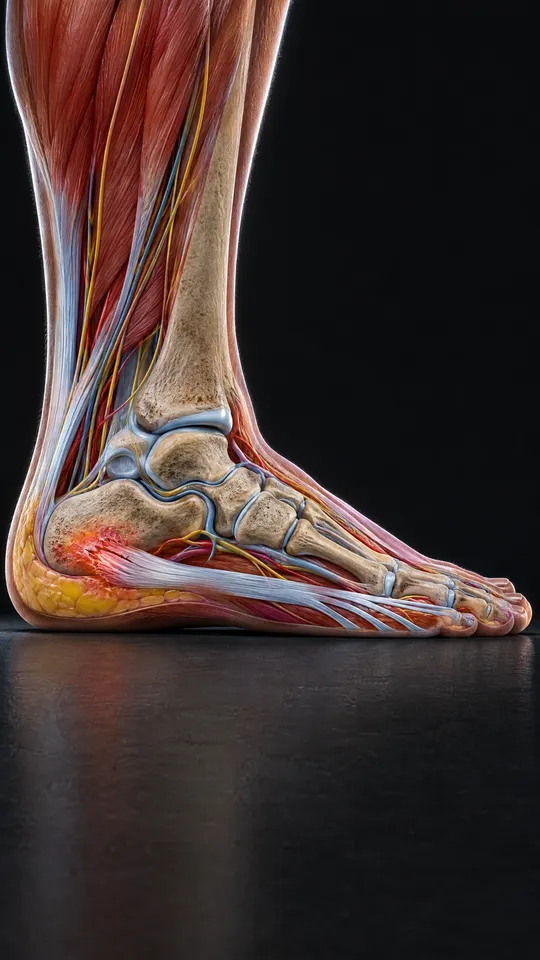

Side view of the foot showing the plantar fascia running from the heel to the toes, irritated where it attaches to the heel

Plantar fasciitis, or something else? How to tell the difference

Heel pain has more than one cause, and the NHS is blunt: don't diagnose it yourself 3. Some patterns are still worth recognising.

  • Plantar fasciitis is a sharp pain between your arch and heel, worse when you start walking and better when you rest 3.
  • Achilles tendonitis sits at the back of the heel, often felt in the ankle and calf too 3.
  • A heel fracture or a ruptured Achilles feels different: sudden sharp pain, swelling, sometimes a popping or snapping sound at the time 3. That needs assessing the same day, not exercises. Call us.
  • Bursitis, a neuroma or a stress fracture can also produce heel or foot pain 2,3.
  • In children aged roughly eight to 16, the most common cause of heel pain isn't plantar fasciitis, it's Sever's disease, stress on the heel bone's growth plate 2.

And the heel spur question. If a scan has shown a spur, it probably isn't the villain. Plantar fasciitis is often associated with a heel spur, but many people have spurs with no pain at all 1. About one in 10 Australians are estimated to have them without symptoms, and the spur itself doesn't cause the pain 2. Imaging helps rule out other causes, but is often not needed for the diagnosis 1. Our heel pain article covers the wider picture.

How it's diagnosed

Most of the time this is diagnosed in the room, from your story and a look at your foot. A scan is often not needed 1. You'll be asked about your symptoms, the work you do and how active you are 1, because long hours on your feet are one of the recognised causes 1. Then your feet and calves are checked for soreness, tightness and weakness 1.

If you're sent for an X-ray or ultrasound, it's to rule out other causes of heel pain 1. It isn't there to prove this one.

How we treat it

1
Assessment first. Where the pain sits, what changed in your activity, footwear or hours on your feet before it started, and how tight or strong your calves are 1, plus ruling out the patterns above 3.
2
A progressive loading program, through exercise prescription and conditioning. The best trial we have gave 48 people shoe inserts plus either daily plantar fascia stretching or high-load strength training: heel raises with a towel rolled under the toes, every second day. At three months the strength group scored 29 points better on a foot function measure. The other half of that result: at one, six and 12 months there was no difference, and by 12 months the numbers slightly favoured stretching 4. Loading may get you comfortable sooner; it hasn't been shown to leave you better off at a year.
3
Stretching stays in the plan. It's standard self-care 1, and in that trial it caught up.
4
Manual therapy for calf tightness, where that's part of your picture. Tight or weak calf muscles are a named risk factor 1, so that's the driver we're treating. We won't claim hands-on work has been tested against this condition, because the sources behind this page don't test it.
5
Supportive taping before activity 1, for getting through a shift while the slower work happens underneath.
6
A graded return, not a switch. Rest the foot while it's irritable, then reintroduce activity such as running gradually 1.

Other treatments we may use

Ice, relative rest and footwear.

Ice for 10 to 20 minutes up to four times a day, supportive cushioned shoes, heel pads or arch supports, and no high heels or tight pointy shoes 1,3. This is symptom relief, and it works best when it buys room for the loading work rather than standing in for it. We'll talk through what you wear for the hours that matter: usually work, not exercise.

Shockwave therapy.

It appears among the options for plantar fasciitis on Australia's national health service listing, which also describes it as performed by a specialist 1. The source is inconsistent there, and we'd rather say so than tidy it up. In practice it suits the stubborn case that hasn't settled after a loading program.

Anti-inflammatory medication, steroid injections and surgery.

Real options in the literature; injections and surgery are rare, usually reserved for the most severe cases 1. They're prescribed and performed by your GP or a specialist, never by a physiotherapist. If your case looks like it's heading that way, our job is to say so and help you get the referral.

Your recovery path: Reset, Rebuild, Return

Plantar fasciitis is slow to settle, so we plan it in the three phases of The Well Motion Recovery Path™. What your heel tolerates decides when you step up, not how many weeks have passed.

  • Reset: while the heel is irritable. Ice, relative rest, cushioned shoes and heel pads or arch supports 1,3, supportive taping before activity 1, and manual therapy if your calves are tight. Expect the first steps of the morning to be the last thing to ease. We move you on once a normal day on your feet no longer leaves the heel worse that night.
  • Rebuild: the longest phase. The progressive loading program 4, with stretching kept beside it 1. Expect some soreness as the load goes up. We may add shockwave therapy if the heel stalls. We move you on when single leg heel raises and brisk walking are comfortable.
  • Return: full shifts on hard floors, long walks or running, brought back gradually 1. We test the task you are going back to. You leave with a loading routine and a footwear plan.

How long it usually takes. Plantar fasciitis often lasts for weeks or months 1. In a study of 105 people treated without surgery, 89.5% had no heel pain within about 11 months 9. Yours depends on how long you have had it and how much standing your week demands.

Reducing your risk of it coming back

Most of the research here looks at who gets plantar fasciitis, and it points to a few things you can change:

  • Keep your weekly running steady. In a year-long study of 1,206 adults, runners covering more than 40 km a week had six times the odds of plantar fasciitis of those running 6 to 20 km 6. Bring running back gradually 1.
  • Watch your weight. Pooled studies found a BMI above 27 went with nearly four times the odds, most clearly in people who weren't athletes 7. Keeping to a healthy weight is on the national prevention list 1.
  • Wear something supportive. Among 306 Australian navy recruits in 11 weeks of training, contoured insoles meant about a third fewer overuse injuries than flat ones, plantar fasciitis included. The gap was small enough to be chance 8. Supportive shoes are still the standard advice 1, and long spells barefoot are best avoided 3.
  • Warm up, and rest between sessions. Both are on the same list 1.

When to get it checked properly

  • Symptoms lasting longer than eight weeks. That's when the national guidance says to see your doctor 1, and it's the mark most people push past.
  • No improvement after two weeks of home treatment, pain that's severe or stopping normal activities, or pain that keeps coming back or is getting worse 3.
  • Tingling or loss of sensation in the foot, or heel pain when you have diabetes (foot problems can be more serious if you do) 3.
  • Urgently: severe pain after an injury, a foot or ankle that's changed shape, a snap, grind or pop at the time of injury, being unable to walk, walk on tiptoes or climb stairs, or swelling and bruising in the calf and ankle 3.

None of that means your foot is in trouble. Heel pain of this kind is well recognised: the physiotherapy profession has its own clinical practice guideline for nonarthritic heel pain 5. Getting it assessed early saves you months of guessing.

Your first appointment

We start by listening: how it began, what makes it worse, and what it's stopping you from doing. Then we examine the area, explain what we find in plain English, and agree a plan with you. Your first visit is 40 minutes at Engadine and 30 minutes at our other clinics.

We see patients at Engadine, Mount Annan, Narellan and Appin, and at home through our mobile physiotherapy service. If you have private health cover, here's how health fund rebates work for physiotherapy.

FAQs

Does physiotherapy help plantar fasciitis?

It helps with the things actually driving it. Stretching, supportive taping, footwear and arch support changes, and modifying your activity are all standard care 1, and all physiotherapy-delivered. In the best trial available, a loading program had a real advantage at three months over stretching alone, gone by six and 12 months 4. So physio changes how quickly you get comfortable. It isn't the only thing that works.

Is it worth seeing a physio for plantar fasciitis?

The clearest signals aren't ours. Australian guidance says see your doctor if symptoms last longer than eight weeks 1, and NHS guidance says see a GP if there's no improvement after two weeks of home treatment, or if the pain is severe, worsening or recurring 3. Inside those windows and improving? Keep going. Outside them, or doing the same things for months with no change? That's when an assessment with our physio earns its keep.

Is walking a lot bad for plantar fasciitis?

A sudden spike in walking or standing tends to provoke it, and long periods on your feet, especially barefoot on hard floors, are on the "don't" list 3. But total rest isn't the goal either. Rest the foot while it's irritable, avoid what causes pain, then build activity such as running back up gradually 1.

What is stage 4 plantar fasciitis?

There isn't one. No staging system for plantar fasciitis appears in any of the national health guidance or research behind this page, so treat a four-stage model you've seen online with caution. What clinicians go on is how long you've had it and how irritable it is right now, which is why the eight-week mark 1 matters more than any stage number.

What finally cured my plantar fasciitis?

No single treatment has been established as the cure. In the trial comparing two sensible approaches, both groups improved and neither was ahead by 12 months 4. Consistency with a reasonable plan matters more than picking the magic one.

More Foot conditions

Foot

Lisfranc Injury

Pain, swelling or bruising across the middle of your foot after a fall, an awkward landing or a twist, and a midfoot that still doesn't want to take your weight.

Read more
Foot

Morton's Neuroma

It's a thickening of the tissue around one of the nerves between your toes, after that nerve has been irritated or damaged.

Read more
Foot

Turf Toe

Turf toe is the sporting name for a sprain of the big toe joint: the structures underneath get overstretched or torn when the toe is forced upwards.

Read more
Foot

Metatarsalgia

Metatarsalgia is a general term for pain around the joints at the base of your toes, a group of conditions rather than a single one. Which one you have changes what helps.

Read more
Foot

Stress Fracture (Foot)

A stress fracture is a fine crack in a bone from repeated loading without enough recovery between efforts, not a one-off injury. In the foot and lower leg it's the most common form of hairline fracture, usually from jogging or running.

Read more
Foot

Cuboid Syndrome

Cuboid syndrome is pain on the outer midfoot, thought to come from a subtle disruption of the joint between the cuboid (a small bone on the outside of your foot) and your heel bone. The exact mechanism hasn't been worked out.

Read more
Foot

Tarsal Tunnel Syndrome

Tarsal tunnel syndrome is compression of the tibial nerve as it runs behind your inner ankle, under a band of tissue called the flexor retinaculum.

Read more
Foot

Heel Spur

A heel spur (calcaneal spur) is a small outgrowth of bone on the heel bone. It can form on the underside or at the back.

Read more
Foot

Bunion

A bunion (hallux valgus) is a bony lump at the big toe joint that forms when the big toe leans towards the other toes. Around 23% of adults have one.

Read more

If your first steps in the morning have been the worst part of your day for a while, book an appointment and we'll work out what changed before it started, what your foot and calf can safely be loaded with now, and what a structured plan looks like built around your week.

If you're not certain the plantar fascia is the problem at all, start from the Foot section of our Injury Finder instead.

Book an Assessment
Ahmed Elsayed, Principal Physiotherapist
Reviewed by Ahmed Elsayed Principal Physiotherapist at Well Motion

References

  1. Plantar fasciitis. healthdirect (Australian Government-funded health service). Page last reviewed March 2025. https://www.healthdirect.gov.au/plantar-fasciitis
  2. Foot problems: heel pain. Better Health Channel, Victorian Department of Health (reviewed with the La Trobe University Department of Podiatry). Reviewed 31 May 2014. https://www.betterhealth.vic.gov.au/health/conditionsandtreatments/foot-problems-heel-pain
  3. Heel pain. NHS (United Kingdom). Page last reviewed 24 October 2025. https://www.nhs.uk/conditions/heel-pain/
  4. Rathleff MS, Mølgaard CM, Fredberg U, et al. High-load strength training improves outcome in patients with plantar fasciitis: a randomized controlled trial with 12-month follow-up. Scandinavian Journal of Medicine & Science in Sports, 2015;25(3):e292-300. PMID 25145882. https://doi.org/10.1111/sms.12313
  5. Martin RL, Davenport TE, Reischl SF, et al. Heel pain—plantar fasciitis: revision 2014. Journal of Orthopaedic & Sports Physical Therapy, 2014;44(11):A1-33. Clinical practice guideline issued by the Orthopaedic Section, American Physical Therapy Association. PMID 25361863. https://doi.org/10.2519/jospt.2014.0303
  6. Plesek J, Hamill J, Burda M, et al. Running distance and biomechanical risk factors for plantar fasciitis: a 1-yr prospective 4HAIE cohort study. Medicine & Science in Sports & Exercise, 2025;57(4):756-766. PMID 39629715. https://doi.org/10.1249/MSS.0000000000003617
  7. van Leeuwen KD, Rogers J, Winzenberg T, van Middelkoop M. Higher body mass index is associated with plantar fasciopathy/'plantar fasciitis': systematic review and meta-analysis of various clinical and imaging risk factors. British Journal of Sports Medicine, 2016;50(16):972-981. PMID 26644427. https://doi.org/10.1136/bjsports-2015-094695
  8. Bonanno DR, Murley GS, Munteanu SE, Landorf KB, Menz HB. Effectiveness of foot orthoses for the prevention of lower limb overuse injuries in naval recruits: a randomised controlled trial. British Journal of Sports Medicine, 2018;52(5):298-302. PMID 29056595. https://doi.org/10.1136/bjsports-2017-098273
  9. Davis PF, Severud E, Baxter DE. Painful heel syndrome: results of nonoperative treatment. Foot & Ankle International, 1994;15(10):531-5. PMID 7834059. https://pubmed.ncbi.nlm.nih.gov/7834059/