Need urgent care? 24/7 Mobile & After-Hours Emergency Physiotherapy Call (02) 8111 5633 For life-threatening emergencies, always call 000
Hamstring

Proximal Hamstring Tendinopathy

5.0 average rating on Google
Registered NDIS Provider
SIRA Registered Provider

It starts as an ache deep in your buttock, right on the bone you sit on. Twenty minutes into a drive or a meeting, you're shifting in your seat. It eases once you're up and moving, then comes back on the next hill or the next set of lunges. There was no single moment you hurt it. It just crept in.

That pattern has a name, and it isn't a pulled hamstring. Here's what's going on, and what the research does and doesn't say about getting it better.

What's actually causing it

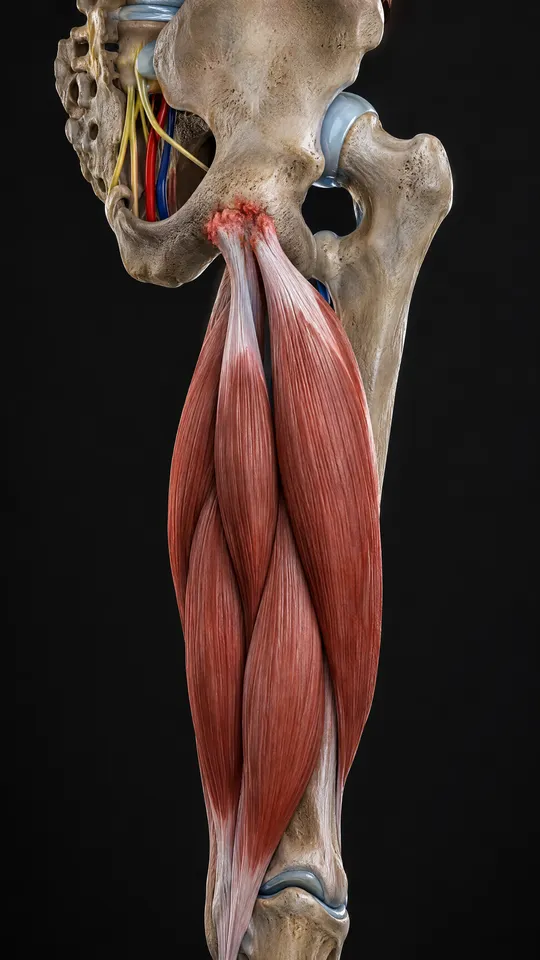
Your hamstrings are the muscles at the back of your thigh. At the top, their tendons share an attachment point on the ischial tuberosity, the bony point you sit on. "Tendinopathy" means that tendon has become painful and less able to cope with load.

It's an overuse condition 2, and by the time people seek help, the pain has often been there a long time 1. It often starts after training volume or intensity goes up too quickly, particularly when sprinting, lunging, hurdles or hills are added suddenly 1. It's reported in distance runners, sprinters and change-of-direction sports. It also turns up in people who don't play sport at all 1,4.

What aggravates it is fairly consistent. Sitting for long periods (especially on hard surfaces), hamstring stretching, and uphill walking are common triggers 4. Squatting, lunging and running can provoke it too 1,4. You may also feel stiff in the morning, or when you start moving after a long rest 1.

Pelvis and thigh from behind showing the hamstring tendons irritated where they attach to the sit bone

Proximal hamstring tendinopathy or a hamstring strain? How to tell the difference

A strain usually has a moment you can name: a sprint, a kick, a stride where it suddenly went. If that's your story, start with Hamstring Strain.

Proximal hamstring tendinopathy usually has no moment like that. It builds up after a rise in load 1,2, sits right at the sit bone 1, and tends to linger 1. The two are managed differently, so it's worth getting the diagnosis right.

Deep buttock pain has more than one possible cause. Clinical tests help, but they can come back negative in milder cases, and an MRI is recommended when the diagnosis is unclear 1. If you're not sure what you're dealing with, start from the Hamstring section of our Injury Finder.

How it's diagnosed

This one can be hard to pin down, because the hamstring tendon is only one of several things that can hurt there 1. A clinician listens for the typical pattern: pain you can point to on the sit bone, which eases a few minutes into activity and is worse afterwards 1. Then they load the tendon in steps, from a single-leg bridge up to a single-leg deadlift, to see what brings it on 1. How accurate those loading tests are still needs more research, and soreness when the area is pressed isn't very specific 1.

Other tests screen the lower back, the sciatic nerve and the hip 1. Scans need care. Tendon changes aren't unusual in people with no symptoms, and you can have the condition with a scan that shows no significant changes 1.

How we treat it

1
Assessment first. We look at where exactly it hurts, what changed in your training or your week, and use clinical tests such as the bent-knee stretch tests 1.
2
Understanding the load. We explain what's irritating the tendon and what to change for now, whether that's sitting, stretching, hills or deep lifts 1. Education is part of the most commonly recommended approach 4.
3
Progressive loading, in stages, through exercise prescription. We start with isometrics: holding a muscle contraction without moving. Next comes strengthening with your hip only slightly bent, then gradually deeper hip bends (70 to 90 degrees), then a return to your normal activity 1.
4
Sports physiotherapy for the return to running, lifting or sport. Faster, hillier running is a common trigger 4, so the way back is graded, not switched on.
5
The whole picture. Long-standing pain affects more than a tendon. Good management also looks at psychological and general-health factors as well as the sore spot 1.

An honest caveat. When a major review of this condition was published in 2016, there wasn't a single randomised trial of its rehabilitation. The approach was borrowed from Achilles and patellar tendinopathy 1. A more recent systematic review found insufficient evidence to recommend any one treatment over another 4. Loading and education remain the expert-recommended starting point 4, and that's why we start there. It isn't a proven winner.

Other treatments we may use

Shockwave therapy.

An Australian trial of 100 people across 10 Victorian physiotherapy practices compared six sessions of individualised physiotherapy with shockwave, with both groups getting education. There were no significant differences in the main outcomes at 4, 12, 26 or 52 weeks. The shockwave group did report higher satisfaction at some time points 3. A review of 18 studies found shockwave improved pain and function in most of them. But the evidence quality was mixed, and around 12% of patients reported side effects such as increased pain or skin irritation 5. It's a reasonable option to discuss, but not an upgrade.

Manual therapy.

Hands-on treatment can be part of a session for comfort. None of the research behind this page tests it as a treatment for this condition, so it's never the whole plan.

Your recovery path: Reset, Rebuild, Return

A sore hamstring tendon is a load problem, so The Well Motion Recovery Path™ is measured in what the tendon tolerates. You move up a phase on how it responds, not on a date.

  • Reset: from the first visit. Assessment, education on what to ease off for now, and isometric holds from the start 1. Manual therapy may be added for comfort. Expect sitting to stay uncomfortable for a while yet. We move you on once the holds no longer stir the pain up afterwards.
  • Rebuild: the longest phase. Strengthening through exercise prescription, with the hip slightly bent at first and deeper later 1. Expect mild pain while you work, which is acceptable if it has settled by the next day 1. Shockwave therapy is an option to discuss here 3. We move you on when loaded hip bends stop flaring it.
  • Return: whatever you came in for: a full work day in a chair, hills, lifting, running. Sports physiotherapy grades the faster, hillier work back in 4. You leave with strength work to continue and a plan for managing load, which expert physiotherapists recommend for preventing recurrence 6.

How long it usually takes. No study gives a typical recovery time, so we won't quote one. The nearest is a single case report: a powerlifter on a loading program lasting 12 weeks noticed meaningfully less pain within 4 weeks and returned to competition afterwards 7. One person is not a forecast.

Reducing the risk of flare-ups

Prevention hasn't been trialled for this condition, and its risk factors still need to be identified 1. What follows is what specialist physios and the main review recommend:

  • Keep the strength work going. In interviews with 13 expert physiotherapists, preventing a recurrence mainly came down to two things: carrying on with strengthening for the hamstrings and the muscles that work with them, and managing training load 6.
  • Change your training one thing at a time. Increasing volume or intensity too quickly is a recognised trigger, particularly the sudden introduction of sprinting, lunging, hurdles or hills 1. Bring hill and speed sessions back with care. Don't stack them on top of your normal week 1.
  • Use the 24-hour check. Mild pain during loading is acceptable, but it should settle within 24 hours 1. If it lingers, ease back on whatever provoked it 1.
  • Spare it the long sits and long stretches. Keep spells of sitting short, avoid hard seats or use a soft cushion 4. Sustained end-of-range hamstring stretches, as in some yoga and Pilates positions, can bring symptoms on 1.

When to get it checked properly

  • Your buttock pain has hung around for a while. Long-standing pain is common with this condition 1, and that's a reason to get a plan rather than keep waiting.
  • It's getting in the way of sitting through work, study or a drive 2.
  • You're not sure it's the tendon. Tests can miss milder cases, and imaging may be worth discussing with your GP 1.
  • The pain started suddenly, with a moment you can name. That's a different problem, so get it assessed.

None of that means something serious is wrong. It means the tendon needs a structured plan.

Your first appointment

We start by listening: how it began, what makes it worse, and what it's stopping you from doing. Then we examine the area, explain what we find in plain English, and agree a plan with you. Your first visit is 40 minutes at Engadine and 30 minutes at our other clinics.

We see patients at Engadine, Mount Annan, Narellan and Appin, and at home through our mobile physiotherapy service. If you have private health cover, here's how health fund rebates work for physiotherapy.

FAQs

How do you fix proximal hamstring tendinopathy?

With education and exercise that gradually rebuilds the tendon's capacity 4, in stages. We start with isometric holds, then strengthening with the hip slightly bent, then deeper hip bends, then a return to activity 1. No one treatment has been shown to beat the others 4.

How long does it take for proximal hamstring tendinopathy to heal?

Often months, not weeks. We won't give you a single number. Pain is often long-standing before people seek help 1, and the main Australian trial followed people for a full year 3.

What not to do with hamstring tendinopathy?

In the early stages, avoid repeated hamstring stretching, long periods sitting on hard surfaces, deep loaded hip bends such as deep squats, deadlifts and lunges, and fast or hilly running 1,4. That doesn't mean forever. It means for now.

What does a hamstring tendinopathy feel like?

A deep ache at the sit bone in your lower buttock 1,2. It's usually worse with sitting, and it often warms up with activity 1.

Is walking good for proximal hamstring tendinopathy?

It depends on the walking. Uphill walking can provoke it 4, and slow walking on level ground is rarely painful 1, so easy walking on flat ground is usually the better starting point. Let your symptoms guide the pace.

What is the difference between hamstring tendonitis and tendinopathy?

"Tendonitis" implies inflammation only. Tissue samples from this tendon show degeneration, known as tendinosis, with disrupted collagen 2. That's why "tendinopathy" is the better umbrella term.

More Hamstring conditions

Hamstring

Hamstring Strain

A pulled or torn muscle at the back of the thigh, usually at speed or in a stretch. Sore to load, and often slow to feel trustworthy again.

Read more

If sitting has become the worst part of your day and stretching hasn't helped, book an appointment at Engadine, Mount Annan, Narellan or Appin.

We'll work out whether it's really the tendon, what it can safely handle right now, and a staged plan that fits your week.

Book an Assessment
Ahmed Elsayed, Principal Physiotherapist
Reviewed by Ahmed Elsayed Principal Physiotherapist at Well Motion

References

  1. Goom TSH, Malliaras P, Reiman MP, Purdam CR. Proximal hamstring tendinopathy: clinical aspects of assessment and management. Journal of Orthopaedic & Sports Physical Therapy, 2016;46(6):483-493. https://www.jospt.org/doi/10.2519/jospt.2016.5986
  2. Lempainen L, Johansson K, Banke IJ, Ranne J, Mäkelä K, Sarimo J, Niemi P, Orava S. Expert opinion: diagnosis and treatment of proximal hamstring tendinopathy. Muscles, Ligaments and Tendons Journal, 2015;5(1):23-28. https://pmc.ncbi.nlm.nih.gov/articles/PMC4396672/
  3. Rich A, Ford J, Cook J, Hahne A. Physiotherapy compared with shockwave therapy for proximal hamstring tendinopathy: a randomized controlled trial. American Journal of Sports Medicine, 2025. Retrieved from PubMed. https://doi.org/10.1177/03635465251391134
  4. Rich A, Cook J, Hahne A, Ford J. Treatment of proximal hamstring tendinopathy with individualized physiotherapy: a clinical commentary. International Journal of Sports Physical Therapy, 2025. Retrieved from PubMed. https://doi.org/10.26603/001c.138308
  5. Rau et al. Extracorporeal shockwave therapy for tendinopathies around the hip and pelvis: a systematic review. HSS Journal, 2025. Retrieved from PubMed. https://doi.org/10.1177/15563316251332189
  6. Nasser AM, Pizzari T, Grimaldi A, Vicenzino B, Rio E, Semciw AI. Proximal hamstring tendinopathy; expert physiotherapists' perspectives on diagnosis, management and prevention. Physical Therapy in Sport, 2021;48:67-75. PMID 33378733. https://pubmed.ncbi.nlm.nih.gov/33378733/
  7. Krueger K, Washmuth NB, Williams TD. The management of proximal hamstring tendinopathy in a competitive powerlifter with heavy slow resistance training: a case report. International Journal of Sports Physical Therapy, 2020;15(5):814-822. PMID 33110701. https://pubmed.ncbi.nlm.nih.gov/33110701/