Hands-on treatment.
Manual therapy may be part of a session, but we don't treat it as the fix. Leaning too heavily on passive treatments is another common pitfall 1.
It hurts in one spot, right at the bottom of your kneecap. It bites when you land from a jump, when you push off to change direction, and on the way down stairs. It might ease once you've warmed up, then it's stiff again the next morning 2,3. If that sounds familiar, here's what's going on, and why pushing through or resting completely usually isn't the answer.
Your patellar tendon connects your thigh muscles (the quadriceps) to your shinbone, by way of the kneecap. Those muscles straighten your knee every time you walk, run or climb stairs 3.
When you jump, land or change direction, the tendon works like a spring. It stores energy, then releases it. Those are the movements that load it hardest, and the ones that hurt most 1. When the load is more than the tendon can cope with, it develops tiny injuries and changes in its structure, and that's what causes the pain 3.
Things that can tip the balance 3:
Tendon pain behaves in a recognisable way. It's rarely there at rest. It starts as soon as you load the tendon and usually stops almost as soon as you stop. And it scales with the load, so a deeper squat or a higher hop hurts more 1.
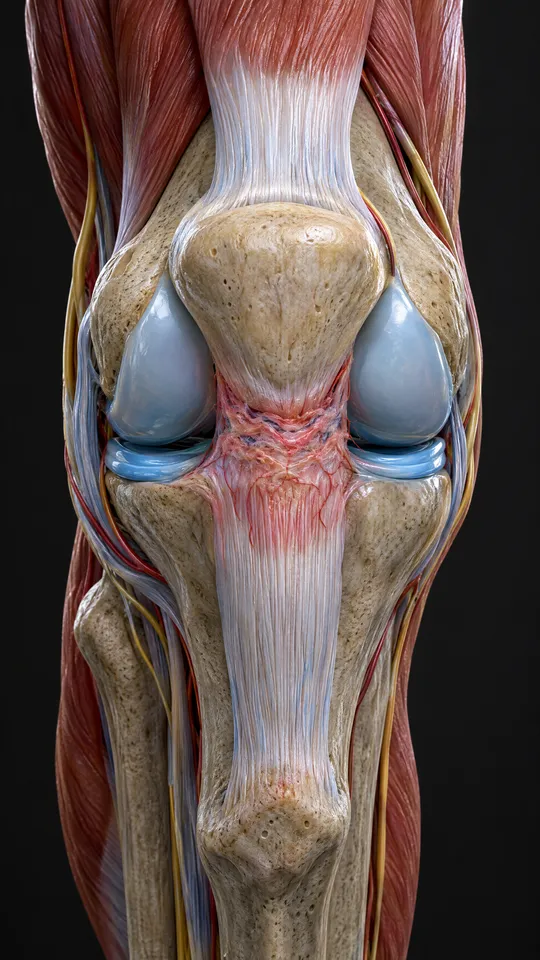
Pain with long periods of sitting, squatting and stairs can happen with patellar tendinopathy. But it's also typical of patellofemoral pain, so on its own it doesn't settle the question 1. What points more to the tendon is pain pinned to the bottom of the kneecap that rises and falls with how hard the tendon is working 1,2.
Other conditions that can look similar include Osgood-Schlatter disease, Sinding-Larsen-Johansson syndrome, fat pad irritation, plica irritation and infrapatellar bursitis 1. Scans can't confirm tendon pain on their own 1, so a hands-on examination does most of the work of telling them apart.
This one is diagnosed by examining you. A clinician looks for two hallmark features: pain pinned to the lower tip of the kneecap, and pain that climbs as you ask more of the muscles that straighten your knee, most of all in movements where the tendon stores and releases energy 1. There may also be tenderness at the front of the knee and a tendon that feels a little thickened 3.
A scan can help rule out other causes. It can't make the diagnosis, because tendon changes show up in people whose pain is coming from somewhere else at the front of the knee 1. A thorough examination also hunts for what's feeding the problem 1: weak thigh muscles, tight leg muscles, or activity that's gone up too fast 3.
The evidence here is reasonable, not perfect. A review of 12 trials found that exercise with monitored loading improved pain, function and strength in the short and medium term, although each trial carried a moderate risk of bias 7. We'll also be straight with you: this rehab can be slow and sometimes frustrating, and unrealistic timeframes are one of its most common pitfalls 1.
Manual therapy may be part of a session, but we don't treat it as the fix. Leaning too heavily on passive treatments is another common pitfall 1.
In one trial these eased pain in the short term, though so did placebo taping 5. See our sports taping page.
The evidence is mixed. A 2023 review found shockwave had a negligible short-term effect on pain and function compared with a placebo, though it did better than general conservative care for pain 6. An earlier trial found no benefit over placebo for in-season athletes with long-standing tendon pain 2. See our shockwave therapy page.
These are medical procedures, not something Well Motion physiotherapists administer. Steroid injections can ease pain in the short term but may raise the risk of the tendon rupturing, and they're generally not recommended. Options such as PRP (platelet-rich plasma) are still considered experimental 4.
Its use for tendon pain is debated. It may reduce pain, but it's been reported to slow tendon repair 5. Your GP or pharmacist can advise on pain relief.
This is generally considered only when conservative care hasn't worked 2,5, and there's no clear evidence on which surgical approach works best 5.
Patellar tendon rehab follows The Well Motion Recovery Path™. You go up a phase when the tendon tolerates the load in front of it, not when a set number of weeks has passed.
How long it usually takes. Allow 6 to 12 weeks of specific exercise before you notice a difference, and more than 3 months for a full program 3. A flare-up usually settles within 6 weeks 3. These figures are patient guidance from a health service, not trial results, and in some people the condition lasts for years 5.
Flare-ups are common with this condition, and some people get them again and again 3. The prevention research is thin, and parts of it are surprising:
Get an assessment rather than managing it on your own if:
Call us the same day if the pain started with an injury and you felt a sudden pop or snap, have severe pain or swelling, or can't straighten your knee 3. We assess it and refer you for imaging or to hospital if it needs it.
Treatment for patellar tendinopathy is mostly non-surgical 5. A check-up often just means your loading plan needs adjusting.
We start by listening: how it began, what makes it worse, and what it's stopping you from doing. Then we examine the area, explain what we find in plain English, and agree a plan with you. Your first visit is 40 minutes at Engadine and 30 minutes at our other clinics.
We see patients at Engadine, Mount Annan, Narellan and Appin, and at home through our mobile physiotherapy service. If you have private health cover, here's how health fund rebates work for physiotherapy.
There's no quick fix, but there is a clear plan. Cut back the load that aggravates it, stay active, and rebuild the tendon's tolerance with exercise that progresses in stages 1,3,7. By comparison, injections and shockwave have weak or mixed evidence 4,6.
Longer than most people expect. It can take 6 to 12 weeks of specific exercises to notice a difference, and a full program can take more than 3 months 3. Flare-ups usually settle within 6 weeks 3. It can also hang around for years 5, which is why steady, structured rehab matters.
Mostly the name. "Tendonitis" means an inflamed tendon, and it's the older term many people still use. "Tendinopathy" is preferred because the tendon tissue shows few or no inflammatory cells 5. The changes are described in stages instead, running from a reactive tendon to a degenerative one 2.
Not usually, if the tendon keeps getting overloaded. It can resolve, but it takes time, and exercise to strengthen the tendon is recommended to improve how much load it can handle 3.
A twist or sudden change of direction, often with a pop at the time, and a knee that hasn't felt trustworthy since.
Read morePain on the outside of the knee that builds through a run, settles with rest, then comes straight back on the next one.
Read moreAn ache at the front, around or behind the kneecap. Worse on stairs, on hills, and after long sitting.
Read moreCatching, locking or swelling after a twist, sometimes with a knee that won't fully straighten.
Read moreA tender, bony lump just below the kneecap in a growing, sporty teenager.
Read moreMorning stiffness and an ache after activity, building over years rather than days.
Read moreThe MCL runs down the inside of your knee. Most injuries happen when something hits the outside of the knee and forces it inwards; it's the ligament most commonly injured in knee trauma.
Read moreA bursa is a small fluid-filled sac that cushions bone from the soft tissue around it. The prepatellar bursa sits at the front of your knee, over the kneecap. When it's irritated it swells, and a tender, warm swelling right over the bursa is the classic sign.
Read moreA patellar dislocation is the kneecap being forced out of its groove at the end of the thigh bone. It almost always goes outwards, towards the outside of the knee.
Read moreA Baker's cyst is a build-up of fluid behind the knee, usually excess fluid from the knee joint itself.
Read more
How would you like to reach us?
Message us on WhatsAppFor bookings and enquiries. Please don't send medical details. Call (02) 8111 5633Request a call-back
Request sent
Thank you. We'll call you back on the number you gave us.
This is a preview, so nothing was actually sent.