Need urgent care? 24/7 Mobile & After-Hours Emergency Physiotherapy Call (02) 8111 5633 For life-threatening emergencies, always call 000
Hip

Gluteal Tendinopathy

5.0 average rating on Google
Registered NDIS Provider
SIRA Registered Provider

Maybe you heard the term from your GP, or read it at the bottom of a scan report. Either way, you already know the pain. It sits on the outside of your hip and sometimes spreads down the side of your thigh. It's worse lying on that side, worse on stairs, and sore when you first get moving after a long rest 1. This page covers what's going on, and why resting it so often doesn't help.

What's actually causing it

A tendon is the tough cord that joins a muscle to bone. Your gluteus medius and minimus sit on the side of your hip. Their tendons attach to the greater trochanter, the bony bump you can feel on the outside of your upper thigh 1.

This surprises most people: the tendons aren't normally inflamed, which is why rest and anti-inflammatory tablets often don't fix it 1. The nearby bursa, a small fluid-filled cushion, shows changes on scans in only a minority of people 3.

Load and compression are what aggravate it. Pain tends to flare with deep squats, stairs and impact exercise 1. Reducing compression on the tendons is one of the main principles of managing it 3. Patient guidance also lists everyday positions to avoid: crossing your legs, standing with your weight hanging on one hip, sitting in low chairs, and sleeping on the sore side 1.

It's recorded in about 1.8 of every 1,000 patients a year 6, and while it's most common in women over 40, younger people and men get it too 3.
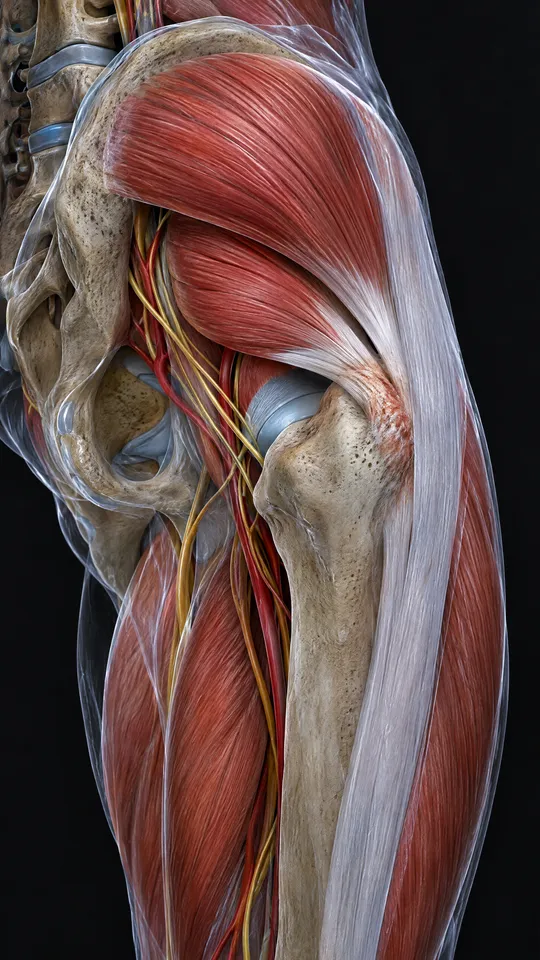

Side of the hip showing the gluteal tendons attaching to the bony point of the thigh bone, shown irritated

Gluteal tendinopathy or hip bursitis? How to tell the difference

If you were told you had hip bursitis, you may have the same thing under an older name. The condition used to be called trochanteric bursitis. That explanation has largely been replaced, because scans show bursa changes in only a minority of people, and tendinopathy is the main finding 3. So the useful question usually isn't "bursitis or tendinopathy?" It's whether the tendon is the whole story.

Things that can sit alongside it, or be mistaken for it 3,6:

  • Lower back pain, which often coexists with it
  • Hip osteoarthritis, arthritis in the hip joint itself, which can be present at the same time
  • A tear in the gluteus medius or minimus tendon, which is often misdiagnosed. Tears may be present in up to 25% of late middle-aged women and up to 10% of middle-aged men 7

An assessment works out which of these is actually driving your pain.

How it's diagnosed

Much of this can be worked out in the clinic with two simple checks. If standing on the sore leg brings on your outer hip pain within 30 seconds, gluteal tendinopathy is very likely. If pressing on the bony point of the hip doesn't hurt, it's unlikely 4. We also use movements that compress or stretch the tendons to see which ones reproduce your pain 4.

No test is perfect, though. In that study of 65 people with outer hip pain, 20 had tendinopathy on MRI but tested negative in the clinic, and the authors warned that the sample was small 4. MRI is also how the Australian treatment trial confirmed each physiotherapist's diagnosis 2.

How we treat it

The strongest evidence comes from an Australian trial of 204 people aged 35 to 70, all with gluteal tendinopathy confirmed on MRI. Fourteen sessions of education and exercise led by a physiotherapist, over 8 weeks, beat both a single steroid injection and a wait-and-see approach. At 8 weeks, average pain was 1.5 out of 10 with education and exercise, 2.7 after the injection, and 3.8 for wait-and-see 2.

Our approach follows the same principles:

1
Assessment first. We check whether the tendon is the main source, or whether your back, your hip joint or a tendon tear is part of the picture 3.
2
Education and load management. Education was a core part of that trial's program 2. In practice, it means cutting back the compressive positions above 1,3 without resting completely, which patient guidance specifically warns against 1.
3
Progressive gluteal strengthening. This is the main active treatment 3,6, built up gradually through our exercise prescription and conditioning service.
4
Getting back to running and impact. Impact exercise is a common aggravator 1, so sports physiotherapy rebuilds it in stages, not all at once.

The longer term is less clear-cut: at 12 months, the trial found education and exercise still gave better overall improvement than the injection, but pain scores were no longer different between the two 2.

Other treatments we may use

Hands-on treatment.

Manual therapy can help keep you comfortable while the exercise work does its job. One caution, straight from patient guidance: deep massage over the sore spot isn't recommended, and neither is a lot of stretching 1. We treat hands-on work as support, not the main event.

Shockwave therapy.

The evidence is limited. In one trial, shockwave did better than a steroid injection at 15 months 8, but there are few studies and little high-quality evidence 3. It's worth discussing if progress stalls. See our shockwave therapy page.

Steroid injection.

This is a medical procedure, not something Well Motion physiotherapists administer. It can ease pain in the short term, but the relief usually doesn't last 1,3. Repeated injections are often not advised because they may weaken the tendon 1. That conversation belongs with your GP or specialist.

Anti-inflammatory medication.

Because the tendon isn't normally inflamed, anti-inflammatories often don't fix it 1. Your GP or pharmacist can advise on pain relief.

Your recovery path: Reset, Rebuild, Return

Gluteal tendinopathy is slow to settle, so we plan it in stages along The Well Motion Recovery Path™. What your hip tolerates decides when you step up, not the calendar.

  • Reset: education and load management first. We change how you sit, stand and sleep to take compression off the tendons 1,3, and you keep moving, because complete rest is advised against 1. Manual therapy may be added for comfort. Expect nights to ease before stairs do. We move you on once walking and lying down no longer set the pain off for hours.
  • Rebuild: the longest phase. Progressive gluteal strengthening 3,6 through exercise prescription and conditioning. Expect some flat weeks as the load goes up. If progress stalls, shockwave therapy is worth discussing 8. We move you on when the hip does what your daily tasks ask of it without a flare the next day.
  • Return: running and impact for some, rebuilt in stages through sports physiotherapy. For others, stairs or long walks. We test the tasks you are going back to, and you leave with a loading program.

How long it usually takes. With exercise therapy, symptoms can take 6 to 12 months to settle 1. That range comes from hospital patient guidance, not a study. One small trial of 44 people, with no untreated group, found pain and disability still improving across 6 months of follow-up 9. It stopped there.

Reducing the risk of flare-ups

No trial has tested prevention on its own. What has been tested, as part of treatment, is teaching people how to load the tendon:

  • Learn which positions squash the tendon. In the Australian trial, people were taught to avoid positions that press the gluteal tendons against the hip bone and to build load up gradually, alongside exercise. More of them rated themselves improved a year later than those who waited or had an injection 2.
  • Don't underrate the advice. In a second trial, 94 postmenopausal women all got that education. They improved at 12 and 52 weeks whether their exercises were targeted or sham 5.
  • Set up your sleep. Lie on your back with a pillow under your knees, or on your good side with a pillow between your legs to keep them level with your hips 1.
  • Stand evenly and use the handrail. Spread your weight across both feet, and take the rail on stairs 1.

When to get it checked properly

Get an assessment instead of managing it on your own if:

  • The pain is moderate or severe and ongoing. Patient guidance says specifically not to ignore that 1
  • It isn't improving even after you've cut back the positions above
  • You also have lower back pain or known hip arthritis, since both commonly coexist with it 3
  • An injection helped for a while and the pain has come back 1,3

None of this means something is seriously wrong. Most cases settle with conservative care 6. It usually just means the plan needs adjusting, or the cause hasn't been fully pinned down yet.

Your first appointment

We start by listening: how it began, what makes it worse, and what it's stopping you from doing. Then we examine the area, explain what we find in plain English, and agree a plan with you. Your first visit is 40 minutes at Engadine and 30 minutes at our other clinics.

We see patients at Engadine, Mount Annan, Narellan and Appin, and at home through our mobile physiotherapy service. If you have private health cover, here's how health fund rebates work for physiotherapy.

FAQs

Does gluteal tendinopathy ever go away?

For most people, yes. Most cases can be managed with conservative, non-surgical care 6. It's slow, though: with exercise therapy, symptoms can take 6 to 12 months to settle 1.

What not to do with gluteal tendinopathy?

Patient guidance lists several 1. Don't rest completely, don't stretch a lot, don't massage deeply over the sore spot, don't ignore ongoing moderate or severe pain, and don't rely on repeated steroid injections. Day to day, avoid crossing your legs, hanging on one hip, low chairs, and sleeping on the sore side.

Is there a quick fix for gluteal tendinopathy?

No. A steroid injection can bring short-term relief 1,3. But in the Australian trial, education and exercise gave lower pain at 8 weeks and better overall improvement at 12 months 2. Tendons take time to adapt 1, and the best-supported route is the steady one.

Does low oestrogen cause gluteal tendinopathy?

It's linked, but it isn't the whole cause. The condition is particularly common in women after menopause 3, when oestrogen falls. Men and younger people get it too 3, so hormones are only part of the picture.

More Hip conditions

Hip

Hip Bursitis

Pain on the outside of the hip, usually worst lying on that side and on stairs. Often called trochanteric bursitis.

Read more
Hip

Hip Flexor Strain

Tight, sore hip flexors at the front of the hip. Common in runners, tradies and anyone whose day is mostly seated, and it deserves a better answer than "just stretch more."

Read more
Hip

Hip Dysplasia

A hip socket that's shaped differently from the start. For parents of a child who's been diagnosed, and for adults managing it long-term.

Read more
Hip

Hip Osteoarthritis

Hip osteoarthritis is a long-term condition that affects the whole joint (cartilage, bone, joint lining, ligaments, tendons and muscles), not just "worn cartilage".

Read more
Hip

Piriformis Syndrome

Piriformis syndrome is when the piriformis, a muscle deep in your buttock, puts pressure on the sciatic nerve. It usually affects one side

Read more
Hip

Snapping Hip Syndrome

A snapping hip is a snap you can hear or feel as the hip moves. It's usually a tendon or band of tissue flicking over a bony point

Read more
Hip

Hip Labral Tear

The labrum is a rim of cartilage around your hip socket. It helps absorb shock, spread pressure and keep the joint stable

Read more

If you've been told it's gluteal tendinopathy and you're still rolling off that side at night, book an appointment.

We'll check what's actually driving it and build a loading plan around where your hip is now. You can see us at Engadine, Mount Annan, Narellan or Appin. If this doesn't sound quite like your pain, head back to the hip injury guide.

Book an Assessment
Ahmed Elsayed, Principal Physiotherapist
Reviewed by Ahmed Elsayed Principal Physiotherapist at Well Motion

References

  1. Royal Orthopaedic Hospital NHS Foundation Trust. Gluteal Tendinopathy (patient information). https://roh.nhs.uk/services-information/therapy/gluteal-tendinopathy
  2. Mellor R, Bennell K, Grimaldi A, et al. Education plus exercise versus corticosteroid injection use versus a wait and see approach on global outcome and pain from gluteal tendinopathy: prospective, single blinded, randomised clinical trial. BMJ, 2018;361:k1662. doi:10.1136/bmj.k1662. https://pubmed.ncbi.nlm.nih.gov/29720374/ (also published in Br J Sports Med, 2018;52(22):1464-1472, https://pubmed.ncbi.nlm.nih.gov/30385462/)
  3. Grimaldi A, Fearon A. Gluteal tendinopathy: integrating pathomechanics and clinical features in its management. Journal of Orthopaedic & Sports Physical Therapy, 2015;45(11):910-922. doi:10.2519/jospt.2015.5829. https://www.jospt.org/doi/10.2519/jospt.2015.5829
  4. Grimaldi A, Mellor R, Nicolson P, Hodges P, Bennell K, Vicenzino B. Utility of clinical tests to diagnose MRI-confirmed gluteal tendinopathy in patients presenting with lateral hip pain. British Journal of Sports Medicine, 2017;51(6):519-524. doi:10.1136/bjsports-2016-096175. https://pubmed.ncbi.nlm.nih.gov/27633027/
  5. Ganderton C, Semciw A, Cook J, Moreira E, Pizzari T. Gluteal loading versus sham exercises to improve pain and dysfunction in postmenopausal women with greater trochanteric pain syndrome: a randomized controlled trial. Journal of Women's Health, 2018;27(6):815-829. doi:10.1089/jwh.2017.6729. https://pubmed.ncbi.nlm.nih.gov/29715073/
  6. Speers CJB, Bhogal GS. Greater trochanteric pain syndrome: a review of diagnosis and management in general practice. British Journal of General Practice, 2017;67(663):479-480. doi:10.3399/bjgp17X693041. https://bjgp.org/content/67/663/479
  7. Domb BG, Botser I, Giordano BD. Outcomes of endoscopic gluteus medius repair with minimum 2-year follow-up. American Journal of Sports Medicine, 2013;41(5):988-997. doi:10.1177/0363546513481575. https://pubmed.ncbi.nlm.nih.gov/23524152/
  8. Rompe JD, Segal NA, Cacchio A, Furia JP, Morral A, Maffulli N. Home training, local corticosteroid injection, or radial shock wave therapy for greater trochanter pain syndrome. American Journal of Sports Medicine, 2009;37(10):1981-1990. doi:10.1177/0363546509334374. https://pubmed.ncbi.nlm.nih.gov/19439758/
  9. Notarnicola A, Ladisa I, Lanzilotta P, et al. Shock waves and therapeutic exercise in greater trochanteric pain syndrome: a prospective randomized clinical trial with cross-over. Journal of Personalized Medicine, 2023;13(6):976. doi:10.3390/jpm13060976. https://pubmed.ncbi.nlm.nih.gov/37373965/