Taping.
Supportive taping before activity is standard self-care for heel pain 1,4. It's symptom relief, not the fix.
Your GP sent you for an X-ray because your heel has been sore for weeks. The report comes back with two words, "heel spur", and now you're picturing a spike of bone jabbing into your foot every time you stand up.
It's an understandable picture. For most people, it isn't quite what's going on. A spur is real, and it often shows up alongside heel pain, but it usually isn't the thing that hurts 1,4,6. That changes what's worth treating.
A heel spur is a bony growth on your heel bone (the calcaneus). Under the sole it's a plantar spur, and it tends to travel with plantar fasciitis: irritation of the thick band of tissue running from your heel to your toes. At the back of the heel it's a posterior spur, linked with Achilles tendinopathy 4.
Why spurs form isn't settled. Researchers have proposed wear and tear, inflammation, repeated pulling from the tissues attached to the heel, repetitive small injuries, and compression from body weight. None of these theories has won the argument 3. Spurs are associated with age, body weight, sex, arthritis, plantar fasciitis and foot posture 3.
The bigger question is whether the spur causes your pain. Usually not on its own. A study of 530 adults aged 50 and over found spurs in about a quarter of feet and a thickened plantar fascia in nearly half. The two usually appeared together, and people with heel pain were about twice as likely to have both 2. A spur by itself turned up in just 6% of feet 2.
We won't tell you spurs never matter, because the evidence doesn't say that 3. In practice, though, the spur is usually a sign of load on the heel, not the target.
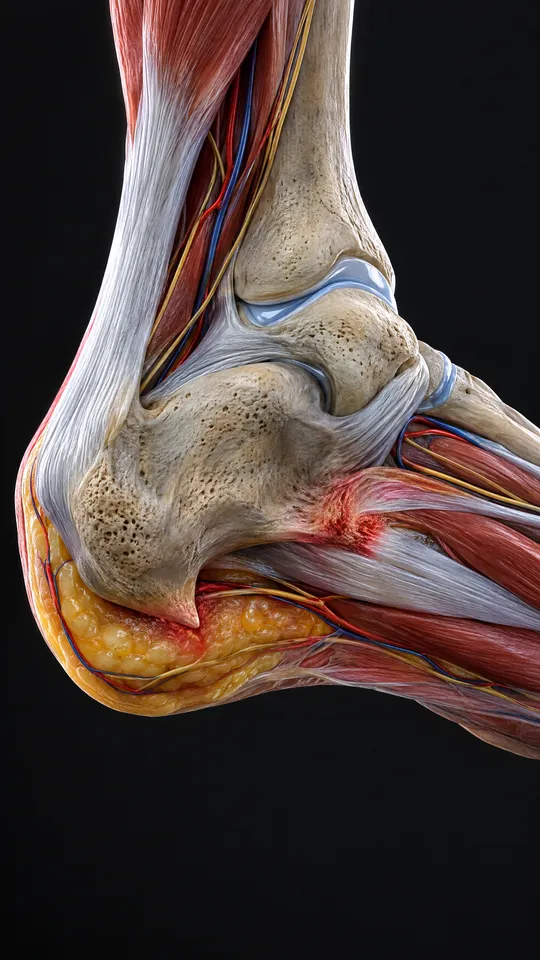
It isn't really either-or. Plantar fasciitis is a soft-tissue problem, and a heel spur is something an X-ray shows. You can have one, the other, both or neither.
Several other conditions can be mistaken for a spur, and they need ruling out before treatment is planned 4:
The reassuring part: working out why your heel hurts often doesn't need a scan 1. The physiotherapy guideline keeps imaging for when simple treatment has failed 7. A clinician asks about your symptoms, your work and how active you are, then examines your feet and calves for tightness and weakness 1. They'll find where the heel is most tender and check how far your ankle bends upwards 6. Pain on pressing where the plantar fascia attaches, and a positive windlass test, are among the guideline's signs 7.
An X-ray or ultrasound is mainly there to rule out other causes, such as a fracture or arthritis 1 6. A spur may turn up on that X-ray, but most people with one have no heel pain 6. It's a finding to note. An MRI is rarely ordered 6.
An honest caveat. Much of this guidance was written for heel pain in general. It treats plantar fasciitis and heel spur syndrome as the same problem 4.
Supportive taping before activity is standard self-care for heel pain 1,4. It's symptom relief, not the fix.
Both appear in the tiered guidance 4. Pooled trials found no significant difference between custom and prefabricated orthotics 7. The physiotherapy guideline suggests a night splint for one to three months if your first steps each morning are consistently painful 7. We'll talk it through before you spend money.
This belongs to a later tier 4, and the research conflicts. Results for plantar fasciitis are mixed, and it isn't clear that it helps 6.
Anti-inflammatories and cortisone injections appear in the medical tiers, and surgery comes last 4. These come from your GP or a specialist, never a physiotherapist. Few people with plantar heel pain need surgery 4.
Heel pain with a spur on the X-ray follows The Well Motion Recovery Path™. You move up a phase when the heel copes with more, not when a date arrives.
How long it usually takes. One review reports that more than 90% of people with plantar fasciitis, the pain a spur usually travels with, get relief within 3 to 6 months of conservative treatment 11. That figure is expert opinion, not a trial result. If pain persists past 6 months, a specialist may consider other treatment 11. This describes the pain settling, not the bone changing.
These steps are aimed at plantar heel pain, the soft-tissue problem a spur usually travels with 1, because that's where the risk factors have been studied 7:
None of this means something is seriously wrong. A spur on an X-ray report usually sounds more alarming than it is, and plenty of people carry one without ever knowing 1.
We start by listening: how it began, what makes it worse, and what it's stopping you from doing. Then we examine the area, explain what we find in plain English, and agree a plan with you. Your first visit is 40 minutes at Engadine and 30 minutes at our other clinics.
We see patients at Engadine, Mount Annan, Narellan and Appin, and at home through our mobile physiotherapy service. If you have private health cover, here's how health fund rebates work for physiotherapy.
You treat the pain, not the bone. Care starts simply, with stretching, padding, taping and insoles, and steps up only if that doesn't help 4. The spur isn't the treatment target. Many people have one and no pain at all 1.
A spur shows up on an X-ray 4,6. Pressing on your heel can't tell a spur from a thickened plantar fascia 2. Even when a spur shows up, it doesn't prove it's causing your pain, because imaging findings and symptoms often don't match 4. Scans are mostly used to rule out other causes 1.
There's no good research on that, so we won't guess at harm. The pain comes from the soft tissue under load 4. Walking differently to avoid it can cause other problems and slow recovery 1. The sensible approach is to avoid what provokes it, then build activity back up gradually 1, rather than pushing through a limp.
Don't count on the bone disappearing. In one shockwave study, symptoms improved even though the spurs didn't significantly shrink 10. The spur doesn't need to go. Spurs are common in people with no pain at all 1,5.
Sharp heel pain that's at its worst on your first few steps out of bed, settles once you get moving, then comes back after sitting or a long day on your feet.
Read morePain, swelling or bruising across the middle of your foot after a fall, an awkward landing or a twist, and a midfoot that still doesn't want to take your weight.
Read moreHeel pain in an active, growing child, usually somewhere between 8 and 14, turning up after footy or athletics training.
Read moreIt's a thickening of the tissue around one of the nerves between your toes, after that nerve has been irritated or damaged.
Read moreTurf toe is the sporting name for a sprain of the big toe joint: the structures underneath get overstretched or torn when the toe is forced upwards.
Read moreMetatarsalgia is a general term for pain around the joints at the base of your toes, a group of conditions rather than a single one. Which one you have changes what helps.
Read moreA stress fracture is a fine crack in a bone from repeated loading without enough recovery between efforts, not a one-off injury. In the foot and lower leg it's the most common form of hairline fracture, usually from jogging or running.
Read moreCuboid syndrome is pain on the outer midfoot, thought to come from a subtle disruption of the joint between the cuboid (a small bone on the outside of your foot) and your heel bone. The exact mechanism hasn't been worked out.
Read moreTarsal tunnel syndrome is compression of the tibial nerve as it runs behind your inner ankle, under a band of tissue called the flexor retinaculum.
Read moreA bunion (hallux valgus) is a bony lump at the big toe joint that forms when the big toe leans towards the other toes. Around 23% of adults have one.
Read more
How would you like to reach us?
Message us on WhatsAppFor bookings and enquiries. Please don't send medical details. Call (02) 8111 5633Request a call-back
Request sent
Thank you. We'll call you back on the number you gave us.
This is a preview, so nothing was actually sent.