Insoles and heel wedges.
An insole that changes your rearfoot position can take pressure off the nerve 1, such as a wedge under the inner heel or a heel seat 2. Again, the evidence is inconclusive 4.
It starts as burning or tingling across the sole of your foot, sometimes into your toes. It's worse after a long day on your feet or a walk uphill, and can still be there at night. Tap just behind the bony bump on the inside of your ankle, and that same zing shoots into your arch.
That pattern is what tarsal tunnel syndrome typically looks like 1,2. It's the same kind of problem as carpal tunnel syndrome in the wrist: a nerve being squeezed as it passes through a tight tunnel.
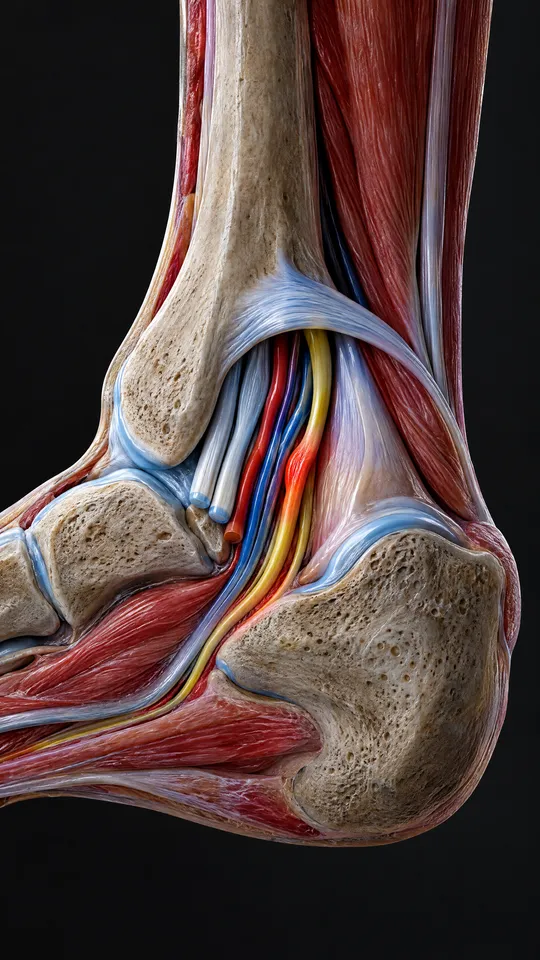
The tibial nerve curves behind your inner ankle bone on its way to the sole of your foot. There it passes through a narrow channel, the tarsal tunnel, roofed by the flexor retinaculum 1,2. There isn't much spare room. Anything that crowds the tunnel or stretches the nerve can irritate it:
In around one in five cases, and more in some studies, no specific cause is found 2,4.
What flares it: walking, especially uphill, standing for long periods, and positions that pull your foot up and outwards 1,2. Completely flat shoes can make it worse too 1.
Several conditions can feel similar. The main ones to rule out are 2,6:
What points towards the tarsal tunnel is nerve-type symptoms (burning, tingling, numbness) plus a tap test at the inner ankle, called Tinel's sign, that reproduces them 1,2. A negative tap test doesn't rule it out: studies differ widely on how often it's positive in people with the condition 5.
Scans need careful reading. There's no gold-standard test, and nerve studies, ultrasound and provocative tests all vary widely in how reliably they pick it up 5. MRI can show compression, but false positives are a real concern 6. A scan backs up the examination. It doesn't replace it, and you won't always need one 1.
No single test confirms tarsal tunnel syndrome 5, so it comes down to your story and an examination. The usual story is burning or tingling in the sole that builds with standing and eases with rest 4. The main test is a tap behind your inner ankle bone. If it sends your usual zing into the arch or toes, that's a positive Tinel's sign 1. Pressing on the nerve, or holding the foot turned in or out, can do the same 4.
You won't always need a scan 1. Nerve conduction tests measure how well the nerve carries a signal, though they miss more cases here than with other trapped nerves 4. Ultrasound or MRI is for finding a cyst or something else taking up room, usually once rest and an insole haven't helped 1.
Treatment research here is thin, and hard evidence that these approaches work is lacking 4. Conservative care is still the accepted first step and settles symptoms for many people, but that rests on only a handful of studies 4.
An insole that changes your rearfoot position can take pressure off the nerve 1, such as a wedge under the inner heel or a heel seat 2. Again, the evidence is inconclusive 4.
If you're not improving with less activity and an insole, an ultrasound or MRI through your GP may be worth it 1, particularly to check for a cyst in the tunnel.
If symptoms don't settle, a surgeon can release the tunnel 1,4. Something taking up space in there, such as a ganglion, is one of the clearer reasons to operate 2. Results aren't guaranteed: carpal tunnel surgery in the wrist tends to do better than surgery here 6. If you're heading that way, we'll tell you and help with the referral.
A squeezed nerve does not mend on a schedule the way a sprain does, so The Well Motion Recovery Path™ for tarsal tunnel syndrome is paced by how the nerve behaves, not by a date.
How long it usually takes. No study gives a reliable recovery time. The 6 week figure is one review's advice, not a trial result 9. How long you have had symptoms is linked to recovery 3. If it is not settling, a scan or a surgeon's opinion decides the next step 1,4.
Nobody has run a trial on preventing tarsal tunnel syndrome, so these come from what's known to crowd or stretch the nerve:
Book an assessment or see your GP if:
None of that means something serious is going on. It's a reason to get the diagnosis right early: how long you've had symptoms is one factor linked to recovery 3.
We start by listening: how it began, what makes it worse, and what it's stopping you from doing. Then we examine the area, explain what we find in plain English, and agree a plan with you. Your first visit is 40 minutes at Engadine and 30 minutes at our other clinics.
We see patients at Engadine, Mount Annan, Narellan and Appin, and at home through our mobile physiotherapy service. If you have private health cover, here's how health fund rebates work for physiotherapy.
Nerve gliding exercises, which gently move the tibial nerve through the tunnel, are one option, alongside calf stretching, footwear changes, insoles and arch taping 2. There's no proven best set: only a few small studies have tested them 4,7.
Often, but not always. Conservative care resolves symptoms for many people 4. Across 32 treatment studies, about three in four cases had excellent or good results and one in four fair or poor, though those studies were low quality 3. Age, how long you've had symptoms, the cause and other health conditions all seem to make a difference 3.
Typical signs are burning, tingling or numbness in the sole, reproduced by tapping behind the inner ankle 1. There's no single definitive test 5, so a proper examination that also rules out your back is how it's diagnosed.
Walking usually makes symptoms worse 2, but you don't need to stop. Walking on flat ground to keep your fitness up is fine. Hills and completely flat shoes are the ones to limit 1.
Sharp heel pain that's at its worst on your first few steps out of bed, settles once you get moving, then comes back after sitting or a long day on your feet.
Read morePain, swelling or bruising across the middle of your foot after a fall, an awkward landing or a twist, and a midfoot that still doesn't want to take your weight.
Read moreHeel pain in an active, growing child, usually somewhere between 8 and 14, turning up after footy or athletics training.
Read moreIt's a thickening of the tissue around one of the nerves between your toes, after that nerve has been irritated or damaged.
Read moreTurf toe is the sporting name for a sprain of the big toe joint: the structures underneath get overstretched or torn when the toe is forced upwards.
Read moreMetatarsalgia is a general term for pain around the joints at the base of your toes, a group of conditions rather than a single one. Which one you have changes what helps.
Read moreA stress fracture is a fine crack in a bone from repeated loading without enough recovery between efforts, not a one-off injury. In the foot and lower leg it's the most common form of hairline fracture, usually from jogging or running.
Read moreCuboid syndrome is pain on the outer midfoot, thought to come from a subtle disruption of the joint between the cuboid (a small bone on the outside of your foot) and your heel bone. The exact mechanism hasn't been worked out.
Read moreA heel spur (calcaneal spur) is a small outgrowth of bone on the heel bone. It can form on the underside or at the back.
Read moreA bunion (hallux valgus) is a bony lump at the big toe joint that forms when the big toe leans towards the other toes. Around 23% of adults have one.
Read more
How would you like to reach us?
Message us on WhatsAppFor bookings and enquiries. Please don't send medical details. Call (02) 8111 5633Request a call-back
Request sent
Thank you. We'll call you back on the number you gave us.
This is a preview, so nothing was actually sent.