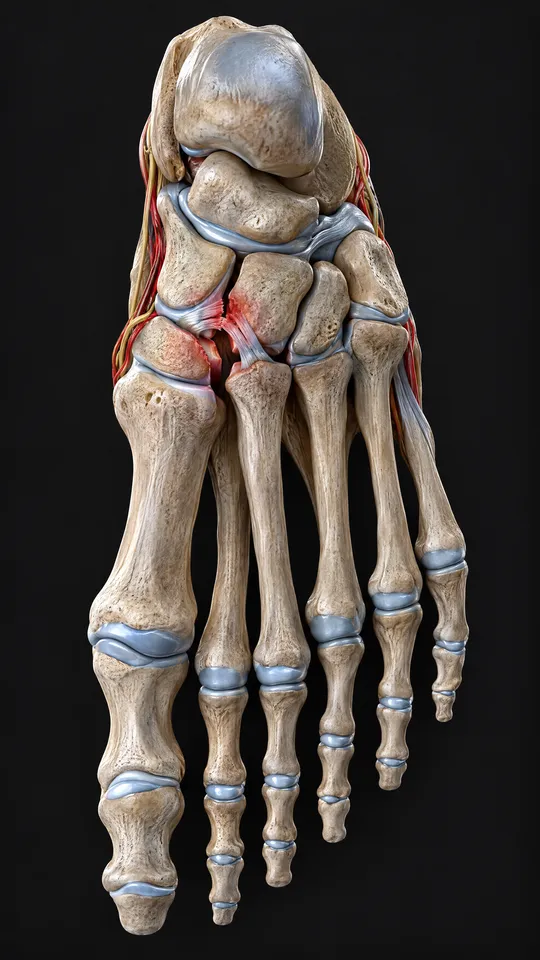
How long does a Lisfranc fracture take to heal?
Normally over 12 weeks, and residual pain and swelling for over 12 months is likely 3. Returning to competitive sport, expect at least 6 to 12 months 1.
Can you walk on a Lisfranc injury?
Not until you've been cleared. Do not put weight through the injured foot until a member of the foot and ankle team tells you to 3, and stay non-weight-bearing until your orthopaedic review 1. Difficulty weight bearing is one of the typical presenting signs in the first place 4.
Is Lisfranc a bad injury?
Yes, and we'd rather say so than soften it. It's described as a significant, life-changing injury that may lead to lifelong challenges, difficulty doing your current job and, rarely, amputation 3. It's a red flag condition in general practice 1, and post-traumatic arthritis develops in roughly 40 to 94% of patients even after surgical fixation 1,2.
Will Lisfranc heal without surgery?
Sometimes, within a narrow indication: stable, non-displaced injuries with pure ligament sprains, six weeks non-weight-bearing, then a gradual return using an arch-support insole 2. Two caveats belong with that: the supporting evidence is a few retrospective case series, not randomised trials 2, and purely ligamentous injuries often carry a poor prognosis 1. There are real positive results too: one case series reported nine athletes back to competition at an average of four months, and a series of 55 people with non-displaced injuries reported good pain and function at two to six years 2.
What is the best treatment for a Lisfranc injury?
There isn't a single best treatment. There's a decision based on stability. No instability or widening on a weight-bearing x-ray means non-operative management is appropriate; any instability or clear widening requires surgery 1, and there's strong consensus that high-energy trauma with displaced or unstable injuries needs operating on 2. No trial has compared the two head to head 2.
What happens if you don't fix Lisfranc?
Inadequately stabilised injuries carry a high risk of debilitating post-traumatic degenerative change. Post-traumatic arthritis is described as a potentially devastating but common complication of poorly treated or missed Lisfranc injuries, often ending in a midfoot fusion, with chronic pain and lost working productivity alongside it 1.
What is the best shoe to wear with a Lisfranc injury?
After the boot phase, a stiff-soled shoe with rigid orthotic support for the next six months 1, or an insole that offloads the arch as you return to activity 2. While you're still in the boot, a supportive firm-soled shoe matching the boot's height on your uninjured side reduces the stress that height difference puts through your other joints 3.