Protective footwear.
Depending on the bone, anything from a stiff-soled shoe or wooden-soled sandal to a removable fracture-brace shoe, and certain fractures need a cast 5. Our cast versus cam boot guide explains what each option means day to day.
Nothing happened. That's usually the first confusing part. You added a couple of runs a week, or swapped the footpath for the fire trails, and a fortnight later your foot started aching partway through a session. It settled when you stopped, then came back earlier the next run.
A stress fracture builds rather than announcing itself, so it's easy to talk yourself into a few more weeks of training, which is what makes it worse.
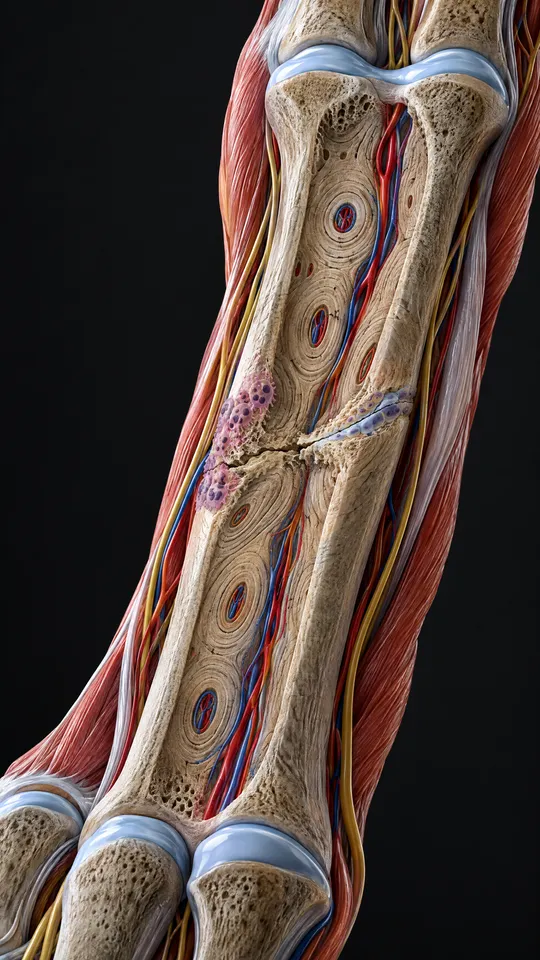
Bone constantly remodels to cope with the load you put through it. A stress fracture happens when repeated, submaximal loads arrive faster than that remodelling can keep up 3. The foot and ankle are a common site 3.
So the useful question isn't "what's wrong with my foot"; it's "what changed?" Usually it's a sudden increase in repetitive activity with muscle fatigue, or a training error 3, in a high-impact sport like running, soccer or basketball 1. A change of training surface counts too 5. Rocky trails and synthetic tracks aren't the footpath your feet had adapted to.
Some things leave bone less able to keep up: low bone mineral density, vitamin D deficiency, and the female athlete triad of disordered eating, missed periods and osteoporosis 3, as well as training more while eating less, and being post-menopausal 4. Female athletes are more prone than male athletes, and stress fractures are more common in winter, when vitamin D levels are lower 5.
Not all foot bones are equal, and that changes everything. Most foot stress fractures are in the metatarsals 4, usually the second and third, which are thinner and longer and take the most load at push-off 5. The heel bone (calcaneus), cuboid and cuneiforms are low-risk and generally heal with activity modification or a short spell off the foot. The navicular, talus and the sesamoids under the big toe are high-risk, with higher rates of failing to heal, longer recovery and more frequent surgery 3. The base of the fifth metatarsal is harder to treat because its blood supply is poor 5.
So there's no single answer to "how long does it take?" Which bone matters more than how sore it feels.
A stress fracture of the heel bone can feel a lot like plantar fasciitis or a heel spur, and sometimes it takes an MRI to tell them apart 5. Two clues point towards a stress fracture:
The test itself is simple. A clinician presses gently along the bone, and pain in one exact spot is often what gives the diagnosis away 5. Expect questions about your work, activities, diet and medications as well, because your risk factors are part of the picture 5.
If a scan is needed, an MRI or bone scan can pick up a stress fracture earlier than an X-ray can 5. You won't necessarily be scanned again: if a new X-ray or scan wouldn't change how the fracture is managed, it isn't required 4. Had a stress fracture before? Your doctor may order blood tests for calcium and vitamin D. One that followed only light activity may prompt a bone density scan 5.
Depending on the bone, anything from a stiff-soled shoe or wooden-soled sandal to a removable fracture-brace shoe, and certain fractures need a cast 5. Our cast versus cam boot guide explains what each option means day to day.
Up to 15 minutes at a time, every few hours, never directly on the skin 4.
Smoking makes healing harder 1, and stopping matters most in the first two weeks after the injury 4.
These have been used with varying success, but there's little supportive evidence that any of them is superior 3. We'd rather tell you that than sell you a shortcut. Supplements are a conversation for your GP, not a physiotherapist.
For high-risk sites (the navicular in particular, and sometimes the base of the fifth metatarsal), surgical fixation is more commonly recommended 3,5, and it's what a stress fracture that fails to heal may need 1. That's an orthopaedic decision, never ours. Our job is to recognise it early and refer you.
A stress fracture in the foot is managed along The Well Motion Recovery Path™. You move up a phase when the bone tolerates the load, not when a set number of weeks has passed.
How long it usually takes. Healing takes six weeks to six months, and high-impact activity up to a year 4. Across 315 navicular stress fractures, return to play averaged 4.17 months after surgery and 4.67 months without, though the studies varied widely 9. For the base of the fifth metatarsal, low-quality studies put bone union at 13.1 weeks with surgery and 20.9 weeks without 10.
Prevention has been tested for stress fractures, mostly in military recruits, so read the numbers with that in mind:
None of this means your foot is in trouble. In most cases a fracture heals with rest and a change in your activities 1. Getting it looked at early is about finding out which bone you're dealing with, because that decides everything that follows.
We start by listening: how it began, what makes it worse, and what it's stopping you from doing. Then we examine the area, explain what we find in plain English, and agree a plan with you. Your first visit is 40 minutes at Engadine and 30 minutes at our other clinics.
We see patients at Engadine, Mount Annan, Narellan and Appin, and at home through our mobile physiotherapy service. If you have private health cover, here's how health fund rebates work for physiotherapy.
Often, yes, which is why they get ignored. How much is safe depends on the bone: some people need a boot, a rigid-soled shoe or crutches, while others can stay in their usual footwear and adjust their activity 4. Going back to weight-bearing activity too early can turn it into a complete fracture 5, so it's worth getting assessed rather than guessed.
Sometimes. It depends far more on which bone than on how bad the pain is. Low-risk sites like the calcaneus and cuneiforms often settle with activity modification alone; high-risk sites like the navicular usually need more 3. Protective footwear runs from a stiff-soled shoe to a removable fracture-brace shoe, and certain fractures need a cast 5.
The well-described pattern is activity-related: the pain builds with weight-bearing and eases with rest 3,5, and it can linger for up to six months into recovery 4. The sources behind this page don't describe a night-pain pattern for stress fracture, so we won't invent one. Pain that's changing, or that doesn't follow that activity pattern, is a good reason to get assessed.
There isn't a shortcut. Shockwave, low-intensity pulsed ultrasound and vitamin D supplements have been used with varying success, with little supportive evidence that any is superior 3. What does help: managing load, returning in graded steps 4 and not smoking 1,4. Going back too soon can mean a complete fracture and a much longer recovery 5.
Pain on the outside of the foot points towards the fourth or fifth metatarsal 5. A fracture at the base of the fifth typically starts as pain on the outside of the midfoot with no injury behind it, and the poor blood supply there makes healing slower and less predictable 5.
Sharp heel pain that's at its worst on your first few steps out of bed, settles once you get moving, then comes back after sitting or a long day on your feet.
Read morePain, swelling or bruising across the middle of your foot after a fall, an awkward landing or a twist, and a midfoot that still doesn't want to take your weight.
Read moreHeel pain in an active, growing child, usually somewhere between 8 and 14, turning up after footy or athletics training.
Read moreIt's a thickening of the tissue around one of the nerves between your toes, after that nerve has been irritated or damaged.
Read moreTurf toe is the sporting name for a sprain of the big toe joint: the structures underneath get overstretched or torn when the toe is forced upwards.
Read moreMetatarsalgia is a general term for pain around the joints at the base of your toes, a group of conditions rather than a single one. Which one you have changes what helps.
Read moreCuboid syndrome is pain on the outer midfoot, thought to come from a subtle disruption of the joint between the cuboid (a small bone on the outside of your foot) and your heel bone. The exact mechanism hasn't been worked out.
Read moreTarsal tunnel syndrome is compression of the tibial nerve as it runs behind your inner ankle, under a band of tissue called the flexor retinaculum.
Read moreA heel spur (calcaneal spur) is a small outgrowth of bone on the heel bone. It can form on the underside or at the back.
Read moreA bunion (hallux valgus) is a bony lump at the big toe joint that forms when the big toe leans towards the other toes. Around 23% of adults have one.
Read more
How would you like to reach us?
Message us on WhatsAppFor bookings and enquiries. Please don't send medical details. Call (02) 8111 5633Request a call-back
Request sent
Thank you. We'll call you back on the number you gave us.
This is a preview, so nothing was actually sent.