Need urgent care? 24/7 Mobile & After-Hours Emergency Physiotherapy Call (02) 8111 5633 For life-threatening emergencies, always call 000
Lower Back

Sciatica

5.0 average rating on Google
Registered NDIS Provider
SIRA Registered Provider

The pain isn't really in your back. It's a line down the back of one leg (buttock, hamstring, sometimes past the knee into the calf or foot), and it can arrive with pins and needles, numbness, or a leg that feels like it isn't quite taking your weight. Sitting makes it worse.

Most people arriving here have already been told to rest it and wait. That's close to the opposite of what the evidence supports.

What's actually causing it

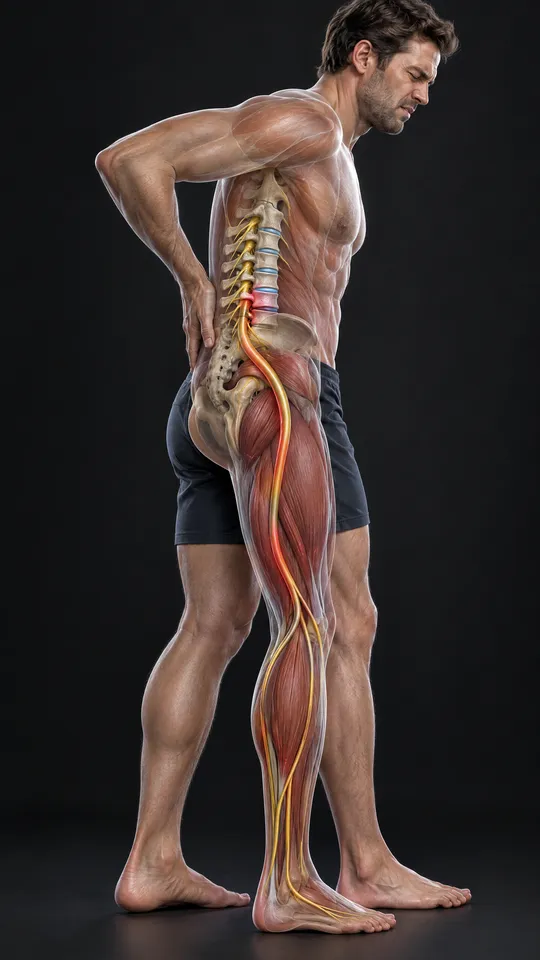
The sciatic nerve doesn't start in your leg. It forms where several nerve roots exit the lower spine (the levels clinicians label L4 through S3), then travels through the hip and buttock and down the back of the thigh, sending branches into the lower leg and foot 1,4.

That explains the most confusing thing about sciatica: the problem is usually in your back, and the pain is usually in your leg. Pressure at the root is felt all along the path that root supplies, which is why treating only the spot that hurts so often goes nowhere.

Between one and five people in every hundred develop sciatica each year 4. The most common cause is a herniated lumbar disc (the "slipped disc" most people have heard of), where disc material presses on a nerve root 1,2,4. Less commonly, the space the nerve travels through narrows: spinal stenosis, degenerative change, or spondylolisthesis 1,2,4. Rarely, a tumour or other space-occupying lesion is responsible 1,6.

Side view of a man showing the sciatic nerve running from the lower spine through the hip and down the back of the leg

Sciatica or something else? How to tell the difference

Not everything that produces leg pain is sciatica, and the distinction changes the treatment.

Lumbar disc bulge is the most common cause of true sciatica, not a separate condition 1,2, but a bulging disc can also cause back pain with no nerve involvement at all, which needs a different plan.

Facet joint pain comes from the small joints at the back of the spine. It refers pain convincingly into the buttock and upper thigh, but typically stops above the knee and doesn't bring the pins and needles, numbness or weakness nerve-root involvement does.

Piriformis-type buttock pain (irritation where the nerve passes through the deep buttock muscles rather than at the spinal root 1) presents similarly, but the level you'd treat is different.

And one that matters more than its rarity suggests: cauda equina syndrome can initially look like ordinary low back pain 6. It's why an assessment asks about bladder and bowel function when you came in about your leg.

How it's diagnosed

Sciatica is diagnosed in the clinic room, from your symptoms and an examination 4. You'll be asked where the pain runs, when it started, and whether there's tingling, numbness or weakness in the leg 4. Leg pain that's worse than the back pain points towards sciatica 4. Back pain with nothing in the leg probably isn't it 2. If your back has grabbed and locked but your leg is fine, read about back spasm instead.

The test most people remember is the straight leg raise: you lie on your back and your leg is lifted with the knee straight. Reflexes, strength and sensation are checked too 4. Scans aren't routine. They're considered when symptoms have gone past 12 weeks, the pain is getting worse or the weakness is progressing 4.

How we treat it

The first job is working out which nerve root is involved and whether your symptoms centralise: whether certain movements pull the pain up out of the leg towards the spine, or push it further down. That response is what turns "do some sciatica stretches" into an actual plan.

From there, here's where the evidence on exercise stands: exercise helps, and no specific exercise has been shown to be the one that helps. The most thorough review available found exercise reduces pain in the short term, but made no recommendation for any particular type, other than that it be supervised exercise therapy 4. That single word is the finding, and it's why our exercise prescription and conditioning programs are built around your presentation, not a template.

What the evidence is clear about is movement itself. Bed rest may be counterproductive; staying active is the preferred option 3. Carry on with normal activities as far as you can, and don't sit or lie down for long stretches. Even when moving hurts, it isn't causing harm 2. Keep it low-impact: walking and swimming, not running or standing weights 1.

For pain that has settled in and stopped responding to the usual advice, our chronic pain management approach deals with what exercise alone doesn't: sleep, load tolerance, and the avoidance that builds up.

Other treatments we may use

Manual therapy and spinal manipulative therapy.

In the largest synthesis available (50 randomised trials, 4,920 people with chronic sciatica), spinal manipulative therapy produced the largest short-term reduction in leg pain of any non-surgical option tested. The authors immediately qualify it: that result, and every other result in the review, rests on very low confidence evidence 5. Worth trying. Not a proven answer, and we'd rather say so than sell it.

Neural mobilisation ("nerve glides" or "flossing").

Gentle, repeated movements designed to let the nerve slide through surrounding tissue. A systematic review concluded these may help short-term with pain, function and disability, but the studies varied so much that no protocol could be recommended, and the results couldn't be pooled 7. Useful; unsettled.

Dry needling.

Where protective muscle guarding around the hip and lower back is contributing to what you're feeling, needling the involved muscle can help settle it. There's a limit, though: the sciatica-specific research doesn't single it out as a treatment for the nerve compression itself. It addresses the layer on top, not the root.

Medication, injections and surgery.

Anti-inflammatory medication, steroid injections and surgery all appear in the literature as real options 1,5. These are not things physiotherapists prescribe or administer: they sit with your GP or a specialist. Australian guidance places surgery last, for severe symptoms where medicines and physiotherapy haven't helped 1.

Your recovery path: Reset, Rebuild, Return

Sciatica is an irritated nerve, not a torn tissue, so The Well Motion Recovery Path™ starts by calming the nerve and then builds up what it can tolerate. You move up a phase when your leg symptoms allow it, not when a date arrives.

  • Reset: from the first visit. We find the nerve root involved, then keep you active with walking or swimming 1,3, adding manual therapy 5, neural mobilisation 7 or dry needling where they suit. Expect the leg pain to come and go. We move you on once it is retreating up the leg and you can sit and walk for longer. New bladder or bowel changes, numbness around the genitals or bottom, or weakness in both legs mean the emergency department, not the next phase 2.
  • Rebuild: supervised exercise therapy 4, through our exercise prescription and conditioning programs. Expect the odd flare as the load goes up. We move you on when everyday tasks no longer stir up the leg.
  • Return: a full day of sitting at work, driving, lifting, and sport if that is yours. We test those tasks directly. You leave with an exercise plan, because regular exercise is linked with a lower risk of sciatica 9.

How long it usually takes. Most cases settle in 6 weeks to 3 months 3. Some people still have symptoms after a year 1.

Reducing your risk of it coming back

Nobody has trialled prevention for sciatica itself. These come from large studies of who gets it and one Australian trial in back pain:

  • Keep exercising once it settles. In seven studies following about 78,000 people, those who exercised four or more times a week were 12% less likely to develop sciatica than people who did none 9. Healthdirect says to keep up low-impact exercise after you've recovered 1.
  • Walk to a plan. In a trial of 701 Australian adults who'd just got over a bout of low back pain, half were given a walking program that built up over six months. They went a median of 208 days before pain next limited their activity. The untreated group went 112 8. That was back pain with no specific diagnosis: close to sciatica, though not the same.
  • If you smoke, quit. Across 28 studies, current smokers had 46% higher odds of sciatica than people who'd never smoked. For ex-smokers it was 15% 10.
  • Rethink the commute. Smoking and obesity both raise the risk of a hospital stay for sciatica. Walking or cycling to work lowers it 4.

When to get it checked properly

Go to your nearest emergency department, or call 000, if you have any of these 2:

  • sciatica in both legs
  • weakness or numbness in both legs that is severe, or getting worse
  • numbness around your genitals, or around your bottom
  • difficulty starting to pee, inability to pee, or loss of control over when you pee
  • not noticing when you need to open your bowels, or loss of control over it

These can indicate cauda equina syndrome (compression of the bundle of nerve roots at the base of the spine), which needs same-day assessment. Some perspective, because that list is frightening and the condition is rare: cauda equina accounts for an estimated 0.04% of low back pain seen in primary care, and occurs in about 2% of people with a disc herniation 6. Almost certainly not you. Still worth knowing.

Book an assessment instead of managing it yourself if you've been treating it for four weeks with no improvement, if the pain is severe lying down or at night, if there's progressive numbness or weakness in the leg, or if it comes alongside fever, a recent infection, unexplained weight loss, or a history of cancer 1.

Most sciatica improves. It's the waiting-and-hoping that tends to cost people months.

If this starts after hours, on a weekend or a public holiday, and you have none of the warning signs on this page, our after-hours emergency physiotherapy can come to you. Call (02) 8111 5633.

Your first appointment

We start by listening: how it began, what makes it worse, and what it's stopping you from doing. Then we examine the area, explain what we find in plain English, and agree a plan with you. Your first visit is 40 minutes at Engadine and 30 minutes at our other clinics.

We see patients at Engadine, Mount Annan, Narellan and Appin, and at home through our mobile physiotherapy service. If you have private health cover, here's how health fund rebates work for physiotherapy.

FAQs

What's the worst thing you can do for sciatica?

Stop moving. Bed rest may be counterproductive, and remaining active is the preferred option 3. The guidance is blunt: don't sit or lie down for long periods, because even though moving hurts, it isn't harmful and it can help you recover faster 2.

Does sciatica go away on its own?

Usually, yes: most cases resolve within six weeks to three months 3, though some people still have symptoms after a year 1. That's not a reason to do nothing in the meantime: how you move during that window is what the evidence is about.

Is walking good for sciatica?

Yes. Walking and swimming are both named as low-impact activities that improve strength and flexibility without heavily loading the spine; running and standing weights are the ones to leave alone for now 1. If walking pushes the pain further down your leg each time, get it looked at.

What is the miracle stretch for sciatica?

There isn't one, and we'd rather say so than invent one. The most thorough review of exercise for sciatica found no recommendation for any specific type, only for supervised exercise therapy 4, and the largest recent synthesis concluded no high-quality evidence confirms the superior effectiveness of any non-surgical treatment 5. The stretch that helps you depends on which nerve root is involved and how your symptoms respond: something to test, not read off a list.

How to untrap a sciatic nerve?

The phrasing is worth correcting, because it shapes what people try. The nerve isn't trapped and then released like a snagged cord; it's irritated, inflamed or under pressure 1, usually at the root where it exits the spine 4. The aim isn't one manoeuvre that frees it; it's reducing what's irritating the root, which is what neural mobilisation targets 7.

What sleeping position is best for sciatica?

None of the sources behind this page recommends a specific sleeping position, and we're not going to invent one. What is supported is changing position often to reduce pressure through your lower back. And severe pain lying down or at night is a reason to get assessed, not a position problem to solve 1.

More Lower Back conditions

If the leg pain has been going on long enough that you've stopped expecting an answer, that's the gap worth closing.

Book an assessment at Engadine, Mount Annan, Narellan or Appin, or browse the Lower Back section of our Injury Finder. For something to do about the pain today, our How to Relieve Sciatic Nerve Pain article is the practical companion to this one.

Book an Assessment
Ahmed Elsayed, Principal Physiotherapist
Reviewed by Ahmed Elsayed Principal Physiotherapist at Well Motion

References

  1. Sciatica: treatment, symptoms and causes. healthdirect (Australian Government). Last reviewed December 2024. https://www.healthdirect.gov.au/sciatica
  2. Sciatica. NHS (United Kingdom). https://www.nhs.uk/conditions/sciatica/
  3. Sciatica. Better Health Channel, Victorian Department of Health. https://www.betterhealth.vic.gov.au/health/conditionsandtreatments/sciatica
  4. Fairag M, et al. Risk Factors, Prevention, and Primary and Secondary Management of Sciatica: An Updated Overview. PMC/NCBI, 2022. https://pmc.ncbi.nlm.nih.gov/articles/PMC9743914/
  5. Zhu Z, et al. Effectiveness of non-surgical interventions for patients with chronic sciatica: A systematic review with network meta-analysis. The Journal of Pain, 2025. https://doi.org/10.1016/j.jpain.2025.105431
  6. Cataldi F, et al. Neoplastic malignant cord compression mimicking low back pain: A case report. Physiotherapy Research International, 2022. https://doi.org/10.1002/pri.1971
  7. Peacock M, Douglas S, Nair P. Neural mobilization in low back and radicular pain: a systematic review. The Journal of Manual & Manipulative Therapy, 2022. https://pmc.ncbi.nlm.nih.gov/articles/PMC9848316/
  8. Pocovi NC, Lin CC, French SD, et al. Effectiveness and cost-effectiveness of an individualised, progressive walking and education intervention for the prevention of low back pain recurrence in Australia (WalkBack): a randomised controlled trial. The Lancet, 2024;404(10448):134-144. https://pubmed.ncbi.nlm.nih.gov/38908392/
  9. Shiri R, Falah-Hassani K, Viikari-Juntura E, Coggon D. Leisure-time physical activity and sciatica: A systematic review and meta-analysis. European Journal of Pain, 2016;20(10):1563-1572. https://pubmed.ncbi.nlm.nih.gov/27091423/
  10. Shiri R, Falah-Hassani K. The Effect of Smoking on the Risk of Sciatica: A Meta-analysis. The American Journal of Medicine, 2016;129(1):64-73. https://pubmed.ncbi.nlm.nih.gov/26403480/