Need urgent care? 24/7 Mobile & After-Hours Emergency Physiotherapy Call (02) 8111 5633 For life-threatening emergencies, always call 000
Foot

Bunion

5.0 average rating on Google
Registered NDIS Provider
SIRA Registered Provider

It started as a small lump at the side of your big toe. Now some of your shoes rub, the joint aches after a long day on your feet, and the big toe seems to lean further towards the others than it used to. You want to know whether anything short of surgery is worth doing.

Physiotherapy can help with how a bunion feels and how you move on it, but it won't straighten the bone. Here's what the evidence says about both.

What's actually causing it

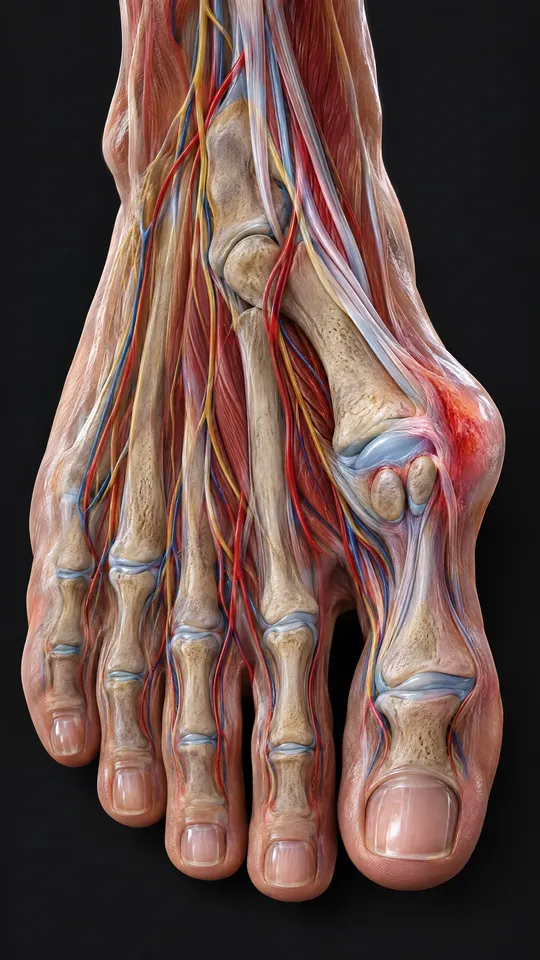
A bunion forms at the joint where your big toe meets your foot. The big toe gradually leans in towards the second toe, and the joint at its base pushes outwards into a bony lump 1.

Nobody fully understands why it happens 1. What is known:

  • Inherited foot shape. Bunions often run in families, and there's likely a heritable component 1,2.
  • Arthritis, including rheumatoid arthritis and osteoarthritis 1.
  • A previous foot injury 1.

Shoes are more complicated than the folklore. Narrow, tight shoes can increase your chance of developing a bunion 1, yet a clinical review for Australian GPs found a causal link with footwear, high heels included, hasn't been shown 2. Both agree roomier, lower-heeled shoes help manage one once you have it 1,2.

Bunions are most common in women over 45 1. Among Australians who see a GP about one, 82.3% are female and 80.5% are aged 45 or over 2.

Foot from above showing the big toe angled toward the second toe and a bony bump at its base

How it's diagnosed

A bunion is diagnosed the simple way: someone asks about your symptoms and examines your foot 1. The examination is where the useful detail comes from. It takes in the whole foot and lower leg, plus a simple check of how you walk 2. If you have diabetes or poor circulation, the skin over the bump gets a careful look too, because it's more likely to break down 2.

An X-ray may be ordered to show how the bones and joints in your foot line up 1. If you're being referred to an orthopaedic surgeon, the X-rays should be taken with you standing 2.

How we treat it

We can't straighten a bunion, and we won't pretend otherwise. What we can do is work on what makes it painful and limiting.

1
Assessment first. How sore and stiff the joint is, how you walk, what shoes you live in, and whether anything points to a referral rather than physio.
2
Keeping the big toe moving. Exercise to keep the joints moving is standard bunion care, and physiotherapists can show you exercises suited to your feet 1. We build that into a program through exercise prescription and conditioning, with manual therapy, hands-on mobilisation of the joint, alongside.
3
Footwear advice. Wide, soft shoes with room for your toes, and no high heels 1,2.
4
Walking and balance. A bunion can change the way you walk, and in older people that raises the risk of falls 1. Our falls prevention work targets that.
5
Staying active. If it's getting in the way of running or sport, sports physiotherapy helps you adjust load and footwear rather than stop.
6
Rehab after surgery. If you do have an operation, post-surgical rehabilitation gets you moving again. Expect a stiff-soled shoe for about six weeks afterwards 2.

An honest caveat. The evidence for non-surgical bunion care is thin. One earlier review found non-operative treatment performed no better than no treatment at all 2. A more recent analysis of 11 trials ranked exercise with a toe separator among the options most likely to reduce the big toe's angle, but its authors said high-quality evidence is still lacking 3. So we use exercise to manage symptoms and function, not to reverse a bunion.

Other treatments we may use

Toe separators, splints, padding and orthoses.

Padding over the bump is a standard first-line option 2. Orthoses with a toe separator showed the best effect on the big toe's angle in one meta-analysis, but the effect was modest and only nine studies qualified 4. Splints and braces won't correct the deformity, and any benefit from orthotics is unlikely to last long term 2. Inserts and splints are usually fitted by a podiatrist 1; we'll refer you if they're worth trying.

Dry needling and joint manipulation.

Both ranked among the better options for symptoms in the same 11-trial analysis 3, but from small studies. Worth discussing, not relying on.

Medication and injections.

Your GP may suggest anti-inflammatory medication or a corticosteroid injection 1. These are prescribed by a doctor, not a physiotherapist.

Surgery.

Considered when a painful bunion hasn't responded to non-surgical care 1,2. Recovery can be long and bunions can return afterwards 1. How a bunion looks isn't, on its own, a reason to operate 2.

Your recovery path: Reset, Rebuild, Return

A bunion does not heal, so The Well Motion Recovery Path™ is used here to manage it, with no promise of a straighter toe. You move up a phase when your foot copes with more, whatever the calendar says.

  • Reset: while the joint is sore or inflamed. Footwear advice and manual therapy, with padding over the bump as a first step 2. Expect the lump to stay where it is 2. We move you on once the joint has settled enough to exercise.
  • Rebuild: the exercise program for the big toe 1, then walking and balance work if the bunion has changed how you walk 1. We move you on when the foot does what your daily tasks ask of it.
  • Return: back to long days on your feet, or to running and sport. We check how the joint handles that load in the shoes you wear. You leave with a home program and a clear point to ask about surgery: pain that persists despite all this 2.

How long it usually takes. Non-surgical care has no set timeframe, because a bunion tends to get slowly worse, not better 1,2. Surgery has one, and your surgeon sets it: about six weeks in a stiff-soled shoe 2, the point at which emergency braking was back to normal in one small study of 28 patients 7, and 3 to 6 months before sport 8. Some stiffness or pain can remain 8.

Reducing the risk of flare-ups

Bunions can't easily be prevented, and they tend to progress over time 1 2. What has been studied points mostly at shoes:

  • Toe room comes first. A 2026 analysis pooling 23 studies found narrow-toed shoes went with roughly double the odds of having a bunion, a stronger link than high heels 5. That's an association, so it can't prove the shoes caused it. A wide, deep toe box and a low heel is still the simplest change to make 1 2.
  • Don't expect an insert to hold it. A review of five studies found too little good evidence that orthotics slow a bunion's progression, though they may ease symptoms 6.
  • Have tight shoes stretched. A podiatrist can stretch or modify the shoes you own, which matters most if you have diabetes or poor circulation 2.
  • Check your skin. Wash and dry your feet, and look for cuts, blisters or changes in the skin and nails 1. See your doctor or podiatrist about any change that worries you 1.

When to get it checked properly

  • The bunion is painful or inflamed 1.
  • It's getting hard to find shoes that fit, or to walk comfortably 1.
  • You have diabetes. See a doctor about any bunion 1, and treat broken skin or an ulcer over the joint as urgent; the same goes if you have poor circulation 2.
  • Pain persists despite a genuine go at footwear, padding and exercise. That's when referral to an orthopaedic surgeon is usually considered 2.
  • A child or teenager has a bunion. Surgery is usually delayed until the bones finish growing 2.

None of this is cause for alarm. Non-surgical care is the recommended starting point 2, and much of what makes a bunion hard to live with is workable.

Your first appointment

We start by listening: how it began, what makes it worse, and what it's stopping you from doing. Then we examine the area, explain what we find in plain English, and agree a plan with you. Your first visit is 40 minutes at Engadine and 30 minutes at our other clinics.

We see patients at Engadine, Mount Annan, Narellan and Appin, and at home through our mobile physiotherapy service. If you have private health cover, here's how health fund rebates work for physiotherapy.

FAQs

How can I get rid of my bunion?

Without surgery, the bony lump won't go away. Footwear changes, padding, exercise and toe separators can ease pain, but they don't correct the deformity 2. Surgery aims to realign the joint, and even then bunions can come back 1. What physio can change is how much it hurts and how well you move.

What is the major cause of bunions?

There isn't a single one, and it isn't fully understood 1. Inherited foot shape looks to be a big part 1,2, alongside arthritis and past foot injuries 1. Tight shoes may increase your chance 1, but a causal link hasn't been proven 2.

Is a bunion a form of arthritis?

No. A bunion is a change in the alignment of the big toe joint 1. Rheumatoid arthritis and osteoarthritis can be among its causes 1, and severe arthritis in the big toe joint is a separate problem that's managed differently 2, one more reason to get a painful big toe assessed.

What happens if bunions are left untreated?

They tend to slowly worsen 1,2. A bunion can change how you walk, make shoes harder to fit and cause skin problems or pressure sores, and in older people it can raise the risk of falls 1. Pain can also spread to the ball of the foot (metatarsalgia) and the smaller toes can become deformed 2.

More Foot conditions

Foot

Plantar Fasciitis

Sharp heel pain that's at its worst on your first few steps out of bed, settles once you get moving, then comes back after sitting or a long day on your feet.

Read more
Foot

Lisfranc Injury

Pain, swelling or bruising across the middle of your foot after a fall, an awkward landing or a twist, and a midfoot that still doesn't want to take your weight.

Read more
Foot

Morton's Neuroma

It's a thickening of the tissue around one of the nerves between your toes, after that nerve has been irritated or damaged.

Read more
Foot

Turf Toe

Turf toe is the sporting name for a sprain of the big toe joint: the structures underneath get overstretched or torn when the toe is forced upwards.

Read more
Foot

Metatarsalgia

Metatarsalgia is a general term for pain around the joints at the base of your toes, a group of conditions rather than a single one. Which one you have changes what helps.

Read more
Foot

Stress Fracture (Foot)

A stress fracture is a fine crack in a bone from repeated loading without enough recovery between efforts, not a one-off injury. In the foot and lower leg it's the most common form of hairline fracture, usually from jogging or running.

Read more
Foot

Cuboid Syndrome

Cuboid syndrome is pain on the outer midfoot, thought to come from a subtle disruption of the joint between the cuboid (a small bone on the outside of your foot) and your heel bone. The exact mechanism hasn't been worked out.

Read more
Foot

Tarsal Tunnel Syndrome

Tarsal tunnel syndrome is compression of the tibial nerve as it runs behind your inner ankle, under a band of tissue called the flexor retinaculum.

Read more
Foot

Heel Spur

A heel spur (calcaneal spur) is a small outgrowth of bone on the heel bone. It can form on the underside or at the back.

Read more

If a bunion is making shoes, walking or sport harder than it should be, book an appointment at Engadine, Mount Annan, Narellan or Appin.

We'll look at the joint, how you walk and what you're wearing, and tell you honestly what physio can help with, and when a podiatrist or surgeon is the better next step. Not sure a bunion is the problem? Start from the Foot section of our Injury Finder.

Book an Assessment
Ahmed Elsayed, Principal Physiotherapist
Reviewed by Ahmed Elsayed Principal Physiotherapist at Well Motion

References

  1. Bunions. healthdirect (Australian Government-funded health information service). Last reviewed March 2026. https://www.healthdirect.gov.au/bunions
  2. Aebischer, Duff. Bunions: A review of management. Australian Journal of General Practice (RACGP), 2020;49(11). doi:10.31128/AJGP-07-20-5541. https://www1.racgp.org.au/ajgp/2020/november/bunions
  3. Ying J, et al. Adjusted indirect and mixed comparisons of conservative treatments for hallux valgus: a systematic review and network meta-analysis. International Journal of Environmental Research and Public Health, 2021;18(7):3841. https://doi.org/10.3390/ijerph18073841
  4. Kwan MY, et al. Hallux valgus orthosis characteristics and effectiveness: a systematic review with meta-analysis. BMJ Open, 2021;11(8):e047273. https://doi.org/10.1136/bmjopen-2020-047273
  5. Zhang G, Ma Y, Zhang S. Determinants and associated factors for hallux valgus: a systematic review and meta-analysis. BMC Musculoskeletal Disorders, 2026;27(1). https://doi.org/10.1186/s12891-026-10054-1
  6. DeHeer PA, Patel NA, Wolfe W, Badell B, Kirkland M, Wallace B. Orthoses Effect on Radiographic Measurements of Hallux Abducto Valgus: A Systematic Review. Journal of the American Podiatric Medical Association, 2024;114(4). https://doi.org/10.7547/23-171
  7. Holt G, Kay M, McGrory R, Kumar CS. Emergency brake response time after first metatarsal osteotomy. Journal of Bone and Joint Surgery (American), 2008;90(8):1660-4. PMID 18676895. https://doi.org/10.2106/JBJS.G.00552
  8. Bunions. NHS (nhs.uk). Page last reviewed 12 June 2023. https://www.nhs.uk/conditions/bunions/