Taping.
Low-Dye taping and other taping techniques support the foot after treatment and are part of preventing recurrence 1,2.
The pain sits on the outside of your foot, roughly halfway between your heel and your little toe. Maybe it started when you rolled your ankle, and the ankle has settled but the side of your foot hasn't. Or it crept up over a heavy block of training, rehearsals or court sessions. Walking is manageable. Pushing off, hopping or changing direction is where it bites. That pattern has a name (cuboid syndrome), and it's an easy one to miss 1.
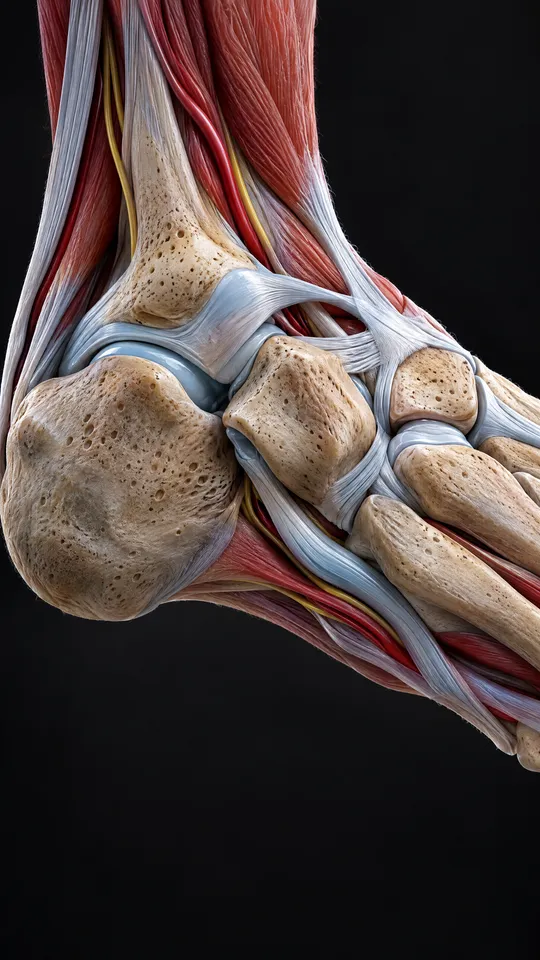
The cuboid is a small, roughly cube-shaped bone on the outer edge of your midfoot. It sits just in front of your heel bone (the calcaneus), where the two meet at the calcaneocuboid joint, and just behind the long bones that run to your fourth and fifth toes. Cuboid syndrome is thought to come from a subtle disruption in how that joint moves or fits together 1. That's why you'll also see it called a subluxed, locked or dropped cuboid 1,2.
The leading explanation is the ankle-sprain movement: a fast roll where your foot points down and turns in. The tendon of peroneus longus, one of the muscles down the outside of your lower leg, wraps around the cuboid on its way under your foot. When that muscle fires hard to protect the ankle, the cuboid can act as a pivot and get pulled slightly out of its normal position 2,5. A second route, gradual repeated overload, is seldom described 2.
The precise mechanism "has not been elucidated", and one proposed contributor, small folds of tissue inside the joint, is described by the same review as "highly speculative" 1. It's considered a relatively common cause of outer midfoot pain 1, but while the dancer figure above is published, we haven't found a reliable figure for runners.
Factors linked to it include 1:
The symptoms of cuboid syndrome resemble a ligament sprain 1, and the two often arrive together. So the useful question usually isn't "which one?" but "is there a cuboid problem that my ankle sprain rehab isn't touching?"
Clues that point towards the cuboid 1:
None of those clues confirms it. There are no definitive diagnostic tests 1, and X-rays are of little value for finding cuboid syndrome 2. Two hands-on tests have been described, the midtarsal adduction and supination tests, but their diagnostic accuracy hasn't been determined 1. Diagnosis comes down to your history, a cluster of signs and a clinician who's thinking of it 1. Checking how the cuboid moves against its neighbours by hand is part of that 5.
Other conditions that can look similar, and need ruling out, include 1:
This one is diagnosed in the clinic room, from your history and your signs and symptoms. A scan won't do it 1. Alongside the two tests described above, a clinician feels for tenderness on top of and underneath the cuboid and along the peroneus longus tendon that wraps around it, checks whether turning your foot in or out against resistance hurts, and watches you walk and hop 1. We may also glide the cuboid gently up and down. That can be sore, and the bone moves less when it's 'locked' 1.
An X-ray still has a job: ruling out a fracture or another bony problem 1. CT and MRI haven't made the diagnosis any easier, partly because harmless variations in outer-foot anatomy are common 1.
Our approach follows what the literature recommends, with the evidence caveat above kept in view.
Low-Dye taping and other taping techniques support the foot after treatment and are part of preventing recurrence 1,2.
A 3 to 6 mm felt pad placed under the inner edge of the cuboid, or orthotics, can help stop it recurring, and a wedge under the outer heel may ease pain when you're on your feet 1. Useful supports, not a cure on their own.
These passive, applied treatments are listed as adjuncts 2. Nothing we've found shows them doing much on their own for cuboid syndrome, so we treat them as optional extras, not the main event.
One review describes the response to conservative treatment as exceptional 2. Another points out that this rests on case reports, not trials 1. The original physiotherapy paper describing cuboid assessment covered two patients 5. Manipulation is a reasonable first step, and the literature supports trying it. We won't promise it fixes everything in one session.
Cuboid syndrome is treated along The Well Motion Recovery Path™. Your foot moves up a phase when it passes that phase's test, whatever the calendar says.
How long it usually takes. No trial has measured it. The only figure comes from one 2005 case series with no comparison group: all 7 athletes returned to sport after 1 to 2 treatments, with no recurrence over a mean 5.7 months 3. Longer-standing cases may need more sessions 2, so that figure is no promise.
Nothing here has been tested in a trial. What's written about cuboid syndrome is mostly case reports 1, so each step goes after a factor that literature links to it:
Get it assessed rather than managing it alone if:
Most outer-foot pain like this has a manageable cause. Getting it checked is about finding which one, not assuming the worst.
We start by listening: how it began, what makes it worse, and what it's stopping you from doing. Then we examine the area, explain what we find in plain English, and agree a plan with you. Your first visit is 40 minutes at Engadine and 30 minutes at our other clinics.
We see patients at Engadine, Mount Annan, Narellan and Appin, and at home through our mobile physiotherapy service. If you have private health cover, here's how health fund rebates work for physiotherapy.
Usually with a specific manipulation of the cuboid by a trained clinician, unless there's a reason not to 1, followed by taping, padding and exercise to stop it recurring 1,2. This rests on case reports rather than trials 1.
Usually, yes. Once it's correctly diagnosed and properly treated, the outlook is described as excellent, and some people feel relief straight after manipulation 2. Longer-standing cases may need several sessions 2. No reliable research timeline exists, so we won't invent one.
A diffuse ache on the outer midfoot that can spread across the foot. It feels a lot like a sprain, is worse with weight-bearing, push-off and side-to-side movement, and eases with rest. Hopping often provokes it 1.
You can't reliably tell yourself, and neither can an X-ray 2. There are no definitive tests 1, and the two described clinical tests haven't had their accuracy established 1. It takes a hands-on assessment and your history together 1,5.
Please don't try it yourself. Cuboid manipulation has real contraindications, including fracture, gout, inflammatory arthritis, and nerve or circulation problems, and it should wait until swelling and bruising have settled 1. That's a judgement call for someone who has examined your foot.
Don't run or do vigorous weight-bearing for several days after manipulation 1. Don't attempt self-manipulation, and don't keep training in poorly made or poorly fitting shoes, or on uneven surfaces, while it's settling 1.
Don't use walking as your test. A fracture is one of the things cuboid syndrome is confused with 1, and if you can't put weight on your foot, or it looks deformed, see a doctor 4.
There's no single best shoe. Poorly fitting or poorly made shoes are a risk factor 1, so look for a good fit and proper support. Cuboid padding or orthotics can be added once we've assessed you 1.
Sharp heel pain that's at its worst on your first few steps out of bed, settles once you get moving, then comes back after sitting or a long day on your feet.
Read morePain, swelling or bruising across the middle of your foot after a fall, an awkward landing or a twist, and a midfoot that still doesn't want to take your weight.
Read moreHeel pain in an active, growing child, usually somewhere between 8 and 14, turning up after footy or athletics training.
Read moreIt's a thickening of the tissue around one of the nerves between your toes, after that nerve has been irritated or damaged.
Read moreTurf toe is the sporting name for a sprain of the big toe joint: the structures underneath get overstretched or torn when the toe is forced upwards.
Read moreMetatarsalgia is a general term for pain around the joints at the base of your toes, a group of conditions rather than a single one. Which one you have changes what helps.
Read moreA stress fracture is a fine crack in a bone from repeated loading without enough recovery between efforts, not a one-off injury. In the foot and lower leg it's the most common form of hairline fracture, usually from jogging or running.
Read moreTarsal tunnel syndrome is compression of the tibial nerve as it runs behind your inner ankle, under a band of tissue called the flexor retinaculum.
Read moreA heel spur (calcaneal spur) is a small outgrowth of bone on the heel bone. It can form on the underside or at the back.
Read moreA bunion (hallux valgus) is a bony lump at the big toe joint that forms when the big toe leans towards the other toes. Around 23% of adults have one.
Read more
How would you like to reach us?
Message us on WhatsAppFor bookings and enquiries. Please don't send medical details. Call (02) 8111 5633Request a call-back
Request sent
Thank you. We'll call you back on the number you gave us.
This is a preview, so nothing was actually sent.