Manual therapy.
Hands-on work can help settle a painful, stiff forefoot. But none of the research behind this page tests massage or manual therapy for metatarsalgia specifically. We use it for comfort and to support the loading work, not as the fix.
Pain under the ball of your foot that builds the longer you're on your feet. It can feel like there's a pebble in your shoe, or like the padding under your toes has worn thin. Barefoot on a tiled floor is usually the worst of it. Maybe you've already changed shoes or tried gel pads from the chemist, and it's still there.
That's metatarsalgia. And the most useful thing to know up front is why the pads might not have worked: metatarsalgia isn't really one diagnosis. It's a description of where it hurts.
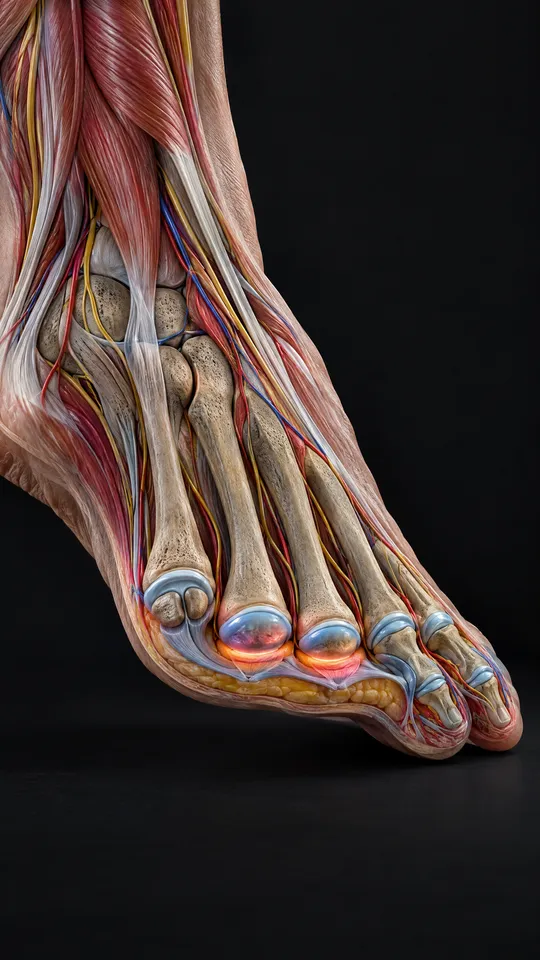
Your metatarsals are the five long bones that run through your foot to the base of your toes. Metatarsalgia is pain around the joints where they meet the toes 2, usually underneath the heads of those bones, on the sole of your foot 3.
There's a mechanical reason it lands there. As you push off at the end of each step, pressure concentrates under the second, third and fourth metatarsal heads 3. Repeat that thousands of times and the tissue carrying the load can start to complain.
The most common driver is the simplest: a sudden increase in pressure or activity, causing small amounts of tissue damage and inflammation 6. A new running program. Hard floors in a new job.
But the label covers several distinct problems. The four most common are thinning of the fat pad under the metatarsal heads, capsulitis (irritation of the joint capsule), intermetatarsal bursitis (an inflamed fluid sac between the bones) and plantar plate injury (damage to the tough ligament under the toe joint) 6. Other causes include nerve pain between the toes, stress fracture, arthritis, a high arch, claw or hammer toes and a shortened Achilles tendon 2,7.
Some cases come from your own foot's anatomy overloading one metatarsal. Others come from something else (arthritis, an old injury, altered alignment, or earlier forefoot surgery) pushing extra load onto the forefoot 3.
What it feels like is fairly consistent: sharp, stabbing, burning or tingling under the ball of the foot and into the toes, worse on your feet and easier with rest, and worse barefoot on hard surfaces 6. A callus can form under the metatarsal heads, and the joints are usually tender to press 7. But don't try to diagnose the cause yourself 1: that's what an assessment is for.
Because metatarsalgia is an umbrella term 2,6, several of these conditions are both a cause of it and something it gets mistaken for. A few patterns are distinct. Nerve pain is sharp, burning or shooting near the toes, and often feels like a lump or a small stone underfoot 1. That points towards Morton's neuroma, a nerve problem, not a loading one. Bursitis tends to bring redness, swelling and a duller ache 1. A bunion is a hard, bony lump near the big toe 1. A stress fracture is a problem in the bone itself rather than the soft tissue around it 2, and it's managed differently enough to have its own page.
You can't reliably separate these by where it hurts alone. Not sure which fits? Start from the Foot section of our Injury Finder.
Mostly from your story and a hands-on examination 7. Because metatarsalgia is a group of conditions 6, the examination is really a hunt for which one you have. A clinician presses on the top and the underside of the joints at the base of your toes and moves each toe to find what's tender 7. Burning, numbness or tingling, or pain in the gap between two toes, points towards a nerve 7. So does pressing between and just behind the metatarsal heads and getting your usual pain back: that suggests a Morton's neuroma, a thickened nerve between the toes 3.
Tests are the exception. A joint that's warm, red and swollen needs infection or an inflammatory arthritis ruled out, which can mean blood tests or an ultrasound 7.
Recovery follows the same order: settle the flare-up, find the driver, then rebuild your tolerance for standing, walking and running step by step.
Hands-on work can help settle a painful, stiff forefoot. But none of the research behind this page tests massage or manual therapy for metatarsalgia specifically. We use it for comfort and to support the loading work, not as the fix.
Here the evidence gets awkward. A metatarsal pad can reduce pressure under painful metatarsal heads by spreading it over a larger area, ideally placed just behind the metatarsal head 3. But in a randomised trial of recreational runners, a ready-made metatarsal-pad insole produced no significant drop in forefoot peak pressure compared with no insole, while forefoot cushioning did, and was more comfortable 5. A meta-analysis found custom-made orthoses clearly beat doing nothing, but were no more effective than standard footwear, off-the-shelf orthoses or a simple metatarsal dome 4. Caveats both ways: the running trial studied people with no symptoms and normal arches 5, and both studies measured pressure, not pain 4,5. The clinical evidence for these options is still thin overall 3. So cushioning is a sensible first step, and custom orthotics aren't the guaranteed upgrade they're often sold as.
If stubborn pain doesn't respond, a GP or surgeon may discuss these: both sit outside what a physiotherapist does. Standard care starts with the basics and self-help 6.
Metatarsalgia is a label for several different problems 6, so The Well Motion Recovery Path™ starts by working out which one is yours. You move up a phase on what your foot tolerates, not on a date.
How long it usually takes. No source behind this page gives a healing time; it depends on the underlying problem 6. The NHS says to get assessed if two weeks of home care have not helped 1. NHS inform sets that checkpoint at 6 weeks 9. In one surgical case series, patients had 6 months of non-surgical treatment before an operation 10. That is one hospital's practice, not a forecast.
None of these has been trialled as prevention for metatarsalgia. Each one goes after something known to load the ball of the foot:
Book an assessment if any of these apply 1:
Some things need assessing the same day rather than an appointment next week 1: severe pain, being unable to walk, a foot that has changed shape, a snap, grind or pop at the moment of injury, or feeling faint from the pain. Those can point to a fracture. Call us. A hot, swollen, painful foot, especially if you also feel hot, cold or shivery, can point to an infection and needs a doctor the same day.
For most people, none of that applies. Metatarsalgia is usually a loading problem, and it tends to respond once the real driver is found rather than padded over.
We start by listening: how it began, what makes it worse, and what it's stopping you from doing. Then we examine the area, explain what we find in plain English, and agree a plan with you. Your first visit is 40 minutes at Engadine and 30 minutes at our other clinics.
We see patients at Engadine, Mount Annan, Narellan and Appin, and at home through our mobile physiotherapy service. If you have private health cover, here's how health fund rebates work for physiotherapy.
Gentle movement, yes. Long walks, not while it's sore. Avoid standing or walking for long periods, while keeping up gentle foot and ankle stretches 1. Pain that increases with weight-bearing and eases with rest is the classic pattern 6, so your foot is already telling you where the line is.
Plenty of room across the front of the foot, a low heel and a soft sole 1. Ill-fitting and high-heeled shoes are a common cause of forefoot problems 3. Beyond that, the research is less decisive than the marketing: forefoot cushioning beat a metatarsal-pad insole in one trial 5, and custom orthoses did no better than standard footwear in a meta-analysis 4. Start with a roomy, soft-soled shoe before spending on inserts.
We won't give you a number, because none of the research behind this page gives one. It depends on which underlying condition is driving it 2,6, and whether the load causing it changes. The clear marker is when to stop waiting: if it hasn't improved after two weeks of home treatment, get it assessed 1.
Usually because the treatment is aimed at the label, not the cause. Metatarsalgia covers several different conditions 2,6, and the research is direct: find the causal factor and solve that 3. Structural drivers such as a long second metatarsal or a high arch won't be fixed by a pad alone 3. If it's worsening, recurring, or unchanged after two weeks, have it looked at 1.
It may help how your foot feels, but none of the six sources behind this page tests massage for metatarsalgia specifically. We treat it as useful for comfort, not as the fix. What changes the picture is finding the driver and sorting out load and footwear around it 1,3.
Sharp heel pain that's at its worst on your first few steps out of bed, settles once you get moving, then comes back after sitting or a long day on your feet.
Read morePain, swelling or bruising across the middle of your foot after a fall, an awkward landing or a twist, and a midfoot that still doesn't want to take your weight.
Read moreHeel pain in an active, growing child, usually somewhere between 8 and 14, turning up after footy or athletics training.
Read moreIt's a thickening of the tissue around one of the nerves between your toes, after that nerve has been irritated or damaged.
Read moreTurf toe is the sporting name for a sprain of the big toe joint: the structures underneath get overstretched or torn when the toe is forced upwards.
Read moreA stress fracture is a fine crack in a bone from repeated loading without enough recovery between efforts, not a one-off injury. In the foot and lower leg it's the most common form of hairline fracture, usually from jogging or running.
Read moreCuboid syndrome is pain on the outer midfoot, thought to come from a subtle disruption of the joint between the cuboid (a small bone on the outside of your foot) and your heel bone. The exact mechanism hasn't been worked out.
Read moreTarsal tunnel syndrome is compression of the tibial nerve as it runs behind your inner ankle, under a band of tissue called the flexor retinaculum.
Read moreA heel spur (calcaneal spur) is a small outgrowth of bone on the heel bone. It can form on the underside or at the back.
Read moreA bunion (hallux valgus) is a bony lump at the big toe joint that forms when the big toe leans towards the other toes. Around 23% of adults have one.
Read more
How would you like to reach us?
Message us on WhatsAppFor bookings and enquiries. Please don't send medical details. Call (02) 8111 5633Request a call-back
Request sent
Thank you. We'll call you back on the number you gave us.
This is a preview, so nothing was actually sent.