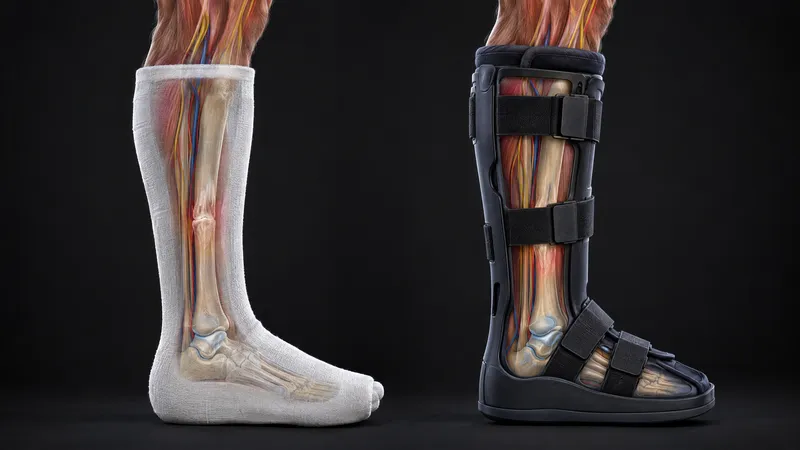
What a cast is
A cast is built directly onto your limb. Padding goes on first, then the casting material (plaster of Paris or fibreglass) is dipped in water and rolled on like a bandage until it hardens into a protective shell around the injury 1.
Because a freshly injured limb swells in the first day or so, the person applying it may cut slits in the cast, or split it lengthwise and tape it back together, so it doesn't get too tight 1. It usually stays on about six weeks, varying with your age, general health and fracture type 1,2.
Getting it off is less dramatic than people expect. A clinician uses a special saw that works by vibration rather than slicing: it breaks through the material without hurting or damaging your skin 1. The one rule that matters: never try to remove a cast yourself 1.
What a cam boot is
A cam boot (you'll also hear "moon boot" or "walking boot") is a rigid outer shell with a padded liner and adjustable straps. It's used instead of a cast for some injuries 5.
CAM stands for controlled ankle motion 6, and "controlled" is the word that matters. When researchers measured healthy adults walking in a hard-cased cam boot, it restricted ankle movement in the sagittal plane (the up-and-down motion you push off with) to under 5 degrees, an 85 per cent reduction on ordinary athletic shoes, and to around 3 degrees side-to-side 6. The ankle's share of the limb's work while walking dropped from 38 per cent to 13 per cent, with the hips and knees on both legs picking up the difference 6.
A note on what that study was and wasn't: 17 healthy participants, one boot model. It tells you what the device does to a normal leg, not how a healing fracture behaves. But it answers what most people are really asking: whether the boot lets you walk normally. It doesn't, and isn't meant to.
Living with one, day to day
This is where the two diverge most, and it's what shapes your week.
| Fibreglass or plaster cast | Cam boot | |
|---|---|---|
| Comes off? | No. A clinician removes it with a vibrating saw 1 | Yes, within your treating team's instructions |
| Showering | Must stay dry. Cover it with one or two plastic bags sealed with a rubber band or tape 1,2 | Comes off. One trial put the bathing care burden 32 per cent lower in the boot group 4 |
| Walking on it | Don't walk directly on a foot cast 1. Use crutches instead 2 | Weight-bearing is set by your doctor 5 |
| Ankle movement | None at the immobilised joint | Restricted, not abolished: under 5 degrees of sagittal movement in one study 6 |
| Adjusting for swelling | A clinician may slit or split it and tape it 1 | Adjustable by design |
| Typical duration | About six weeks, varying with age, health and fracture type 1,2 | Set by your treating team 10 |
| Itching | Don't poke anything down it to scratch 1,2 | Liner is accessible |
Two things the research adds that most people aren't warned about. The first is a measurable care burden with a cast: in a trial of young children in above-knee plaster versus a cam boot, caregivers reported personal care was significantly harder with the cast at every check: day two, day seven to ten, and the four-week review 7.
The second is leg length. A cam boot makes one leg effectively longer than the other, which throws your balance off and can nag at your knees, hips and back. A randomised trial of 95 people weight-bearing in a cam boot found that adding a levelling orthotic to the other shoe meaningfully improved how steady they felt 9. Worth asking your treating team about.
So is a boot better than a cast?
This is what everybody wants answered. It depends, and the research contradicts itself more than you'd expect.
What favours the boot. A 2025 meta-analysis pooling 11 studies and 1,485 ankle-fracture patients found removable braces produced better function than casts in both the early and mid-term periods, and a significantly lower risk of deep vein thrombosis 3. A randomised trial in young children found a boot was no worse than a cast for pain at four weeks, and that 77 per cent of those children returned to usual activities "almost all of the time" against 41 per cent in casts 4. An Australian trial found the same: 77.5 per cent of children in cam boots were weight-bearing by day seven to ten against 53.8 per cent in above-knee plaster, with no difference in healing 7.
What favours the cast. The same meta-analysis found removable braces caused significantly more wound breakdown and significantly more wound infections 3, the clearest complication signal in the adult data. The paediatric trial saw a similar shape: 72 per cent of children in boots had some skin complication against 50 per cent in casts, including five early-stage pressure sores against one 4.
And then the evidence stops agreeing. That paediatric skin difference was described by its own authors as clinically relevant but not statistically significant 4. The Australian trial found no difference at all in pressure injuries 7. A trial of children with low-energy lateral ankle injuries found fewer complications with a cam boot than a walking cast 8. The meta-analysis's own early-function advantage had a confidence interval touching zero, so it wasn't clearly significant either, and its authors were candid that the field is divided, with two prior meta-analyses disagreeing on complications, one reporting roughly three times more wound complications in brace groups 3.
One caveat: three of the four trials that make boots look good on liveability studied children 4,7,8. The main adult evidence is the meta-analysis 3, and that's where the wound-complication signal is strongest.
So a boot generally buys earlier movement and an easier few weeks, possibly at some cost to skin integrity, though how much is unsettled. Anyone telling you a boot is simply better is going further than the evidence does.
Why you got one and not the other
Almost always, it comes down to how stable the fracture is and whether the bone ends have moved out of position.
Fractures that haven't displaced can often be managed in a short leg cast or a walking boot 5. The traditional approach is a below-knee cast for four to six weeks 3. Weight-bearing varies: some people are asked to keep weight off the ankle for several weeks, while many stable fractures of the outer ankle bone can take weight 5. The removable option tends to get chosen when the plan calls for movement sooner, because it allows the ankle to start moving earlier 3.
To be clear about our role: Well Motion doesn't decide this. Which device you're in, how long you're in it and how much weight you can put through it are decisions for your treating doctor or orthopaedic team. If you're unsure why, that's a fair question to ask them.
Why the choice matters for what comes next
The device is only the opening stage of a longer program.
Whichever one you've been in, the limb underneath has been resting. When immobilisation ends, some stiffness and weakness is expected, and physiotherapy is often needed to get range, strength and balance back 2. The bone is also still healing; take care of it for at least another month 2.
This is where the choice matters. A removable boot opens a window for earlier ankle movement 3, so some rehabilitation can begin while you're still in it. A cast doesn't offer that window, so more of the work sits on the other side of removal.
We've written up what that recovery involves, stage by stage, on our fracture clinic page. Read that if you're out of your cast or boot and nobody has given you a plan. If your fracture was managed with an operation, post-surgical rehabilitation is the closer fit.
When to get it checked properly
Most of the time, a cast or boot is uncomfortable, annoying and entirely fine. Some things, though, warrant a phone call rather than waiting it out. Call us if you notice 1:
- Swelling, tingling, numbness or loss of movement in your fingers or toes
- Burning, stinging, pins and needles, or pain that keeps going under the cast
- A cast that has cracked, softened, or feels too tight or too loose
- Blisters, a rash, or raw skin
Go to your doctor, or to an emergency department, for a fever, fingers or toes that feel very cold or turn white or blue, or a bad smell coming from inside the cast 1.
In a boot, add one more: a boot that's rubbing or has started to feel too loose 10. And in a lower-limb cast, moving your toes often and keeping the limb raised, especially over the first 48 hours, helps keep the circulation moving 2.
None of that is a reason to be anxious. It just helps to know which sensations mean "normal and irritating" and which mean "get it looked at today."
FAQs
What is a cam boot?
A removable walking boot with a rigid outer shell, a padded liner and adjustable straps, used instead of a cast for some injuries 5. CAM stands for controlled ankle motion 6: it limits movement at the ankle while still letting you get about, rather than locking the joint as a cast does.
Is a walking boot better than a cast?
It depends, and the trade-off is real. Pooled data from 11 studies and 1,485 ankle-fracture patients found removable braces gave better early and mid-term function and less deep vein thrombosis, but significantly more wound breakdown and infection 3. Other trials point the other way: no difference in pressure injuries in one 7, fewer complications with a boot in another 8. The literature disagrees with itself 3, so only your treating team can settle it for your fracture.
Why did I get a boot instead of a cast?
Usually because of how stable your fracture is and whether the bone has shifted. Undisplaced fractures can often be managed in either a short leg cast or a walking boot, and whether you keep weight off the ankle for several weeks or can stand on it depends on the fracture 5. The removable option tends to be chosen when starting movement sooner is part of the plan 3.
Can you walk normally in a cam boot?
No, and it isn't designed to let you. Measured in healthy adults, a hard-cased cam boot cut ankle movement to under 5 degrees in the sagittal plane (an 85 per cent reduction on normal footwear) and dropped the ankle's contribution to the limb's work from 38 per cent to 13 per cent, with the hips and knees on both legs compensating 6. It also makes one leg longer than the other, which affects balance 9. How much you're allowed to walk is a separate question, set by your doctor.
How many hours a day should you wear a cam boot?
There's no general number, and we won't invent one. Wear time depends on the fracture, how stable it is and what stage of healing you're at, and it changes as you progress. Follow your treating team's instruction over anything you read online, including this page.
Should I sleep with the cam boot on?
Also a treating-team instruction rather than a general rule, and it differs depending on how stable your fracture is. Notice the contrast, though: it's a question you can only ask because you're in a boot. A cast can't be removed at all 1.
How do you shower with a walking boot?
This is where the two differ most. A cast has to stay dry, and the standard advice is to cover it with one or two plastic bags sealed at the top with a rubber band or tape 1,2. A boot comes off, and one trial measured the bathing care burden 32 per cent lower in the boot group 4. Check with your treating team about when you can remove it, then wash normally.
How long does it take to transition from a walking boot to a normal shoe?
There's no reliable general timeline, so here's what is documented instead. A broken ankle usually takes six to eight weeks to heal, though it can take longer 10, and casts typically stay on about six weeks 1,2. The part people underestimate is what follows: the bone is still healing and needs care for at least another month, and stiffness and weakness are expected, with physiotherapy often needed 2. Getting back into a shoe isn't the finish line; it's where rehabilitation starts.
I took off my walking boot too early. What should I do?
Contact your treating team and tell them, rather than waiting for your next appointment. We're not going to reassure you it's fine, because that depends on your fracture and how far along it is. What should prompt a same-day call regardless: worsening or persistent pain, numbness, tingling or burning, toes that go cold, pale or blue, skin that's blistered or raw 1, or a boot rubbing or feeling too loose 10.