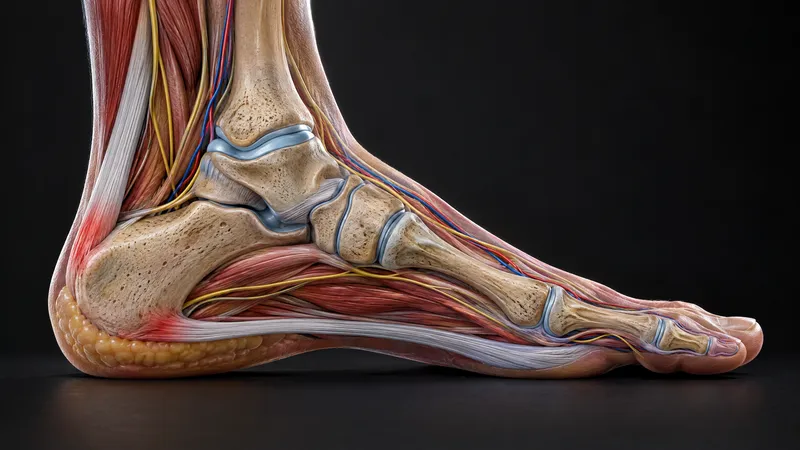
Start with where it hurts
Before anything else, put a finger on the sore spot. It does more diagnostic work than any symptom list.
| Where it hurts | Most likely | What it feels like |
|---|---|---|
| Underneath the heel, toward the arch | Plantar fasciitis | Worst on your first steps in the morning, easing after a few minutes of walking 1 |
| The back of the heel, where the tendon attaches | Achilles insertional tendinopathy | Stiff and sore at the back, often worse with shoes that press on it 1 |
| Deep in the centre of the heel pad, worse barefoot on hard floors | Heel fat pad problems | A bruised, aching feeling under the bone rather than a sharp pull 7 |
| The back of the heel, in a child aged roughly 8 to 16 | Sever's disease | Sore during and after sport, often settling with a few days off 1,2 |
That's the shortcut. Here's what's behind each one.
Plantar fasciitis: the common one, by a distance
Your plantar fascia is the thick band of tissue running from your heel bone to your toes. When it gets irritated, the pain sits underneath the heel.
It's the most common foot condition treated by health care providers 8, with a peak between 40 and 60 years of age 3. It accounts for roughly 15% of adult foot complaints needing professional care and about 8% of running injuries 8, and in around a third of people it turns up in both feet at once 4.
The giveaway is the morning pattern. Pain may be worse when you first get out of bed, then usually eases after a few minutes of walking 1, and comes back after you've been sitting, or after a long day standing.
A note on the name, because you'll see both: the condition is also called plantar heel pain 9, since "-itis" implies an inflammation that isn't always the main story 4.
If this is the pattern you recognise, our plantar fasciitis page goes much deeper: what changes the load on that tissue, what the loading research shows, and what a program looks like week to week.
Achilles insertional tendinopathy: the back of the heel
Move your finger to the back of the heel, where the Achilles tendon anchors onto the bone, and you're in different territory. Achilles tendinitis is one of the three most common causes of heel pain 1, and the version that hurts right at the attachment point is called insertional, as opposed to the type that sits a few centimetres higher up in the tendon itself.
That distinction matters more than it sounds, because the insertional kind is harder to treat. Loading the tendon (progressive strength work, usually starting with eccentric exercise) is still the first-line approach. But the research is unusually blunt about its limits: insertional Achilles tendinopathy is typically treated with eccentric exercises "despite the absence of satisfactory and sustained results" 5. It's the right starting point. It isn't a guaranteed fix, and anyone promising you one isn't reading the same literature.
What about shockwave? We offer shockwave therapy, and we'd rather you heard this from us. A 2021 randomised trial put 119 people with insertional Achilles tendinopathy through eccentric exercise plus either real shockwave or a sham. At 24 weeks there was no difference between the groups on any outcome measure 5. The secondary results pulled in both directions: the shockwave group had a higher failure rate but a lower recurrence rate, which is another way of saying the picture isn't settled. For this specific problem, shockwave has not been shown to add anything to loading, and we won't present it as though it has.
More on the tendon itself, including the non-insertional version, on our Achilles tendinopathy page.
Heel spurs: usually an innocent bystander
This is the one that causes the most unnecessary worry, so we'll be direct.
A heel spur is a bony growth on the heel bone. If an X-ray has found one, the natural assumption is that the pointy thing is what's stabbing you. It usually isn't. An estimated one in ten Australians have heel spurs with no symptoms whatsoever; the spur itself does not cause the pain, though pain may be associated with inflammation in the area 2.
So a spur on a scan doesn't change the plan much. What's irritated, and why, is still the question to answer. We've written more on heel spurs separately.
Heel fat pad problems: the cushion, not the ligament
Under your heel bone sits a specialised pad of fat, built to absorb load every time your foot lands. It can thin out or lose its shock-absorbing quality with age, high mileage, or repeated impact, and when it does, the pain is different in character. It tends to feel deep and bruised in the middle of the heel, not like the sharp pull of the fascia, and it's noticeably worse barefoot on hard surfaces.
In the clinical literature, fat pad atrophy is described as the second cause of heel pain after plantar fasciitis 7. Take that ordering as a clinical impression, not a population statistic: it comes from a nine-patient case series, not an epidemiological study. The same paper flags another one worth ruling out: entrapment of Baxter's nerve, a small nerve branch in the foot that can mimic fascia pain 7.
One cause is avoidable. Corticosteroid injections do relieve heel pain temporarily, but they may increase the risk of both plantar fascia rupture and fat pad atrophy 4. That's a real trade-off found in the literature, and it's a conversation for the doctor offering it; injections sit outside what physiotherapists prescribe or administer, so it's not something we'd be doing either way.
We don't have a dedicated page for fat pad problems yet. If this is what your heel sounds like, it's worth having someone put hands on it instead of reading further.
Sever's disease: the one in growing kids
If you're the parent reading this, this is your section.
Sever's disease is the most common cause of heel pain in children aged eight to 16 2, and the reason it exists at all is growth. There's an active growth plate at the back of the heel bone, and in a growing child it's the weakest link in that chain. Running and jumping put repeated stress through it, and it gets sore 2.
It's strongly tied to sport (soccer, Australian football and basketball come up repeatedly in the research 6), which is why it tends to show up mid-season, not out of nowhere. Boys between roughly eight and 13 are listed among the higher-risk groups 2.
The reassuring part is that it responds to conservative treatment. A 2024 systematic review pulled together eight randomised studies of non-surgical management (insoles, therapeutic exercise, taping, foot orthoses) and concluded that conservative treatment is an effective option for relieving the symptoms 6. But that evidence base is small and uneven. Of those eight studies, only four were at low risk of bias, three were at high risk, and one raised some concern 6. It points clearly in one direction; it just isn't a large, settled body of work.
Practically, management usually means rest from the aggravating activity, ice, calf stretching and heel lifts 2, along with load management, not a season written off. Our Sever's disease page covers it properly, and it's the kind of thing our paediatric physiotherapy team sees regularly.
One thing that helps every parent who asks: it's self-limiting. The growth plate closes, and when it does, this stops.
What actually helps, whatever the cause
Some of the first-line management overlaps regardless of which cause you're dealing with. The standard starting list for heel pain includes ice, supportive footwear or orthoses, changing the activities that aggravate it, strengthening work for the foot and calf, managing body weight where that's a factor, and night splints or strapping 1.
Two things to know before you start.
The timeline is longer than you want it to be. Non-operative treatment resolves pain completely in about 90% of people 4. Those are good odds, and the reason surgery is rarely the answer. But the same source puts the usual timeframe at three to six months 4. Most people quit at week four because nothing's changed yet. Week four isn't the verdict.
"Rest" isn't a plan on its own. Stopping what hurts settles things down; it doesn't build the tissue's capacity back up. What changes the outcome is the graded return afterwards, which is the part that's hard to get right alone, and the part physiotherapists and podiatrists exist for 1. Physiotherapy's own professional body revised its clinical practice guideline for heel pain in 2023 3, which is where the profession's current treatment framing comes from.
When to get it checked properly
Most heel pain is one of the causes above and is not dangerous. A few situations are different.
- Sudden pain in your calf or heel while exercising: call us the same day. That can be a ruptured Achilles tendon, and it's the one on this list that can't wait 1.
- Heel pain with fever, redness or heat, or that's rapidly worsening: bone and joint infections are uncommon but need ruling out 1.
- Pain that came on after a specific impact, or that's severe enough to stop you weight-bearing: a stress fracture of the heel bone behaves differently to a soft-tissue problem 1.
- Numbness, pins and needles or burning instead of a mechanical ache: nerve-related causes like tarsal tunnel syndrome present that way 1.
- Heel pain alongside pain in other joints: inflammatory arthritis can involve the heel, and that changes the whole plan 1.
- Nothing has shifted after a few weeks of sensible self-management: that's not a failure, it's the point at which a proper assessment saves you months.
None of those means something is badly wrong. They mean the question is bigger than a stretch, and somebody should look at it.
FAQs
What could be causing pain in my heels in the morning?
Most often plantar fasciitis. The classic pattern is pain that may be worse when you first get out of bed and then usually eases after a few minutes of walking 1, with tenderness you can find by pressing on the inside of the heel bone 4. It happens because the fascia shortens overnight and then gets loaded all at once when you stand. If the morning pain is at the back of the heel, not underneath, that points toward the Achilles instead.
How do I help my heels from hurting at home?
Start with the basics that apply across most causes: ice, supportive or cushioned footwear, heel pads or orthoses, easing off the activity that aggravates it, calf and foot strengthening, and strapping or night splints 1,2. Managing body weight is on the list too where it's a factor 1. Give it a proper run: the realistic timeline for heel pain to resolve without surgery is three to six months 4, and most people stop far too early to find out whether it was working.
What diseases start with heel pain?
Beyond the mechanical causes, heel pain can be a feature of several other conditions: arthritis, bursitis, a stress fracture of the heel bone, tarsal tunnel syndrome, and rarely a bone infection (osteomyelitis) 1. Diabetes and arthritis are both listed as disorders that can contribute to heel pain 2. That list sounds alarming and mostly isn't: these are the possibilities a clinician rules out, not the likely answer. The practical version is the red-flag list above: heel pain with fever, rapid worsening, numbness, or pain in other joints is worth a doctor's look.
Is heel pain a symptom of diabetes?
Diabetes is named among the disorders that can contribute to heel pain 2, so it isn't unrelated, but heel pain on its own is a poor reason to conclude anything about it. If you have diabetes, foot problems do need closer attention than they otherwise would, and that's a conversation for your GP, not us. If you don't, plantar fasciitis remains far and away the more likely explanation for a sore heel.