Taping and bracing.
Taping to realign the kneecap and unload soft tissues can reduce pain, and there's evidence supporting knee braces too 7. Short-term support alongside the strength work, not instead of it.
The x-ray came back with words like "degenerative change" and "wear and tear", and you left with the impression the knee is simply wearing out, nothing much to do until it's bad enough to replace. Stairs are where you notice it. So is getting going after sitting.
That impression is worth arguing with, and Australia's own clinical care standard argues with it directly: exercise is safe for your knee even if your osteoarthritis is severe, and nine in ten people manage without needing joint replacement surgery 1.
"Wear and tear" suggests a simple story: you used the joint, it wore out. The real answer is less tidy. The exact cause isn't known. It's a complex disorder with many contributing factors: age, family history, being female, extra weight, previous joint injuries and physically demanding work 8. Prevalence does climb with age, from around 10% of people aged 45 to 54 to 30% of those aged 75 and over 4. But it isn't just a disease of ageing 5.
What matters most for treatment is that how bad a knee looks and how bad it feels are poorly related. Pain varies a lot between people and often doesn't correlate with the change seen on x-rays 5. Imaging isn't routinely used to diagnose knee osteoarthritis at all: substantial pain can come with only minor structural changes, while minimal symptoms can accompany more notable ones 1.
So the picture on the film isn't your prognosis. What your knee can do, and what sets it off, is more useful information, and unlike the x-ray, it's changeable.
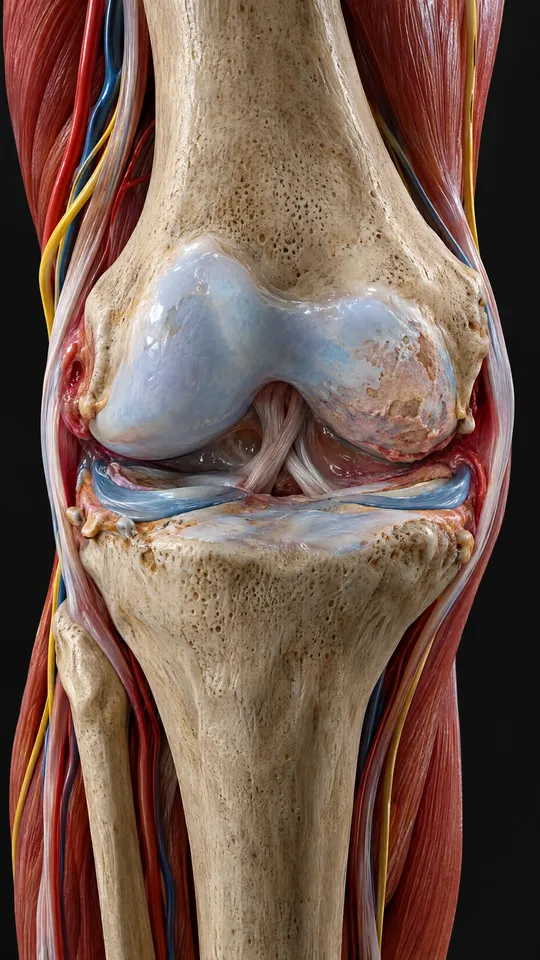
Often it isn't either/or. Degenerative meniscal tears are common in osteoarthritic knees whether or not there are symptoms 1, so a scan reporting a meniscus tear alongside arthritic change is usually part of the same picture, not a separate problem needing its own operation.
Two other patterns are worth telling apart. Pain at the front of the knee, around the kneecap, worst on stairs and after long sitting, fits patellofemoral pain syndrome. Pain on the outside of the knee that builds through a run and settles with rest fits ITB syndrome. Neither is arthritis; both are managed differently.
If your symptoms and examination are typical, knee osteoarthritis can be diagnosed without a scan or any other test 1. Your clinician takes a detailed history of your pain, stiffness and movement, and asks how the knee affects your work, daily tasks and the things you care about 1. Then they examine the knee and watch you walk, checking movement, joint-line tenderness, alignment, swelling, and crepitus, the grating feeling a joint can make 1.
More tests are for things that don't fit: an old injury to the knee, morning stiffness that drags on, symptoms getting worse quickly, a hot swollen joint, or pain that might be coming from the hip or spine 1. A doctor might also order tests if it isn't clear which type of arthritis you have 8.
Does the exercise actually work? Here's the honest version. Across 139 trials and 12,468 people, exercise probably improves pain, function and quality of life in the short term, but the authors concluded those benefits were "of uncertain clinical importance", on low-to-moderate certainty evidence from trials mostly at unclear or high risk of bias 2. A separate trial of 377 adults found high-intensity strength training was no better than lighter training or a control group at 18 months 3, though reassuringly, the heavy loading didn't increase compressive force through the knee 3.
That's not an argument for doing nothing. It's an argument against anyone selling you a magic technique. No exercise type has been shown to outperform another, and benefit doesn't track the number of sessions prescribed 2,7. What's left is individualising the program to your knee and your life, and helping you keep it going, and we'd rather be straight about that.
Taping to realign the kneecap and unload soft tissues can reduce pain, and there's evidence supporting knee braces too 7. Short-term support alongside the strength work, not instead of it.
May be beneficial, but the evidence explicitly says it shouldn't be used as a stand-alone treatment 7. We use it to make the exercise easier, not as the treatment itself.
Lab studies show they reduce load through the knee, but clinical trials don't support a symptomatic benefit 7. Worth knowing before buying a pair.
A valid option alongside land-based activity 1; appropriate exercise spans strength, stretching, aerobic and balance work 5.
People who are overweight or obese are strongly encouraged to lose weight, and should be supported in doing so 5. That support belongs with your GP or dietitian, not a physiotherapist.
Medication has a real place in osteoarthritis care 1,5, prescribed and managed by your doctor, never by us.
Arthroscopic procedures (including debridement and partial meniscectomy) shouldn't be offered for uncomplicated knee osteoarthritis: they provide little or no clinically significant benefit 1. Joint replacement is a separate question for you and your surgeon; if it's on the table, being physically active beforehand can improve your recovery 1, which is what prehabilitation and post-surgical rehabilitation are for.
Knee osteoarthritis is managed, not healed, so on The Well Motion Recovery Path™ the phases track what your knee can do. You move up when it copes with more, not when a date arrives.
How long it usually takes. There's no cure 8, so there is no healing date. In a review of 12 trials, large improvements in pain and function were most often seen with strength programs lasting 8 to 12 weeks 12. The benefits measured in trials are short term 2, which is why the exercise carries on after you finish with us.
Flares aren't random: a 13-week study of 744 adults found 13 things that made one more likely over the next day 9. Nobody has yet tested whether steering around them prevents flares, but they show where to look:
None of that describes most arthritic knees. Usually the answer isn't a scan or a specialist; it's a program pitched correctly for the knee you've got today.
We start by listening: how it began, what makes it worse, and what it's stopping you from doing. Then we examine the area, explain what we find in plain English, and agree a plan with you. Your first visit is 40 minutes at Engadine and 30 minutes at our other clinics.
We see patients at Engadine, Mount Annan, Narellan and Appin, and at home through our mobile physiotherapy service. If you have private health cover, here's how health fund rebates work for physiotherapy.
The evidence-backed "don'ts" aren't the ones most people expect. Avoiding activity out of fear is one: exercise is safe even with severe osteoarthritis, and some discomfort while exercising doesn't mean you're damaging the joint 1. Chasing imaging to explain the pain is another: it isn't routinely used to diagnose knee osteoarthritis, and pain correlates poorly with what shows up 1,5. Arthroscopic surgery is a third, with little or no clinically significant benefit 1. The real stop-signals are narrower: excessive pain, or a more swollen joint the next day 6.
Yes. Exercise is safe even if your osteoarthritis is severe, it can be adjusted to your pain, and even a small amount is better than none 1. Appropriate exercise includes aerobic activity alongside strength, stretching and balance work 5. If walking flares the knee for days, adjust the distance or surface rather than stopping.
No, there's no cure for osteoarthritis. But many people manage their symptoms well 8, and nine in ten manage without needing joint replacement surgery 1. We'd rather give you that answer straight than promise a reversal nobody can deliver.
Best defined by what the knee does to your life, not by a grade on an x-ray. Pain correlates poorly with the joint change seen on imaging 5, which isn't routinely used to diagnose the condition anyway 1. Modest changes on film can come with substantial pain, and more notable changes with minimal symptoms 1. What matters is how far you walk, how stairs feel, and whether sleep is affected.
The one you'll actually keep doing. No exercise type has been shown to outperform another for knee osteoarthritis 2,7. What the Australian program used in general practice sets is a dose, not a winner: at least three times a week, hard enough to feel "hard" or "very hard" 6. Consistency matters more than the specifics.
A bad stretch isn't proof of rapid structural decline. Pain varies a lot between people and often doesn't track the change in the joint 5, so a flare can be severe without the knee having deteriorated underneath. The known risk factors 8 describe who develops osteoarthritis, not how fast anyone's will move. No source we'd stand behind gives reliable individual progression rates, so if someone's quoted you a timeline, ask what it's based on.
A twist or sudden change of direction, often with a pop at the time, and a knee that hasn't felt trustworthy since.
Read morePain on the outside of the knee that builds through a run, settles with rest, then comes straight back on the next one.
Read moreAn ache at the front, around or behind the kneecap. Worse on stairs, on hills, and after long sitting.
Read moreCatching, locking or swelling after a twist, sometimes with a knee that won't fully straighten.
Read moreA tender, bony lump just below the kneecap in a growing, sporty teenager.
Read moreThe MCL runs down the inside of your knee. Most injuries happen when something hits the outside of the knee and forces it inwards; it's the ligament most commonly injured in knee trauma.
Read moreA bursa is a small fluid-filled sac that cushions bone from the soft tissue around it. The prepatellar bursa sits at the front of your knee, over the kneecap. When it's irritated it swells, and a tender, warm swelling right over the bursa is the classic sign.
Read moreA patellar dislocation is the kneecap being forced out of its groove at the end of the thigh bone. It almost always goes outwards, towards the outside of the knee.
Read morePatellar tendinopathy, often called jumper's knee or patellar tendonitis, is pain in the tendon just below your kneecap that builds when the tendon is overloaded.
Read moreA Baker's cyst is a build-up of fluid behind the knee, usually excess fluid from the knee joint itself.
Read more
How would you like to reach us?
Message us on WhatsAppFor bookings and enquiries. Please don't send medical details. Call (02) 8111 5633Request a call-back
Request sent
Thank you. We'll call you back on the number you gave us.
This is a preview, so nothing was actually sent.