Need urgent care? 24/7 Mobile & After-Hours Emergency Physiotherapy Call (02) 8111 5633 For life-threatening emergencies, always call 000
Thigh

Quadriceps Tendon Rupture

5.0 average rating on Google
Registered NDIS Provider
SIRA Registered Provider

You missed the last step, or landed awkwardly coming off a ladder, and your knee buckled as you tried to catch yourself. You felt a pop or a tearing sensation just above the kneecap. Now you can't straighten your knee properly, and lifting your leg off the bed feels impossible.

Get that combination checked today. Don't wait a week to see if it settles. This page explains what a quadriceps tendon rupture is, why timing matters so much, and what recovery looks like.

What's actually causing it

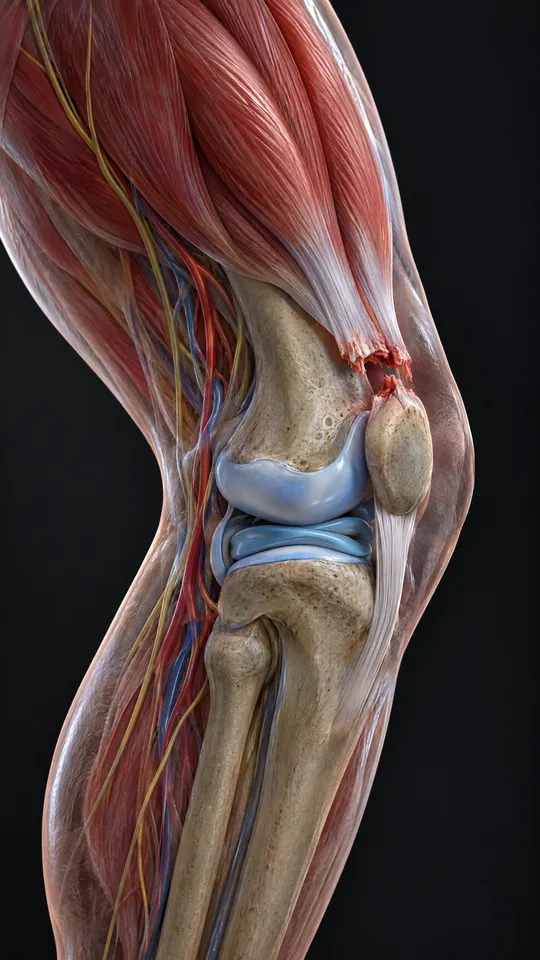
Your quadriceps are the four muscles at the front of your thigh. They join into one tendon that attaches to the top of your kneecap. That tendon is what straightens your knee every time you stand up, climb a step or land from a jump.

It usually tears when the quads are working hard to stop the knee bending any further. In other words, the muscle is contracting while it's being stretched. That's what happens when you stumble and try to catch yourself, land badly with your foot planted, or fall with the knee bent 1,5. In younger people, a direct blow to the front of the knee is a more common cause 1.

A healthy tendon is strong. About half its fibres have to be disrupted before it ruptures 1. These health factors are linked to a higher risk 1:

  • diabetes
  • chronic kidney disease or dialysis
  • obesity
  • an overactive parathyroid gland (hyperparathyroidism)
  • corticosteroid medication or steroid injections
  • fluoroquinolone antibiotics
  • previous knee replacement or ACL surgery

Tears can be partial or complete. A partial tear leaves some of the tendon intact. With a complete tear, you can't straighten your knee at all 5.

Side of the knee showing the quadriceps tendon torn just above the kneecap

Quadriceps tendon rupture or a quad strain? How to tell the difference

Both come on suddenly and hurt at the front of the thigh, so they get mixed up. The difference is where it hurts and what your knee can still do.

A tendon rupture sits right at the knee. You'll feel the pain, bruising and any dent just above the kneecap, and the kneecap itself may sag lower than usual 5. With a complete tear you can't straighten the knee yourself, and walking is difficult because the knee buckles or gives way 5.

There's a catch. Swelling can hide the gap, and some people can still manage a partial straight-leg raise. That's one reason these injuries get missed early 1. Lifting your leg a little doesn't rule a rupture out.

If the pain is higher up in the muscle itself and you can still straighten your knee, a quad strain is more likely. If you're not sure, don't guess. Get it assessed. With this injury, a week's delay matters.

How it's diagnosed

This is mostly diagnosed on examination 1. A doctor asks about earlier knee injuries and any health conditions that make a tear more likely, then tests how well you can straighten the knee. That part can hurt, but it's what separates a tendon tear from other injuries 5.

Scans back that up. A side-on X-ray may show the kneecap sitting lower than it should 5, though a normal X-ray doesn't rule a tear out 1. Ultrasound can tell a partial tear from a complete one quickly, but its accuracy depends on who's holding the probe. Many centres use MRI to confirm where the tear is and how far the tendon has pulled back, and to plan surgery 1.

How we treat it

Our first job is to recognise a likely rupture and get you to the right people quickly. Our second is to get you back on your feet afterwards.

1
Assessment and fast referral. The diagnosis is made mainly by examination. We check whether you've lost active knee straightening and whether there's a gap above the kneecap 1. If a complete rupture looks likely, we refer you urgently to your GP or an orthopaedic surgeon. Repair within about three weeks gives the best results 1, so we don't wait and see.
2
Rehab for partial tears managed without surgery. Selected partial tears in people with lower physical demands are managed with the knee braced straight for about 4 to 6 weeks, then physiotherapy 1. We guide that phase, then rebuild your knee bend and strength.
3
Post-surgical rehabilitation after a repair. Most of our work with this injury happens here. Rehab moves in phases:
  • Weeks 0 to 6. Your knee is protected in a brace and you walk on crutches. Some protocols keep the brace locked straight throughout 1. Others allow controlled bending to 100 degrees in a hinged brace from week 2, alongside gentle thigh-muscle activation 3.
  • Weeks 6 to 12. The brace is unlocked or removed 1,3. You put full weight through the leg, re-learn to walk normally and work on balance 3.
  • Month 3 onwards. Strengthening gets progressively harder 1,3.
  • Month 4 onwards. Running and jumping come back in if things are going well 3.
4
Sports physiotherapy for the return to sport. Your return depends on meeting criteria, not on the calendar. You need full range of motion 3, strength of at least 85 to 90% of your other leg 5, and to have worked through agility and sport-specific training 3. In one NHS protocol, full contact sport comes no earlier than six months, and only once those criteria are met 3.

An honest caveat. These timelines are guides, not rules. The NHS protocol is one hospital's approach, and your surgeon may progress you differently depending on your repair 3. The research on this injury is mostly small, retrospective case series, so overall evidence quality is low to moderate 1. We couldn't find strong trials comparing earlier and later movement after repair. The review's own advice is to follow an individualised, goals-based plan, not a fixed timeline 1, and that's how we work.

Other treatments we may use

Manual therapy.

Stiffness is expected after weeks with your knee braced. Hands-on work may sit alongside your exercises to help with it. That said, none of the sources behind this page test manual therapy for this injury specifically. It supports your exercise program and doesn't replace it.

PRP and stem-cell injections.

You may come across these online. They're still investigational, and no large clinical trials back them yet 1. Any injection is a conversation for your surgeon. It isn't something a physiotherapist provides.

Your recovery path: Reset, Rebuild, Return

Rehab after a quadriceps tendon rupture follows The Well Motion Recovery Path™. Your surgeon sets the early limits. After that you move up a phase when the knee is ready, not when a week number comes around.

  • Reset: from the day of the repair, or the day a partial tear is braced. The brace and crutches protect the tendon 1, and how much bend you are allowed is your surgeon's call 3. Expect a stiff knee and a thinner thigh. We move you on once your surgeon clears the brace and you can tighten the thigh muscle comfortably.
  • Rebuild: the longest phase. Post-surgical rehabilitation brings back knee bend, normal walking and balance first, then strength 3, with manual therapy alongside if stiffness is holding your exercises back. Expect the bend to return sooner than the strength. We move you on when the leg does what your daily tasks ask of it.
  • Return: stairs, ladders and work for most people, sport for some. Sports physiotherapy tests your range, your strength against the other leg and your sport-specific drills before you go back 3,5. You leave with a strength program to keep up.

How long it usually takes. Most people are back to daily activities 4 to 6 months after repair, and heavier work or sport takes 6 to 10 months 1. Those figures come from a review of mostly small case series 1, so treat them as a guide.

Reducing the risk of it happening again

Re-rupture after a repair is uncommon, at about 2 to 6% 1. No one has tested a program to prevent it, so these target what's known to weaken the tendon or the repair:

  • See the rehab through. Not sticking with rehab, or not getting enough of it, is a recognised reason for a poor result 1. The usual bar for sport is an injured leg at least 85 to 90% as strong as the other 5.
  • Stop smoking. In a study of 191 repairs, current smokers had much higher odds of complications afterwards 6.
  • Keep diabetes and kidney disease well managed. Both affect the tendon's quality and how well it heals 1. That's a conversation for your GP.
  • Mention the rupture to anyone prescribing for you. Corticosteroids, steroid injections near the tendon and fluoroquinolone antibiotics have all been linked with tendon weakening and rupture 1. Don't stop a prescribed medicine yourself.

When to get it checked properly

  • You felt a pop or tearing above the kneecap and now can't straighten your knee 5. Get it seen that day or the next, not next week.
  • You can't lift your leg straight off the bed, or you can feel a dent above the kneecap 4.
  • You can't walk on the leg properly because the knee buckles or gives way 5.
  • Your knee has suddenly gone weak and you have one of the risk factors above, such as diabetes, kidney disease or recent steroid or fluoroquinolone use 1.
  • It's been close to three weeks since a known tear and you still haven't seen a surgeon. Later repair has worse outcomes 1, so don't let it drift.

This is a serious injury, but it's a well-understood one. With a prompt diagnosis and a structured rehab plan, most people get back to the life they had.

Your first appointment

We start by listening: how it began, what makes it worse, and what it's stopping you from doing. Then we examine the area, explain what we find in plain English, and agree a plan with you. Your first visit is 40 minutes at Engadine and 30 minutes at our other clinics.

We see patients at Engadine, Mount Annan, Narellan and Appin, and at home through our mobile physiotherapy service. If you have private health cover, here's how health fund rebates work for physiotherapy.

FAQs

How serious is a ruptured quad tendon?

It's rare, but it matters. Losing the tendon means losing the ability to straighten your knee actively, which can be significantly disabling 1. Early diagnosis and repair give the best outcomes, while delayed and chronic cases do worse 1. That's why speed matters more than anything else here.

Can you walk on a ruptured quad tendon?

Often not well. Walking is difficult because the knee buckles or gives way, and with a complete tear you can't straighten the knee 5. Some people can still lift the leg a little using the surrounding tissue, which makes the injury easy to underestimate 1. After surgery, walking usually starts early on crutches with the brace locked straight 3.

How long does it take to recover from quadriceps tendon tear surgery?

Most people are back to daily activities within 4 to 6 months. Heavier physical work and sport take around 6 to 10 months 1. In one NHS protocol, the brace comes off at week 6, running starts from month 4, and full contact sport from month 6 if you meet return-to-sport criteria 3.

Can you fully recover from a quad tear?

Most people do. Early repair generally restores knee straightening and function, and a high proportion of people return to their usual activities 1. Not everyone does, though. In some case series, about 11% are left with a lag of more than 5 degrees, meaning the knee can't quite straighten fully under its own power. Re-rupture is reported in about 2 to 6% 1. We'd rather you knew that from the start.

How badly does a tendon need to be torn to require surgery?

Surgery is recommended for complete ruptures, high-grade partial tears that affect how the knee works, partial tears that haven't improved with bracing and rehab, and older, chronic ruptures 1. Partial tears where you can still straighten your knee are the ones usually managed without surgery 1. Your surgeon makes that call after examining you.

More Thigh conditions

Thigh

Quad Strain

A pulled quad: torn fibres at the front of the thigh, from sprinting, kicking or overstretching. Sore to load, and slow to trust again.

Read more
Thigh

Meralgia Paresthetica

Burning, numbness or pins and needles down the outside of the thigh, with no injury behind it: a compressed nerve, not a torn muscle.

Read more

If you think you've just ruptured your quadriceps tendon, see your GP or an emergency department promptly.

If you're recovering from a repair, or you've been told you have a partial tear, book an appointment. We'll build your rehab around your surgeon's plan and your own goals, at Engadine, Mount Annan, Narellan or Appin. If you're not sure this is your injury, start from the Thigh section of our Injury Finder.

Book an Assessment
Ahmed Elsayed, Principal Physiotherapist
Reviewed by Ahmed Elsayed Principal Physiotherapist at Well Motion

References

  1. Quzli AA, et al. Quadriceps Tendon Ruptures: A Clinical Review. Cureus, 2025. PMC12574947. https://doi.org/10.7759/cureus.95757
  2. Whitmore JA, Lele P, Lyons JG, Froehle A. Quadriceps tendon ruptures: a narrative review. Annals of Joint, 2025;10:15. https://pmc.ncbi.nlm.nih.gov/articles/PMC12082177/
  3. Patella/Quadriceps Tendon Surgical Repair Rehabilitation Guide. Robert Jones and Agnes Hunt Orthopaedic Hospital NHS Foundation Trust. https://www.rjah.nhs.uk/media/xudbge2g/patella-quadriceps-tendon-surgical-repair-rehabilitation-guide.pdf
  4. Quadriceps Tendon Rupture. StatPearls, NCBI Bookshelf. https://www.ncbi.nlm.nih.gov/books/NBK482389/
  5. American Academy of Orthopaedic Surgeons. Quadriceps Tendon Tear. OrthoInfo, 2025. https://orthoinfo.aaos.org/en/diseases--conditions/quadriceps-tendon-tear/
  6. Coladonato C, Hanna AJ, Patel NK, et al. Risk Factors Associated With Poor Outcomes After Quadriceps Tendon Repair. Orthopaedic Journal of Sports Medicine, 2024;12(2):23259671241229105. Abstract via PubMed (PMID 38379579). https://pmc.ncbi.nlm.nih.gov/articles/PMC10878232/