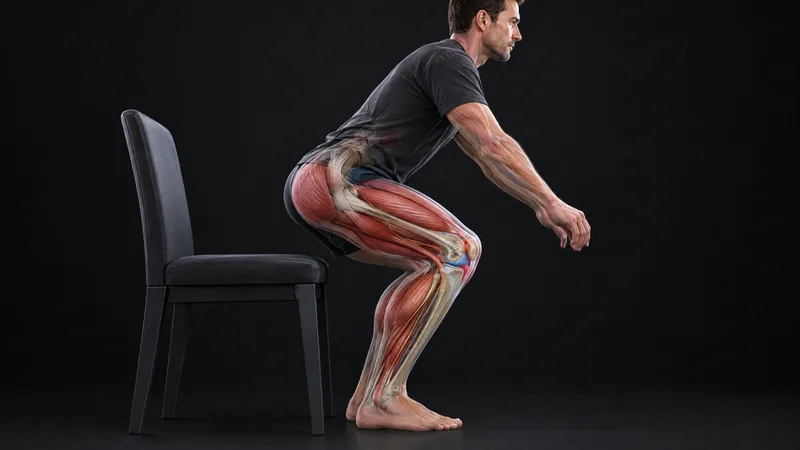
How do you make a knee stronger?
You strengthen a knee by strengthening the muscles that control it: the quadriceps at the front of the thigh, the glutes and the muscles at the side of the hip, the hamstrings and the calves. Load them at least three times a week, hard enough that the effort feels "hard" or "very hard", and move on when it starts to feel easy 5.
Stronger muscles help cushion, support and protect the joint, and make ordinary things (standing up from a chair, stairs, walking) easier 5. That's the whole mechanism. There's nothing you can do at home that rebuilds cartilage or thickens a ligament.
Which exercises? Less important than most lists suggest. When the largest review of the field compared different types of exercise against each other, it found no differences between them, and no relationship between how many sessions were prescribed and how much people improved 1. The best knee program is the one that fits your knee and that you'll still be doing in eight weeks.
One thing does change by diagnosis, though. For pain at the front of the knee, the clinical practice guideline is specific: hip- and knee-targeted exercise together, with the hip work aimed at the muscles at the side and back of the hip, not quads alone 2. That's why the routine below includes side-lying and standing hip work that looks like it has nothing to do with your knee.
Before you start
Check with your physiotherapist or doctor before starting an exercise program, warm up beforehand and cool down afterwards 4. Some discomfort during the exercises is normal, but revise the dose if the pain is excessive, or if the joint is more swollen the next day 5.
Get your knee assessed before you start any of this if you: 4
- can't move the knee, or can't put weight on it
- have a knee that locks, catches or gives way
- have severe pain, or pain that hasn't improved after a few days
Seek urgent care if the knee is badly swollen or has changed shape, if the pain followed a major injury, or if you have a fever with a knee that's red and hot 4.
The routine: a real Australian program, in three stages
The program below is the knee-strengthening resource used in Australian general practice, published by the Royal Australian College of General Practitioners. It was designed for knee osteoarthritis, and its progression logic works for most stiff, sore or deconditioned knees 5.
The rules that matter more than the exercise list 5:
- Do all your exercises at least three times a week.
- To get stronger, the exercise needs to feel "hard" or "very hard". If it felt easy, you may not be gaining strength.
- Move up a stage when the current one feels easy. Not on a date in the calendar.
- Move at a medium speed (no sudden or jerky movements) and hold each position for five seconds where the exercise calls for it.
- Standing? Have a chair, bench or wall within reach in case you lose balance, and wear shoes you won't trip in.
- Add resistance with ankle weights or an elastic band. Ask your physiotherapist what level to start at rather than guessing.
The program doesn't specify repetitions. For a reasonable default, Australian guidance for older adults suggests aiming for 10 to 15 repetitions for each major muscle group 7.
Stage one: getting started 5
- Inner-range quads over a roll. Sit with your weight supported on your arms behind you (or lie down), knee resting over a rolled towel so it's bent about 30 degrees, kneecap and toes pointing at the ceiling. Keeping the knee on the towel, straighten the leg and slowly lift the heel over two seconds. Hold it as straight as it will go for five seconds, then lower slowly.
- Bridge. Lying on the floor, lift your bottom, keeping your shoulder blades down. Hold five seconds and lower slowly.
- Seated knee extension with resistance. Sit in a firm, fairly high chair with a looped resistance band around the chair leg and just above your ankle. Straighten the knee to about two-thirds straight, hold five seconds, lower slowly.
Stage two: building 5
- Sit-to-stand, without using your hands. Chair against a wall. Lean forward over your toes, and as your buttocks lift, bring your hips under you and straighten up. Sit back down slowly. Make it harder with a lower chair, or by holding three seconds with your buttocks just off the seat.
- Standing side leg raises. Holding a chair or wall, keep your hips and shoulders facing forward and lift the sore leg out sideways, leading with the heel. Don't let it swing forward or turn out. That sends the work to the wrong muscles. Hold five seconds, lower slowly. This is the hip work the patellofemoral guideline asks for 2.
- Single-leg bridge. Either keep the hips level as you lift one leg from a normal bridge, or lift the leg first and then the hips.
Stage three: the full program 5
- Step-ups and step-downs, with a handrail or chair back for balance, keeping your weight through the sore leg and your knee tracking over your foot.
- Crab walk with a resistance band looped around both thighs just above the knees. Knees slightly bent, feet pointing forward, step sideways against the band without twisting.
- Calf raises. Rise slowly onto your toes, hold five seconds, lower slowly. Progress to one leg, then off the edge of a step.
- Wall slide. Back against a wall, feet about 30 cm out, slide down as if to sit, keeping your knees over your toes. Stop at about 60 degrees of knee bend, or less if it's painful.
The mistake that makes a sore knee worse
We can't tell you the "#1 mistake": nobody has ranked them. But the one we see most often is running a generic knee routine on a knee whose problem nobody has identified yet.
It matters because the right program differs from knee to knee. Kneecap pain needs hip work as well as quads 2. A degenerative meniscal tear needs a properly graded program: the trial that put exercise on equal footing with surgery used 16 supervised sessions, not a printout 3. And some knees shouldn't be loaded at all until they've been looked at 4.
Start with whichever of these sounds most like yours:
Pain around or behind the kneecap, worse on stairs and after long sitting
patellofemoral pain syndrome. This is the one where the hip work isn't optional 2.
Sharp pain on the outside of the knee that switches on at a predictable point in a run
Catching, locking or swelling after a twist, or a scan reporting a "meniscal tear"
A twist or awkward landing, possibly a pop, and a knee that hasn't felt trustworthy since
A tender, bony lump just below the kneecap in a growing, sporty teenager
Morning stiffness and an ache after activity, building over years, often after being told it's "wear and tear"
One caution on the meniscus point. In 321 people aged 45 to 70 with a degenerative tear, exercise-based physiotherapy was noninferior to keyhole surgery for knee function at five years, with comparable arthritis progression on x-ray 3. Surgery was very slightly better on the numbers (3.5 points on a 100-point scale) but nowhere near the difference the researchers had set as clinically meaningful 3. That finding is about degenerative tears in middle-aged and older knees. It says nothing about a young athlete with a locked knee after a twisting injury, and it isn't a reason to delay getting that assessed 4.
If none of the six above fits, start from the knee section of our Injury Finder instead.
Do walking and cycling count?
They count for a lot, just not as strengthening. Walking, cycling and swimming are low-impact ways to improve your general fitness and keep the joint moving; strengthening comes from resistance work with weights or bands 4. If your goal is a stronger knee, a daily walk won't get you there on its own, and that's not a failure of effort.
While we're correcting things: you can't strengthen cartilage. What you can strengthen is the muscle around the joint, which helps cushion and protect it 5. Any program promising to rebuild cartilage through exercise is promising something the evidence doesn't support.
How long before it works?
Most research programs run roughly 8 to 12 weeks. The meniscus trial used 16 supervised sessions 3; the exercise programs pooled in the big review ranged from 2 weeks to 104 weeks, and there was no relationship between the number of sessions prescribed and how much people improved 1. More isn't automatically better.
What usually gets left out is that the improvements are real but modest, and they fade. Immediately after a program, pooled results showed pain about 12 points better and function about 10 points better on a 100-point scale; between two and six months after formal treatment stopped, that had settled to about 6 points for pain and 3 for function 6. Roughly half.
The 2024 update of that review is blunter still: the short-term benefits it found were "of uncertain clinical importance" measured against the thresholds for what patients notice, from trials mostly at unclear or high risk of bias 1.
That's not an argument against strengthening. It's an argument against treating it as a course of treatment you finish. A knee program works while you're doing it, which is why the useful question isn't "how long until this is fixed" but "what's the version of this I'll still be doing next year". Building that version (pitched at the right level for your knee, adjusted as it changes) is most of what exercise prescription and sports physiotherapy involve.
FAQs
How can I strengthen my knees in old age?
The same way, with more attention to recovery. Australian guidance for older adults is to include strength exercises twice a week with 48 hours of rest between sessions, aiming for 10 to 15 repetitions per major muscle group 7. The program above was designed for exactly this group: it uses a chair, a towel and a band, not a gym 5. Set your expectations to match: the average improvement in pain and function is real but modest 1.
Can weak knees be strengthened?
The muscles around them can, at any age. That's what the whole program above is for, and stronger muscles mean better support for the joint during walking and daily tasks 5. It's fair to expect gradual, meaningful change, not a cure. Across 139 trials, exercise probably improved pain, function and quality of life in the short term, though the authors judged those benefits to be of uncertain clinical importance against the thresholds people notice 1.
Can I do knee strengthening exercises every day?
Gentle movement to keep the knee mobile is fine daily. Loaded strength work needs recovery: the guidance for older adults is twice a week with 48 hours between sessions 7, and the RACGP program asks for at least three times a week 5. Somewhere in that range is the target. Doing more than that isn't automatically better: there was no relationship between the number of sessions prescribed and improvement 1. Back off the dose if pain is excessive or the joint is more swollen the next day 5.
What helps a knee heal faster?
Nothing on this page speeds up tissue repair. What it can do is restore what the knee can handle. In the first few days after an acute flare-up, avoid putting weight on it and use an ice pack for up to 20 minutes every two to three hours 4. After that, progressive loading, not rest, is what the evidence supports 1,3. And "heal" means different things for a torn ACL, a degenerative meniscus and an arthritic knee, which is why the routing section above matters more than any single recovery tip.