Heat and cold.
Heat or cold packs, along with a few days of rest, are a simple way to settle pain early on 1.
It starts as a deep ache in one buttock. Sitting in the car or at your desk makes it worse, and so does standing up afterwards. On some days it sends a burning or shooting pain down the back of your leg. You've probably been told it's sciatica, or read somewhere that it might be piriformis syndrome instead. Working out which one it is comes first.
The piriformis is a small muscle deep in the buttock that sits close to the sciatic nerve, the large nerve that runs down the back of each leg. When the muscle presses on that nerve, you get pain deep in the buttock. Sometimes the pain travels down the leg as far as the foot 1.
Most cases aren't caused by unusual anatomy. They're usually set off by something else 4: a knock or fall onto the buttock or the back of the thigh, or overuse such as long-distance walking or running 1. Less often the cause is structural, and very rarely a tumour is responsible 1. It's more common in women and in middle-aged adults 1.
Estimates put it at somewhere between 0.3% and 6% of all low back pain cases, and it's thought to be underdiagnosed 4.
One thing you should know: piriformis syndrome has been described for more than 70 years and is still debated 3. Most of the research is case series and reviews, not controlled trials 3. How common it really is among people with sciatica hasn't been established 2. None of that means your pain isn't real. It means a careful assessment matters more than a label.
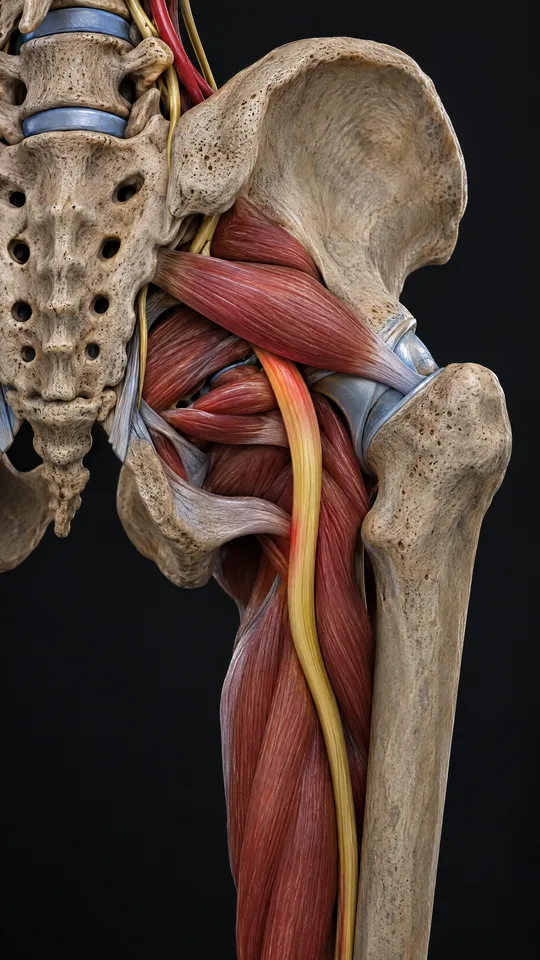
The symptoms overlap so much that the two are easily confused 1. Sciatica usually starts at the spine, where a nerve root is irritated as it leaves the lower back. Piriformis syndrome irritates the same nerve further along, in the buttock. Our guide on how to relieve sciatic nerve pain covers what you can do at home.
The features most consistently reported in piriformis syndrome are 2,3:
Those patterns are useful, but none of them is proof. The accuracy of the physical tests used for piriformis syndrome hasn't been established 2, and there's no official test for it 1. A normal straight-leg raise, a common nerve test for sciatica, doesn't rule it out either 2.
In practice, piriformis syndrome is diagnosed by ruling other things out, and that can take a while 1. That's why an assessment for buttock pain always includes your lower back, even when your back doesn't hurt.
There's no result to wait on here. Piriformis syndrome is a clinical diagnosis, made from your story and an examination once other causes have been ruled out 1 4. Expect questions about your symptoms and medical history 1. Then the clinician moves your leg into different positions to see which ones bring the pain on 1. One of these is the FAIR test: your hip is bent, brought across your body and turned inwards, and it's positive if pressing over the piriformis is tender 4. They'll also feel deep in the buttock for tenderness, or for a small tight band of muscle 1 4.
You may still be sent for an ultrasound or MRI as part of working out the cause 1.
How strong is the evidence? Modest. Physiotherapy and medical management "show some promise" 4, but the research is mainly case series and narrative reviews, not controlled trials 3. It's a reasonable, low-risk first step, not a guaranteed fix.
Heat or cold packs, along with a few days of rest, are a simple way to settle pain early on 1.
Acupuncture and dry needling are listed among the treatment options 1, and dry needling is an option when conservative care hasn't been enough 4. It can help settle a tight, sensitive muscle, but the trial evidence for this condition is one study of 32 people followed for a week 4. We use it as an addition, not the centrepiece.
Muscle relaxants, anti-inflammatories, nerve-pain medicines, botulinum toxin or steroid injections, and surgery when other treatment fails are all real options 1,4. Physiotherapists don't prescribe or perform any of these. They're handled by your GP or a specialist, and we'll refer you if you need them.
Care for piriformis syndrome follows The Well Motion Recovery Path™. You move up a phase when sitting and walking show you're ready, not when a date arrives.
How long it usually takes. No good-quality figure exists. In one imaging study, 41 of 42 people whose MRI or CT scan was normal recovered fully within 35 days, on their own or with conservative care 4. That is one group with no comparison, and it excludes structural causes. If conservative care isn't working, your GP or a specialist decides the next step 4.
Prevention hasn't been tested in trials for piriformis syndrome, so each of these targets a known trigger:
Seek medical care urgently if you notice 1:
Sudden numbness or weakness in your leg, with no bladder or bowel changes: call us the same day.
See a doctor or physiotherapist, instead of managing it yourself, if 1:
If you can't get in to see your GP quickly, you can go to a Medicare Urgent Care Clinic or call the healthdirect helpline on 1800 022 222 1.
Most deep buttock pain isn't serious. It's still worth a proper look. That beats months of stretching the same spot and hoping.
We start by listening: how it began, what makes it worse, and what it's stopping you from doing. Then we examine the area, explain what we find in plain English, and agree a plan with you. Your first visit is 40 minutes at Engadine and 30 minutes at our other clinics.
We see patients at Engadine, Mount Annan, Narellan and Appin, and at home through our mobile physiotherapy service. If you have private health cover, here's how health fund rebates work for physiotherapy.
Start conservatively with a few days of rest, heat or cold, stretching and physiotherapy 1,5. Medication or injections come later, and only if that isn't working 4.
Conservative care is the recommended starting point, and injections or surgery are kept for cases where it hasn't worked 1,4. That tells you many people are expected to improve without them. What the research doesn't give is a reliable timeframe, so we won't invent one.
Symptoms tend to get worse with jumping, running, sitting, standing up and climbing stairs 1, and with movements that put the piriformis under tension 2,3. We won't hand you a blanket list of exercises to avoid. We'll work out which ones set you off.
In the early stages, don't sit for long stretches without a break, and don't push through the activities that clearly flare it up 1.
None of the sources behind this page recommends a specific sleeping position, and we won't make one up. If certain positions reliably bring the pain on, tell us at your assessment.
Pain on the outside of the hip, usually worst lying on that side and on stairs. Often called trochanteric bursitis.
Read moreTight, sore hip flexors at the front of the hip. Common in runners, tradies and anyone whose day is mostly seated, and it deserves a better answer than "just stretch more."
Read moreA hip socket that's shaped differently from the start. For parents of a child who's been diagnosed, and for adults managing it long-term.
Read moreHip osteoarthritis is a long-term condition that affects the whole joint (cartilage, bone, joint lining, ligaments, tendons and muscles), not just "worn cartilage".
Read moreIn FAI, the ball and socket of your hip meet too early as it bends, because one or both have an unusual shape, called cam or pincer
Read moreGluteal tendinopathy is irritation of the tendons that attach two of your buttock muscles, gluteus medius and gluteus minimus, to the bony point on the outside of your hip. You may also hear it called greater trochanteric pain syndrome, or GTPS.
Read moreA snapping hip is a snap you can hear or feel as the hip moves. It's usually a tendon or band of tissue flicking over a bony point
Read moreThe labrum is a rim of cartilage around your hip socket. It helps absorb shock, spread pressure and keep the joint stable
Read more
How would you like to reach us?
Message us on WhatsAppFor bookings and enquiries. Please don't send medical details. Call (02) 8111 5633Request a call-back
Request sent
Thank you. We'll call you back on the number you gave us.
This is a preview, so nothing was actually sent.