Anti-inflammatory medication.
It's part of standard conservative care 1. Physiotherapists don't prescribe it, so ask your GP or pharmacist.
It's a deep ache at the front of your hip or in the groin. Pivoting, climbing out of a low car or a long stretch of sitting sets it off. Every so often the hip clicks, or feels like it might give way. Maybe a scan has just come back with the words "labral tear" on it. So what does that actually mean?
Your hip is a ball-and-socket joint. The labrum is a ring of cartilage lining the rim of the socket, a bit like a seal around the edge of a cup. It helps with shock absorption, lubrication, spreading pressure and stability 1.
It can be damaged by a traumatic injury, FAI, a shallower-than-usual socket (hip dysplasia), unusually loose or hypermobile joints, or gradual wear 1. Still, up to 74% of cases have no identifiable specific cause 1.
Pain usually sits at the front of the hip or in the groin, less often the buttock. It often comes with clicking, locking or the hip giving way 1. Between 22% and 55% of people with hip or groin pain have been found to have a labral tear. Symptoms often run for more than two years before anyone names the problem 1.
Before you read too much into a scan: a 2018 review found labral tears on imaging in 54% of people with no hip pain, and 62% of people with it 3. Plenty of tears hurt no one. The real question is whether this tear is causing your pain. Answering it takes an examination as well as an image.
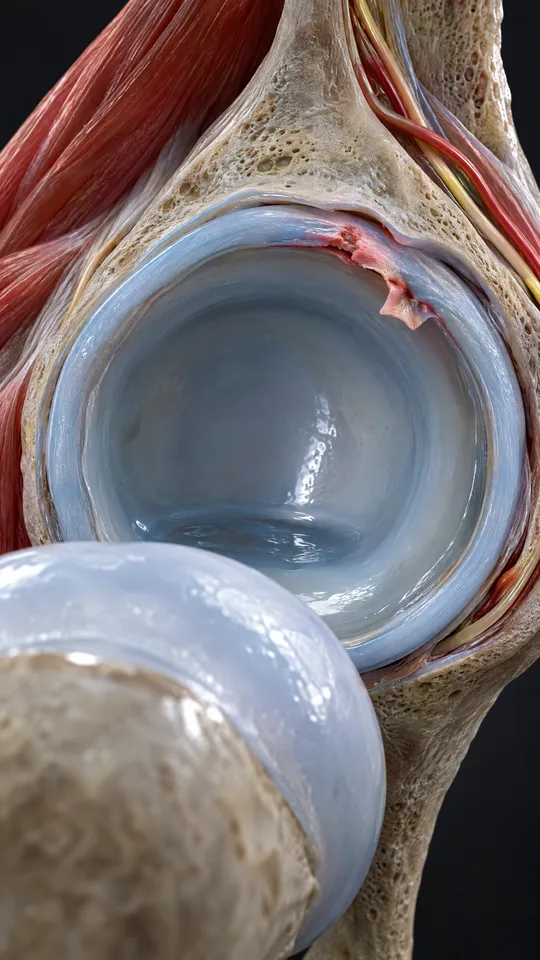
These two overlap, which is why they get mixed up. FAI is about bone shape: the ball or the rim of the socket is shaped so they pinch together as the hip bends. A labral tear is damage to the cartilage rim itself. FAI is a recognised cause of labral tears 1, so the two often turn up together.
No single symptom cleanly separates them. An older review named MR arthrography as the imaging test of choice 1. That's an MRI taken after contrast dye is injected into the joint. Given how often tears appear in pain-free hips 3, the scan is one piece of the picture, not the verdict. If bone shape looks like the main driver, see our femoroacetabular impingement page.
No single test proves a labral tear, so the diagnosis gets pieced together. The most consistent finding is the impingement test. You lie on your back, we bend your hip and knee to 90 degrees, then turn the hip inwards while easing the knee across your body. Pain at the front of the hip or in the groin counts as a positive test 1. It's the same test used for FAI, and findings vary 1.
X-rays are usually normal. They're taken to look for arthritis, a shallow socket or an impingement shape 1. If it's still unclear whether the pain is coming from inside the joint, a doctor can inject local anaesthetic into the hip under imaging. In studies checked against keyhole surgery, that injection was about 90 per cent accurate 1.
Physiotherapy doesn't heal or reattach a torn labrum. What it does is settle the hip, build strength and control around it, and get you moving the way your life needs. The professional clinical practice guideline for non-arthritic hip pain, which includes labral problems, covers exercise therapy, manual therapy and education 2.
That phased programme comes from clinical recommendation, not head-to-head trials. One trial took 348 people with FAI syndrome (not isolated tears). Physio-led care and hip arthroscopy both improved quality of life. At 12 months surgery was ahead by 6.8 points, just above the 6.1 considered clinically meaningful 4. Physio clearly helps, but it isn't always enough.
It's part of standard conservative care 1. Physiotherapists don't prescribe it, so ask your GP or pharmacist.
This is keyhole surgery on the hip joint, often needed when conservative care isn't enough 1. That's a decision for you and an orthopaedic surgeon, and Well Motion doesn't perform surgery. If you go that way, see post-surgical rehabilitation.
A 2009 review called physiotherapy's role in labral tears "controversial" 1. The evidence has grown since 2,4, but the best trial studied FAI syndrome, not isolated tears 4. For a tear on its own, the evidence is thinner than anyone would like.
Physiotherapy manages a labral tear without mending it, so The Well Motion Recovery Path™ tracks what your hip can do. You step up a phase when the hip copes with the work, whatever the calendar says.
How long it usually takes. The recommended course is 10 to 12 weeks 1. That figure is a 2009 review's recommendation, not a trial result. After arthroscopy with a repair, your surgeon sets the timeline: weight bearing is typically restricted for 6 weeks and return to sport is usually possible in 2 to 4 months 1, with post-surgical rehabilitation alongside.
Nobody has trialled a way to prevent a labral tear or its flare-ups, and the guideline advice is expert opinion 2. It targets what's known to load the labrum:
None of this is an emergency. Labral tears are common, and many people with one have no pain at all 3. An assessment works out whether yours is the problem, and what to do about it.
We start by listening: how it began, what makes it worse, and what it's stopping you from doing. Then we examine the area, explain what we find in plain English, and agree a plan with you. Your first visit is 40 minutes at Engadine and 30 minutes at our other clinics.
We see patients at Engadine, Mount Annan, Narellan and Appin, and at home through our mobile physiotherapy service. If you have private health cover, here's how health fund rebates work for physiotherapy.
The labrum has limited healing capacity 1. But the tear healing and the pain settling aren't the same thing. Many tears cause no pain at all 3, and conservative care is the usual first step 1. Symptoms can settle even if the tear still shows on a scan.
Usually it's a deep pain at the front of the hip or in the groin, sometimes the buttock. It comes with clicking, locking, catching or giving way. It's often worse with pivoting, long sitting or deep hip bending 1.
No source we relied on sets a walking limit. Standard conservative care is relative rest 1. That means easing back on what provokes your pain, not stopping altogether. If walking is comfortable, nothing we've cited says to avoid it. If it reliably flares your hip, adjust it with your physio.
It depends on whether the tear is actually your problem and how you respond to conservative care, which is usually where treatment starts 1. Tears are common without pain 3. In FAI syndrome, surgery and physio both helped, with a modest 12-month edge for surgery 4. Weigh up surgery with an orthopaedic surgeon.
Labral damage has been associated with osteoarthritis 1. That's an association, not proof that an untreated tear causes arthritis. And many tears seen on scans cause no symptoms at all 3.
Not necessarily, and we can't give you a figure. No source we relied on reports how often it happens. What's documented is the association with osteoarthritis above 1.
Pain on the outside of the hip, usually worst lying on that side and on stairs. Often called trochanteric bursitis.
Read moreTight, sore hip flexors at the front of the hip. Common in runners, tradies and anyone whose day is mostly seated, and it deserves a better answer than "just stretch more."
Read moreA hip socket that's shaped differently from the start. For parents of a child who's been diagnosed, and for adults managing it long-term.
Read moreHip osteoarthritis is a long-term condition that affects the whole joint (cartilage, bone, joint lining, ligaments, tendons and muscles), not just "worn cartilage".
Read morePiriformis syndrome is when the piriformis, a muscle deep in your buttock, puts pressure on the sciatic nerve. It usually affects one side
Read moreIn FAI, the ball and socket of your hip meet too early as it bends, because one or both have an unusual shape, called cam or pincer
Read moreGluteal tendinopathy is irritation of the tendons that attach two of your buttock muscles, gluteus medius and gluteus minimus, to the bony point on the outside of your hip. You may also hear it called greater trochanteric pain syndrome, or GTPS.
Read moreA snapping hip is a snap you can hear or feel as the hip moves. It's usually a tendon or band of tissue flicking over a bony point
Read more
How would you like to reach us?
Message us on WhatsAppFor bookings and enquiries. Please don't send medical details. Call (02) 8111 5633Request a call-back
Request sent
Thank you. We'll call you back on the number you gave us.
This is a preview, so nothing was actually sent.