Anti-inflammatory medicine.
Listed as part of adult management 1. A medical decision, not something Well Motion physiotherapists prescribe or administer. But if your GP raises it, that's consistent with the guidance.
You might be here because a midwife or GP found something at your baby's six-week check and the word "dysplasia" has been sitting in your head ever since. Or you might be an adult with a sharp ache in the groin (worse on stairs, worse after a long day standing) that someone has finally put a name to. Two very different situations sharing one word, and this page covers both. What they share is a hip socket shallower than it should be, and no amount of exercise changes that shape.
Your hip is a ball-and-socket joint: the socket (the acetabulum) is a cup in the side of your pelvis, the ball is the top of your thigh bone. In hip dysplasia that cup is shallower than it should be. The ball sits less securely, and in babies it can slip partly or completely out. Load a deep socket would spread across a broad surface instead concentrates on the rim of the joint. That's the mechanism, and it explains both the adult pain pattern and the long-term risk.
In babies this is usually a developmental problem present at or shortly after birth. Risk factors include a family history, breech delivery, twins or more, being a first baby, and conditions such as cerebral palsy and spina bifida 2.
One thing parents can act on directly: wrapping a baby tightly with the legs held straight can lead to hip dysplasia and dislocation 2. Safe wrapping leaves the hips free to bend and spread, and the same goes for carriers: thighs spread around your torso, hips bent, knees slightly higher than the bottom 3.
In Australia every newborn is examined for hip dysplasia in the first few days of life and again at six weeks, with an ultrasound if something is found or your baby is higher risk. In older children and adults, diagnosis is a physical examination plus an X-ray, with MRI or CT if the pelvis needs closer assessment 1.
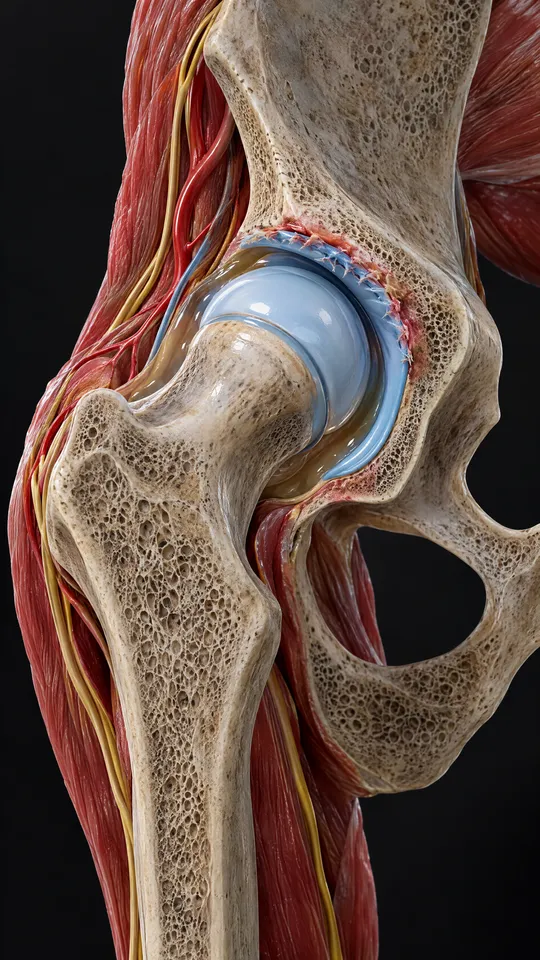
Worth getting straight, because almost everything true of one is untrue of the other.
| Babies and young children | Adolescents and adults | |
|---|---|---|
| Usual name | Developmental dysplasia of the hip (DDH) | Acetabular dysplasia |
| Pain | Typically none 1,3 | Sharp groin pain, worse with standing, walking, stairs, running 1 |
| How it's found | Newborn examination, six-week check, ultrasound 1 | Examination plus X-ray, often years after symptoms start 1 |
| What treats it | Pavlik harness, bracing, reduction under anaesthetic, hip spica cast, osteotomy 1,3 | Activity modification, strengthening, and surgery where needed 1,4 |
| Physiotherapy's role | Education and support, not correction 1,3 | A recommended part of ongoing management 1 |
If you're the adult in that right-hand column, one more thing is worth naming. A study of 57 patients found the average time from first symptoms to a diagnosis of hip dysplasia was about five years, with patients seeing an average of three health professionals first 5. If you've spent years being told your hip was fine, that wasn't you imagining it.
In babies, hip dysplasia is usually picked up before anyone notices a problem, because it's looked for routinely. The signs are hard to spot, even for a doctor 3. What gets checked: a hip that clicks when it's rotated, legs that are hard to spread apart, one leg longer than the other, a leg that turns outwards, and uneven skin folds at the groin, thigh or buttocks 1 3. An ultrasound or X-ray of the hip then confirms it 3.
For adolescents and adults it's a physical examination, then an X-ray. An MRI or CT scan is added only when the pelvis needs a closer look, to show whether the hip has been damaged 1.
Start with what physiotherapy can't do. We can't reshape the socket. The published framing for this work is building stability in a hip that isn't bony-stable, compensating for the shape, not correcting it 4. Anyone promising otherwise is overselling.
For an adolescent or adult:
For parents, the honest version is shorter. The harness, brace or surgery is the treatment 1,3. We help with the part around it: safe wrapping and carrying, watching how your child's movement develops, and getting back to normal activity afterwards. Our paediatric physiotherapy page explains those appointments. One practical thing Healthdirect flags: if your baby is in a harness, some breastfeeding positions work better than others, and the Australian Breastfeeding Association has advice 1.
One caveat. If your dysplasia is more severe you may not be a candidate for a trial of non-surgical management at all, because of the raised risk of early arthritis 4. Severity is measured on your X-ray. A conversation with your specialist, not something a physio decides.
Listed as part of adult management 1. A medical decision, not something Well Motion physiotherapists prescribe or administer. But if your GP raises it, that's consistent with the guidance.
Suggested in later stages to take load off the joint, alongside gentle movement to keep the hip moving well 1. Unglamorous, but useful when walking distance is what limits your day.
The Pavlik harness is described by the Victorian Department of Health as effective in over 85 per cent of cases, usually worn for six to twelve weeks 1,2. A smaller number need surgery and a rigid brace afterwards 1. Orthopaedic care, fitted and monitored by the treating team, not by us.
The options are listed in the table above 3. For adults it's a real route where conservative management isn't enough, and many adults with hip dysplasia eventually develop osteoarthritis and may need a hip replacement 1. Not our scope to perform or recommend, but worth knowing the pathway exists rather than hearing it cold.
The authors of the only structured physiotherapy guidance for adult hip dysplasia state plainly that there is a paucity of research on non-surgical management, and that no physiotherapy guidelines or description of exercise progression exist in the literature 4. They add that future studies still need to test how patients do on this approach 4. We work from that consensus because it's the best there is, not because it's settled.
For an adolescent or adult, managing a shallow hip socket follows The Well Motion Recovery Path™. You move up a phase when the hip shows it can take more, not on a date. For a baby, the orthopaedic team's harness or cast sets the timeline.
How long it usually takes. Non-surgical care has no published recovery time, because the research is thin 4. The one marker is expert consensus: see a specialist if symptoms haven't eased after four to eight weeks 4. After socket-reshaping surgery, return to sport took 8.8 to 12.8 months across three small retrospective studies 9. A baby's harness is usually worn full time for at least 6 weeks, then part time for 6 more 8.
You can't change the shape of the socket. What you can change differs for babies and adults:
For a child:
For an adult:
None of this is cause for alarm. Found early in a baby, hip dysplasia is usually treated successfully, and in adults it's a condition to manage well, not an emergency. Families sometimes also find Healthy Hips Australia useful for support between appointments.
We start by listening: how it began, what makes it worse, and what it's stopping you from doing. Then we examine the area, explain what we find in plain English, and agree a plan with you. Your first visit is 40 minutes at Engadine and 30 minutes at our other clinics.
We see patients at Engadine, Mount Annan, Narellan and Appin, and at home through our mobile physiotherapy service. If you have private health cover, here's how health fund rebates work for physiotherapy.
For adults, the clearest advice is to avoid running and impact sports, which put too much pressure on the joint 1. Cycling and swimming are the low-impact options to start with, and higher-impact work comes later if strength improves and the hip settles 4. Beyond any list, anything that consistently increases your pain should be adapted or dropped 4.
Not structurally, no. Hip dysplasia is a bone-shape problem (a shallow socket) and physiotherapy doesn't reshape the socket. What it can do for an adolescent or adult is build strength and control so the hip is more stable and less irritable, with the goal of keeping it working as well as possible for as long as possible 1,4. Reshaping the socket, where needed, is surgery.
Our sources disagree, so we'll show you both. Healthdirect advises adults to avoid running and impact sports outright 1. The expert panel is conditional: 93 per cent agreed a person may begin running once hip irritability has decreased and they can show good pelvic and lower-limb control on one leg with a normal walking pattern 4. Your severity decides which applies. Settle it with your physio and specialist, not from a web page.
Sometimes, in babies. Some newborns have loose ligaments around the hip that settle on their own in the first few months 2. Established dysplasia is different: it needs bracing or surgery, which is why newborns are screened and re-checked at six weeks 1,3. In adults, the socket shape doesn't correct itself.
No source we found says walking damages the hip. It's listed as something that can bring on pain in adolescents and adults 1, and gentle movement is recommended to keep the joint moving well 1, while a normal walking pattern is a rehabilitation goal, not a risk 4. Pain with walking tells you how much load the hip is happy with today, not that you should stop moving.
Treated early in infancy, usually yes: the Victorian Department of Health puts successful treatment at around 95 per cent of babies born with it, most with no later hip problems, though some develop arthritis in that joint in later years 2. Left untreated, arthritis develops and a hip replacement may eventually be needed 3. Diagnosed in adulthood, it's managed rather than cured 1.
Pain on the outside of the hip, usually worst lying on that side and on stairs. Often called trochanteric bursitis.
Read moreTight, sore hip flexors at the front of the hip. Common in runners, tradies and anyone whose day is mostly seated, and it deserves a better answer than "just stretch more."
Read moreHip osteoarthritis is a long-term condition that affects the whole joint (cartilage, bone, joint lining, ligaments, tendons and muscles), not just "worn cartilage".
Read morePiriformis syndrome is when the piriformis, a muscle deep in your buttock, puts pressure on the sciatic nerve. It usually affects one side
Read moreIn FAI, the ball and socket of your hip meet too early as it bends, because one or both have an unusual shape, called cam or pincer
Read moreGluteal tendinopathy is irritation of the tendons that attach two of your buttock muscles, gluteus medius and gluteus minimus, to the bony point on the outside of your hip. You may also hear it called greater trochanteric pain syndrome, or GTPS.
Read moreA snapping hip is a snap you can hear or feel as the hip moves. It's usually a tendon or band of tissue flicking over a bony point
Read moreThe labrum is a rim of cartilage around your hip socket. It helps absorb shock, spread pressure and keep the joint stable
Read more
How would you like to reach us?
Message us on WhatsAppFor bookings and enquiries. Please don't send medical details. Call (02) 8111 5633Request a call-back
Request sent
Thank you. We'll call you back on the number you gave us.
This is a preview, so nothing was actually sent.