Meralgia paresthetica is feeling only.
No weakness, and no other symptoms in the legs 3. The affected area is a defined patch on the outside of the thigh, usually one you can draw around with a finger 3.
There's a patch on the outside of your thigh that burns, tingles or feels numb, and you can trace its outline with a finger. It's worse after a long stint standing or walking, and it eases when you sit down. Jeans, a belt or a work harness make it sharper. Nothing feels weak. It just doesn't feel like your leg.
That pattern has a name: meralgia paresthetica, spelled meralgia paraesthetica in most Australian and British clinical writing. It isn't a muscle or joint problem. It's a single nerve being squeezed near your groin.
The lateral femoral cutaneous nerve comes from the L2 and L3 nerve roots in your lower back. It runs through the pelvis and passes beneath (sometimes straight through) the inguinal ligament at the front of your hip, then fans out across the outer thigh 6. Its only job is sensation.
Squeeze it at that crossing point and you get burning, pins and needles, numbness, sometimes a stabbing pain. Light touch, different fabrics, heat or cold can all feel wrong 4.
What does the squeezing is usually mechanical. Recent weight gain and pregnancy are the two commonest causes 3: in pregnancy, the growing uterus presses on the nerve 4. Tight clothing and belts sitting right where the nerve passes can do the same 2. Diabetes and some other metabolic factors raise the risk 2. A second group follows surgery: hip replacement, spine surgery, or lying face-down for a long operation 2. It's most common in mid-life: one review puts the peak at 30 to 40, another at 40 to 60 2,6.
Two details give it away. Symptoms are typically worse with prolonged standing or walking and relieved by sitting, which reduces tension on the nerve 2. And pressing where the nerve crosses the outer part of that ligament is often tender 6.
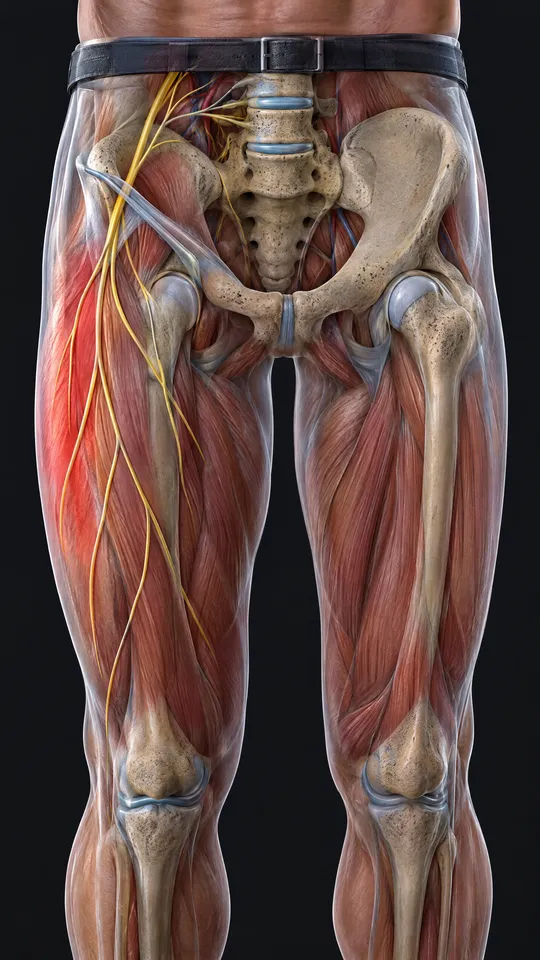
No weakness, and no other symptoms in the legs 3. The affected area is a defined patch on the outside of the thigh, usually one you can draw around with a finger 3.
A nerve root problem in the lower back can produce real weakness or lost reflexes alongside the sensory symptoms 6. That's the clean line: if the leg is weak as well as odd-feeling, it isn't meralgia paresthetica. If your symptoms seem to start in your back, our Lower Back section is the better starting point.
The reassuring part: this is usually diagnosed from your story and where the numb patch sits, with no further tests needed 3. A clinician will ask you to trace the patch, then check your leg strength and reflexes. Both should be normal, because this nerve only carries feeling 6. Weakness or a lost reflex points towards your lower back instead 6.
Tests are for when the picture doesn't fit. A nerve conduction study, an ultrasound of the nerve or an MRI can help in those cases. A small injection of local anaesthetic just inside the bony point at the front of your hip is sometimes used to confirm it: if the patch goes quiet, that supports the diagnosis 6.
The aim is to take the pressure off the nerve, then keep it off.
A systematic review of treatments for this condition found no trials of massage or manual therapy 1, and a review of the rehabilitation research found only three case reports 2. It can have a place in comfort and assessment, but we wouldn't present it as a treatment for the compression itself.
A small device that sends a mild electrical current through pads on the skin. The evidence is thin. One review lists it among the treatments that can be tried 6. But in the one randomised, sham-controlled trial in meralgia paresthetica, real TENS did not significantly outperform a sham device on pain, quality of life or sleep 5.
Taping is sometimes suggested, but current evidence is insufficient for this condition: it rests on one pilot study of 10 people 2. Something to trial, not a treatment with results behind it.
It's reported as possibly effective, but the studies are mostly case reports and small series, with its mechanism still under investigation 2.
Real options in the literature, but they sit with a GP or specialist: physiotherapists don't prescribe, give or arrange them. The reported figures look strong: cure or improvement in 83% of injection cases and 88% after surgical decompression 1. But the same review notes a comparable result (69%) with no intervention at all 1, so those numbers can't be read as proof the procedure did the work.
Thinner than you might expect. There are no randomised or quasi-randomised trials for any treatment of this condition, and the objective evidence base is weak 1. Taking load off the nerve and following a structured exercise plan is sensible, low-risk, standard care, not a guarantee, and we won't dress it up as one.
Nothing is torn in meralgia paresthetica, so The Well Motion Recovery Path™ here is about a squeezed nerve settling, not tissue healing. You move up a phase on how the patch behaves, not on a date.
How long it usually takes. Nobody can give you a reliable figure. No randomised trials exist for any treatment 1, and the studies of injection and surgery checked results anywhere from 1 to 38 months later 6. In one small natural history study, 20 of 29 cases improved with no treatment 1. For some people symptoms persist 3.
Prevention hasn't been put through a trial for this condition, so these come from what's known to raise the risk:
Don't manage it alone. Get it assessed properly if:
None of that means something serious is going on. This is a benign condition, diagnosed from your story and where the numb patch sits 3. Getting that clear early means you know what you're managing.
We start by listening: how it began, what makes it worse, and what it's stopping you from doing. Then we examine the area, explain what we find in plain English, and agree a plan with you. Your first visit is 40 minutes at Engadine and 30 minutes at our other clinics.
We see patients at Engadine, Mount Annan, Narellan and Appin, and at home through our mobile physiotherapy service. If you have private health cover, here's how health fund rebates work for physiotherapy.
Often, yes, sometimes without treatment. In one natural history study, symptoms improved on their own in 20 of 29 cases, about 69% 1, and most people need no further treatment 3. But symptoms can persist 3. In pregnancy, they usually go away after birth 4.
Not on the affected side: increased pain when lying on that side is a typical symptom, and avoiding it is standard advice 4. If you're pregnant, a pregnancy pillow is recommended too 4. And nothing tight across the waist 4,6.
It targets what's driving the compression (clothing, load, activity, weight) and gives you a structured plan. Conservative management is reported to ease symptoms in up to 70% of people 6, but that figure rests on sparse evidence, so read it as encouraging, not proven. What we won't tell you is that physio is proven to fix it: no randomised trials exist for any treatment of this condition 1.
Usually it doesn't need a specialist. It's diagnosed on the story and the location of the numbness, and further tests usually aren't required 3. A physiotherapist or GP can recognise it and start conservative management. If that doesn't settle it, the medical options are a nerve block or anti-inflammatory medication, with surgery reserved for when non-surgical treatment has failed 2: conversations for your GP, not us.
A pulled quad: torn fibres at the front of the thigh, from sprinting, kicking or overstretching. Sore to load, and slow to trust again.
Read moreA cork: a deep bruise from a direct knock, common in contact sport. It tightens over the following hours, and the first day or two matters.
Read moreA tear of the tendon joining the quad muscles to the kneecap. Usually a sudden give-way on landing, after which straightening the knee is difficult.
Read more
How would you like to reach us?
Message us on WhatsAppFor bookings and enquiries. Please don't send medical details. Call (02) 8111 5633Request a call-back
Request sent
Thank you. We'll call you back on the number you gave us.
This is a preview, so nothing was actually sent.