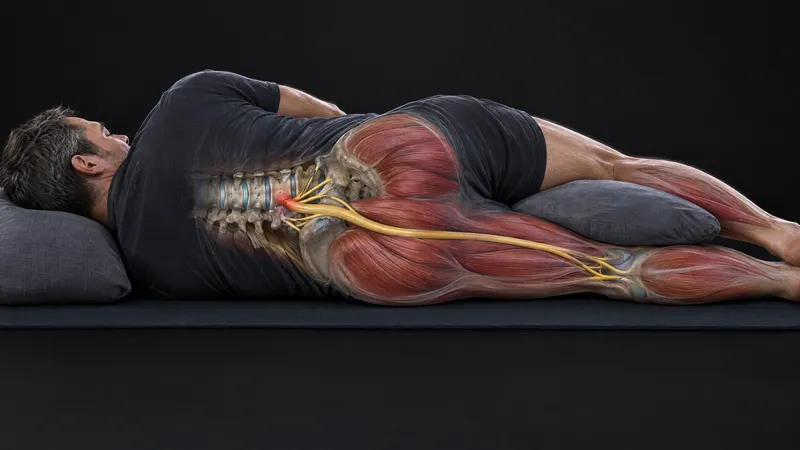
Before you try anything: the symptoms that mean hospital
This is short, and then we'll get to the useful part.
Go to your nearest emergency department, or call 000, if you have any of these 2:
- sciatica in both legs
- weakness or numbness in both legs that is severe, or getting worse
- numbness around your genitals, or around your bottom
- difficulty starting to pee, an inability to pee, or loss of control over when you pee
- not noticing when you need to open your bowels, or loss of control over it
These can point to compression of the bundle of nerve roots at the base of the spine, and it needs same-day assessment, not a night of stretches. Australian guidance carries the same warning, and puts it at the very top of its own page 1.
Read that list once, satisfy yourself that it isn't you, and then get on with the rest of this.
What actually helps in the first few hours
None of these is dramatic. Together they're what the guidance supports, and they're safe to start right now 1,2,3.
Keep going, in smaller pieces. Carry on with your usual activities as much as you can, work included, if you can manage it 1,2. The instinct to cancel everything and lie down is the one to resist.
Don't settle into one position. The guidance here is unusually blunt: do not sit or lie down for long periods, because even if moving hurts, it isn't harmful and it can help you get better faster 2. If you've been in a chair for forty minutes, stand up and walk to the end of the hallway.
Start gentle movement sooner than feels reasonable. Beginning gentle exercise as early as you can is explicitly recommended: anything that gets you moving counts 2.
Try heat. Holding a heat pack to the painful area is named directly as a self-care measure 2. Warm baths turn up in Australian guidance too 3.
Mind how you're sitting and standing. Proper posture, and resting your back by not bending, flexing or lifting heavy weights while it's angry, are both standard self-care advice 3. A mattress that is neither too soft nor too firm, and a chair with real lumbar support, sit in the same list 3.
Notice what isn't on that list: a named stretch, a magic angle, a specific number of repetitions. We haven't left it out to make you book an appointment. It isn't there because the sources behind this page don't put it there.
Heat or ice?
This one comes up constantly, and most pages answer it with more confidence than the evidence earns.
UK guidance recommends heat packs and doesn't mention ice at all 2. Australian state guidance lists ice packs, alongside warm baths, in its self-care advice 3. You'll also find a confident ice-first-then-heat timeline circulating online. No source we could verify supports a specific timeline like that.
So: whichever one eases it is a reasonable choice. Wrap it, don't apply it directly to skin, and give it fifteen to twenty minutes, not an hour. If neither changes anything, that's information too: it means the irritation is at the nerve root, not in the tissue you're heating or cooling, and no amount of either will reach it.
What about anti-inflammatories?
This is where we have to be careful about two different things at once.
The first is scope. Physiotherapists don't prescribe or administer medication. Anti-inflammatory medicines, muscle relaxants, nerve-pain medicines and steroid injections all appear in the literature as real options for sciatica 1, but every one of them is a conversation with your GP or pharmacist, not with us.
The second is that the evidence is weaker than almost anyone expects. A systematic review of ten trials covering 1,651 people found that, pooled against placebo, the pain-reducing effect of non-steroidal anti-inflammatory drugs in sciatica was not statistically significant, and rated that finding very low quality, with only one of the ten trials at low risk of bias 4. The same review found a meaningfully higher risk of adverse events with NSAIDs than placebo, and concluded that because they're prescribed so frequently, the risk-benefit balance needs real consideration 4. UK guidance arrives at the same hedge independently: paracetamol is unlikely to help, and it isn't clear how much NSAIDs help 2.
That doesn't mean don't take them. It means: if you take one and it doesn't do much, that's the expected result, not a sign your sciatica is unusually bad. Ask a pharmacist, and don't build the next three weeks around it.
Movement that helps now, movement that can wait
Once the immediate panic settles, the question becomes what you can safely do with your body today.
Helps now: stretching and low-impact activity, with walking and swimming named specifically 1. Swimming earns a particular mention because it's non-weight-bearing: you get the movement without loading the spine 3.
Can wait: high-impact activity. Running and standing weights are both named as things to avoid while this is active 1. So is prolonged bending, flexing or lifting anything heavy 3.
The old advice (complete bed rest) has been reversed. Lying in bed may offer only minimal improvement, and may even make things worse; unless a doctor has specifically told you otherwise, staying active is the preferred option 3. Short rests are fine. Days in bed are not the plan.
Start smaller than you think. A ten-minute walk that you repeat three times beats a forty-minute walk that leaves you unable to move the next morning.
Why nothing relieves it in thirty seconds
Search this topic and you'll be offered relief in eight minutes, in thirty seconds, or permanently. We'll say it directly, because chasing it costs people time.
There is no single movement that reliably delivers instant relief, and the reason is structural. The sciatic nerve is irritated, inflamed or under pressure, usually at the root, where it exits your lower spine 1. That irritation doesn't reverse in a minute because you found the right position. What changes over days and weeks is the irritation itself.
The guideline-level picture backs this up. A review of four high-quality clinical practice guidelines for low back pain with and without nerve involvement found the recommended interventions were education about recovery expectations and self-management, keeping up usual activities, and multimodal care combining education with exercise, not any single home remedy 5. The strongest thing on that list is knowing what to expect, which is most of what this page is trying to give you.
How long this usually takes
Most sciatica resolves on its own within six weeks to three months 3. Many people recover within a few months, though some still have symptoms after a year 1.
That range is wide, and it's uncertain which end you'll land on. What isn't uncertain is that how you move during that window matters more than what you take. If you're at week three and slowly improving, that's a normal trajectory. If you're at week four with no change at all, that's the point where guidance says to stop self-managing 1.
When first-aid isn't enough anymore
Book an assessment instead of continuing on your own if 1:
- you've been treating it for four weeks with no improvement
- the pain is severe when you're lying down, or worse at night
- there's numbness, tingling or weakness in the leg that's progressing
- it's come alongside a fever, a recent infection, unexplained weight loss, or you have a history of cancer
At that point the question stops being "what can I try tonight" and becomes "which nerve root is involved, and what does your leg do when we test it". That's the work on our sciatica page: assessment first, then a program built around how your symptoms respond, not a list of movements pulled off a page.
If muscle guarding around the hip and lower back is adding a layer to what you're feeling, dry needling can help settle that layer. It addresses the guarding, though, not the nerve compression underneath it. And if this has been going on long enough that it's reshaped your sleep and what you're willing to attempt in a day, our chronic pain management approach is built for that stage, where exercise alone has stopped being the whole answer.
If a flare-up hits after hours, on a weekend or a public holiday, and you have none of the symptoms that mean hospital (listed at the top of this page), our after-hours emergency physiotherapy can come to you. Call (02) 8111 5633.
FAQs
How to fix sciatic nerve pain?
In two stages, and they're different. Today: keep moving in small doses, avoid sitting or lying down for long stretches, try a heat pack, and stick to low-impact activity like walking or swimming 1,2. Over the following weeks: the guideline-level recommendation is education about what to expect, keeping up your usual activities, and exercise, ideally supervised rather than self-selected 5. Most cases settle within six weeks to three months 3. If four weeks pass with no improvement, that's the signal to get it assessed and stop experimenting 1.
What is the one movement for instant sciatica pain relief?
There isn't one, and we'd rather say that than invent it. The nerve is irritated, inflamed or under pressure at its root 1. That isn't a state a single movement reverses. What the evidence does support is the unglamorous version: don't stay in one position, keep moving even though it hurts, and use heat if it helps 2,3. If a particular position eases your leg, use it; just don't expect it to be the fix, and don't stay in it for an hour.
What sleeping position is best for sciatica?
None of the sources behind this page recommends a specific sleeping position, and we're not going to make one up. What is supported is a mattress that's neither too soft nor too firm 3, and not staying in any one position for long stretches 2, including overnight, so changing position when you wake is reasonable, not something to avoid. One thing to flag: severe pain when lying down, or pain that's clearly worse at night, is a reason to get assessed 1. That's not a pillow problem to solve.