Manual therapy.
In that Melbourne trial, hands-on treatment was part of a package that didn't beat a sham 4. So we use it only to help you get moving, never as the treatment itself.
It's the first few steps that give it away. Out of the car, up from a low chair, the first walk of the morning: the groin aches and the hip feels stiff, then it loosens a little once you're moving. Putting socks on has become a small project.
Someone said "arthritis in the hip", and it's easy to hear that as the start of a slow slide towards surgery. It doesn't have to be. Many people manage hip osteoarthritis well, and the approach with the best evidence behind it is something you do, not something done to you.
Your hip is a ball-and-socket joint: the ball at the top of your thigh bone sits in a cup on the side of your pelvis. Osteoarthritis isn't simply that joint wearing out like a tyre tread. It involves the whole joint: the cartilage, the bone beneath it, the synovium (the joint's lining), and the ligaments, tendons and muscles around it 1.
Risk rises with age, family history, being female, carrying extra weight, a previous joint injury and physically demanding work 1. Some of that you can't change. Some of it (how strong the muscles around your hip are, and how much load the joint carries) you can 1,2.
The x-ray and the experience often disagree. Some people have big changes on film and mild symptoms; others have the reverse 2. Tests usually aren't needed for the diagnosis at all, though an x-ray may be used when it's unclear 1. So the film isn't a forecast. What your hip can do, and what sets it off, is far more useful, and it's changeable.
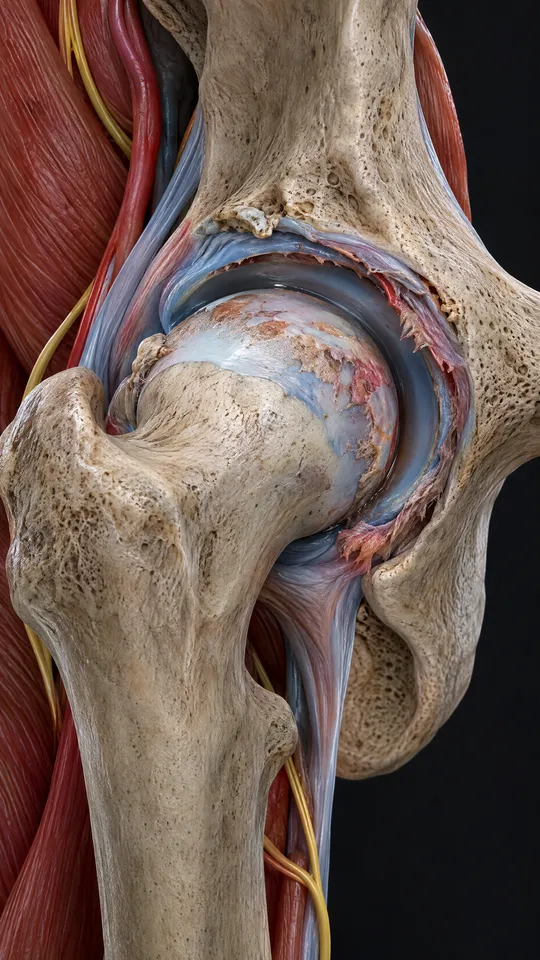
Both get called "my hip", and they're managed differently. Osteoarthritis tends to be felt in the groin, buttock or front of the thigh, gets worse with activity, and brings stiffness after rest, sometimes with a grinding, sticking or locking feeling 2.
Pain on the outside of the hip, over the bony point, worst lying on that side, fits hip bursitis better: a problem in the tissues outside the joint, not the joint itself. Working out which is driving your pain is what an assessment is for.
Most people don't need a scan to be told they have hip osteoarthritis. Tests usually aren't needed for the diagnosis 1. Your clinician asks about your symptoms, then examines the hip: how far it moves, how strong the muscles around it are, and whether the joint is tender 1 2.
An X-ray comes into it sometimes, mainly when it isn't clear what type of arthritis you're dealing with 1 2. Now and then a further examination is needed to rule out other health conditions 2.
The honest version. Exercise helps, but modestly: roughly 8 points on a 100-point pain scale, and no clear improvement in quality of life in the few small trials that measured it. A few people found exercise increased their pain 3. And a Melbourne trial of 102 people found that 12 weeks of education, hands-on treatment, home exercise and a walking aid did no better than a sham treatment, with more mild side effects 4.
What we take from that: nobody should sell you a magic technique. The part worth investing in is a program you'll keep doing, pitched to your hip and adjusted as it changes.
In that Melbourne trial, hands-on treatment was part of a package that didn't beat a sham 4. So we use it only to help you get moving, never as the treatment itself.
It reduces load through the hip 1. Hold it in the hand opposite your sore hip 2.
Losing weight can reduce hip pain 1. Support best led by your GP or a dietitian.
A corticosteroid injection gives only a few weeks of relief, with limits on how many you can have 1. A medical decision for your doctor, not something Well Motion physiotherapists administer.
Considered once other options have been tried, and if you're waiting for it, keep moving in the meantime 2.
Hip osteoarthritis has no cure 1, so here The Well Motion Recovery Path™ is about managing the hip, not healing it. You move up a phase when the hip copes with more, not on a date.
How long it usually takes. There is no healing date to give. In the largest review, gains from exercise lasted three to six months after supervised sessions ended 3, so the program carries on at home. After a hip replacement your surgeon sets the timeline. Surgeons' patient guidance, not a trial, puts most light daily activities at 3 to 6 weeks after the operation 7.
Hip flare-ups have been studied directly. Researchers followed people with hip osteoarthritis online for 90 days and compared the days before each flare with their ordinary days 5. That shows what tends to come first. Whether changing it prevents flares hasn't been trialled.
None of this is cause for alarm. Usually the next step isn't a scan; it's a program pitched correctly for the hip you've got today.
We start by listening: how it began, what makes it worse, and what it's stopping you from doing. Then we examine the area, explain what we find in plain English, and agree a plan with you. Your first visit is 40 minutes at Engadine and 30 minutes at our other clinics.
We see patients at Engadine, Mount Annan, Narellan and Appin, and at home through our mobile physiotherapy service. If you have private health cover, here's how health fund rebates work for physiotherapy.
Generally, yes. Brisk walking is one of the low-impact activities recommended for osteoarthritis 1, and keeping the joint moving is the core of managing it 2. Pace it rather than pushing through, and if distance is the problem, a walking stick in the opposite hand takes load off the hip 1,2.
There's no universal "avoid" list. The guidance is to favour low-impact activity that doesn't stress the joint 1, and to adapt whatever consistently increases your pain 2. That's individual, so the program should be built around your hip, not a printout.
Low seating, sitting in one position for a long time, and activities that increase your pain 2. Pain is typically worse when you're moving or active 2, and stiffness tends to follow rest.
Exercise, consistently. It reduces pain and improves function 3, and keeping the hip mobile and strengthening the muscles around it is the core approach 2. Weight management and pain management help too 1.
No, there's no cure. But many people manage their symptoms well 1,2, and that's what a management plan is for.
Pain on the outside of the hip, usually worst lying on that side and on stairs. Often called trochanteric bursitis.
Read moreTight, sore hip flexors at the front of the hip. Common in runners, tradies and anyone whose day is mostly seated, and it deserves a better answer than "just stretch more."
Read moreA hip socket that's shaped differently from the start. For parents of a child who's been diagnosed, and for adults managing it long-term.
Read morePiriformis syndrome is when the piriformis, a muscle deep in your buttock, puts pressure on the sciatic nerve. It usually affects one side
Read moreIn FAI, the ball and socket of your hip meet too early as it bends, because one or both have an unusual shape, called cam or pincer
Read moreGluteal tendinopathy is irritation of the tendons that attach two of your buttock muscles, gluteus medius and gluteus minimus, to the bony point on the outside of your hip. You may also hear it called greater trochanteric pain syndrome, or GTPS.
Read moreA snapping hip is a snap you can hear or feel as the hip moves. It's usually a tendon or band of tissue flicking over a bony point
Read moreThe labrum is a rim of cartilage around your hip socket. It helps absorb shock, spread pressure and keep the joint stable
Read more
How would you like to reach us?
Message us on WhatsAppFor bookings and enquiries. Please don't send medical details. Call (02) 8111 5633Request a call-back
Request sent
Thank you. We'll call you back on the number you gave us.
This is a preview, so nothing was actually sent.