Need urgent care? 24/7 Mobile & After-Hours Emergency Physiotherapy Call (02) 8111 5633 For life-threatening emergencies, always call 000
Hip

Hip Flexor Strain

5.0 average rating on Google
Registered NDIS Provider
SIRA Registered Provider

Maybe it happened in a moment: you changed direction chasing a ball, felt something grab at the front of your hip, and finished the game sore. Or maybe there was no moment at all: just a pinch when you stand up after a long drive. Both are hip flexor problems, they behave differently, and neither is fixed by being told to stretch more.

What's actually causing it

Your hip flexors lift your thigh towards your chest. The main one is the iliopsoas, running from your lower spine and inner pelvis to the top of your thigh bone. It's the main hip flexor you have, and it also helps stabilise your hip and lower back 7.

A strain is an injury to a muscle or tendon 4. Sudden injuries to the iliacus and psoas major tend to occur during change-of-direction movements; injuries to rectus femoris, the other big hip flexor, during kicking and sprinting 2.

The slower version is different. Runners and dancers commonly present with pain here from overuse, not one incident 2: load accumulating faster than tissue adapts. The same logic applies to physical work: repeated lifting from low positions, climbing in and out of a truck cab, long stretches of kneeling. There's no study on tradies specifically, so we won't pretend otherwise.

And if you sit all day? The best available study compared people sitting over seven hours daily and moving little against people sitting under four hours and moving more. The active group had about 6.1 degrees more passive hip extension 3. Real and measured, but a snapshot of two groups at one point in time, not proof that sitting caused it 3.
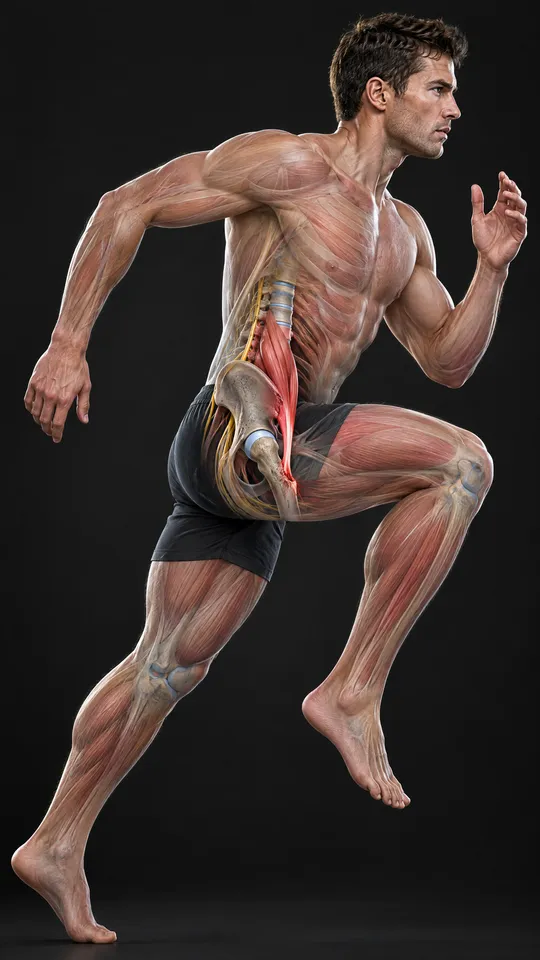

Man sprinting with the hip flexor muscle shown running from the lower spine to the top of the thigh bone

Hip flexor strain or a hip joint problem? How to tell the difference

The treatment is completely different, so this is worth getting straight. The international consensus taxonomy (24 experts across 14 countries) puts iliopsoas-related pain in one category and hip-related pain, meaning the joint itself, in another 1.

Hip flexor (iliopsoas) problemHip joint problem
Where it sitsFront of the upper thigh, further out than adductor pain 2Deep in the groin crease, hard to point to
What reproduces itResisted hip flexion, or stretching the front of the hip 2Rotating or loading the joint itself
What we findTenderness over the iliopsoas, above or below the groin 2Pain on joint-specific tests, often confirmed on imaging
Typical storyA change of direction, sprint, kick, or accumulating load 2Longstanding, sometimes structural: see hip dysplasia

Other things live here too: an inflamed tendon, arthritis, a fracture, or pain referred from your lower back 5. Bursitis and tendinopathy can affect the iliopsoas too 7, and a snapping sensation can be the tendon flicking over a bony ridge, not a strain 11. Since this pain often refers into the groin, the groin injury guide is worth a look.

How it's diagnosed

A hip flexor strain is usually diagnosed in the clinic, without a scan 8. You'll be asked what you were doing just before it happened 8. Then the clinician watches how you stand and walk 5, presses along the muscles for tenderness or swelling, and moves the hip and leg in different directions 8. A few stretches and movements help pin down which muscle is injured 8.

An X-ray may be ordered to rule out a stress fracture or, in younger people whose growth plates are still open, a small piece of bone pulled away by the tendon. In most cases no other imaging is needed 8. If the picture points to a different cause of hip pain, blood tests or a CT scan may follow 5.

How we treat it

1
A proper assessment first. Palpation above and below the groin crease, resisted hip flexion and stretch testing 2, separating a muscle problem from a joint problem from referred pain 1,5. Our physiotherapy page explains how an appointment runs.
2
Sensible early management if it's acute. Protection, relative rest, ice, compression and elevation 4, avoiding what significantly increases your pain, while otherwise staying active.
3
Graded loading, not passive waiting. Strength work through the range the hip tolerates, progressed as symptoms settle. See exercise prescription and conditioning.
4
Mechanism-specific return to sport. If yours went on a change of direction, that's what the plan rebuilds; if it went kicking or sprinting, that is 2. See sports physiotherapy.
5
Strength as prevention. The government advice is plain: avoid overuse, maintain muscle strength, see a physiotherapist 6.

Other treatments we may use

Stretching the front of the hip.

Worth doing when assessment finds a real length restriction: exercises to improve flexibility are a standard part of treating a hip strain 8. Be realistic about it, though: it's one part of a loading plan, not the plan.

Hands-on treatment, and what "release" means.

There's a lot of content online about releasing the psoas by pressing deep into the abdomen. We won't teach that, and we'd ask you not to try it on yourself: the psoas sits close to your abdominal and pelvic organs 7, and some groin symptoms are serious problems in muscular disguise 6. Hands-on work has a place alongside active treatment, but we found no good evidence for passive release on its own.

Pain-relieving medication.

Real, with a caveat from the source itself: it can sometimes disrupt the healing of soft tissue injuries 4. It's a medical decision, not something Well Motion physiotherapists prescribe.

What the evidence doesn't support.

There's no verified source for a sleeping position that lengthens hip flexors, and none for a fixed timeline to "unlock" a tight hip.

Your recovery path: Reset, Rebuild, Return

A hip flexor strain follows The Well Motion Recovery Path™. What moves you up a phase is what the hip can do, whatever the date.

  • Reset: straight after the injury or a flare. Protection, relative rest, ice, compression and elevation 4. Expect walking to be sore but possible. We move you on once everyday walking and stairs stop building the pain.
  • Rebuild: usually the longest phase. Graded strength work through exercise prescription and conditioning, plus stretching if the assessment found a real restriction 8. Expect soreness after a session that settles by the next day. We move you on when lifting the knee against resistance is pain free.
  • Return: back to whatever strained it: change of direction, kicking and sprinting 2, or the lifting your work asks for. We test that task at full effort; see sports physiotherapy. You leave with a strength program, because 10.1% of these strains in college athletes were repeats 12.

How long it usually takes. It depends on the grade, and no source we trust gives a timeline by grade. In US college athletes, 83.8% of 770 hip flexor strains kept the player out for less than a week 12. That counts time away from sport, not healing, so expect longer if yours is severe.

Reducing your risk of it coming back

No trial has tested prevention for hip flexor strains on their own. The closest evidence is for groin injuries in sport:

  • Strengthen the hip and groin. In a trial of 35 semi-professional football teams, players who added one inner-thigh strengthening exercise were 41% less likely to report groin problems during the season 9. That exercise targets the adductors, so treat it as a pointer for the hip flexors. Maintaining muscle strength is also the standing government advice 6.
  • Respect a previous strain. A past groin injury is one of the best-established risk factors for another 10. Wait until strength and flexibility are back to pre-injury levels before you return 8.
  • Keep your sport-specific training up. Lower levels of sport-specific training go with more groin injuries 10, and doing too much too quickly is a listed risk for hip strains 8. Build kicking and sprinting back in stages.
  • Warm up. Skipping the warm-up is on the same list of risk factors 8.

When to get it checked properly

Book in for an assessment with us if any of these apply:

  • Pain that came on suddenly and intensely, or straight after a fall or direct knock 5
  • You can't move the hip or leg properly, or can't put weight through it 5
  • Visible swelling alongside the hip pain 5
  • Pain that hasn't settled with relative rest and gentle activity over a couple of weeks
  • Snapping or catching at the front of the hip, or pain that feels deep in the joint 11

Bleeding or a fever alongside the hip pain needs a doctor 5.

Two things here are urgent, and aren't physiotherapy problems: sudden testicular pain, and a sudden painful lump in the groin. Both need immediate attention: call 000 or go to your nearest emergency department 6.

Most hip flexor pain is none of that. It's a muscle asked to do more than it was ready for, and it responds well to being loaded properly.

Your first appointment

We start by listening: how it began, what makes it worse, and what it's stopping you from doing. Then we examine the area, explain what we find in plain English, and agree a plan with you. Your first visit is 40 minutes at Engadine and 30 minutes at our other clinics.

We see patients at Engadine, Mount Annan, Narellan and Appin, and at home through our mobile physiotherapy service. If you have private health cover, here's how health fund rebates work for physiotherapy.

FAQs

How do you release tight hip flexors?

Not by finding the one stretch that unlocks it. What the evidence supports is general activity (people who move more and sit less have measurably more hip extension 3) plus stretching where assessment finds a real restriction 8, and graded strengthening.

What exercises aggravate hip flexors?

It depends which muscle. Change-of-direction movements are the main mechanism for acute iliacus and psoas injuries; kicking and sprinting for rectus femoris 2. For the gradual version it's volume accumulating faster than tissue adapts, not one villain exercise 2.

Does walking loosen tight hip flexors?

It probably helps, though we can't promise that. The iliopsoas is the main muscle that flexes your hip 7, and the group who sat less and moved more had more hip extension, but that study can't show walking produced the difference 3.

Can tight hip flexors be reversed?

Range of motion can improve: that's what the gap between the active and inactive groups suggests 3. We won't promise reversal, because that study is a snapshot and its authors say more research is required 3.

How long does it take for a strained hip flexor to heal?

It depends on the grade, and we won't quote a number we can't stand behind. The confident timelines online trace back to commercial blogs, not to any source we'd cite. Australian guidance gives a grading system from Grade 0a to Grade 4, plus the acute-versus-chronic split 4.

Can I still walk with a hip flexor strain?

Usually yes, and usually you should. The guidance is relative rest: avoid what significantly increases your pain, otherwise stay gently active 4. If you can't move the hip properly or bear weight through it, get assessed promptly instead 5.

How do physios release hip flexors?

The first job isn't release, it's working out what's going on: palpating the iliopsoas, testing resisted hip flexion and stretching 2. Individual tests aren't much better than a coin toss alone, so it's a package of findings 2. Treatment from there is load management and graded strengthening.

More Hip conditions

Hip

Hip Bursitis

Pain on the outside of the hip, usually worst lying on that side and on stairs. Often called trochanteric bursitis.

Read more
Hip

Hip Dysplasia

A hip socket that's shaped differently from the start. For parents of a child who's been diagnosed, and for adults managing it long-term.

Read more
Hip

Hip Osteoarthritis

Hip osteoarthritis is a long-term condition that affects the whole joint (cartilage, bone, joint lining, ligaments, tendons and muscles), not just "worn cartilage".

Read more
Hip

Piriformis Syndrome

Piriformis syndrome is when the piriformis, a muscle deep in your buttock, puts pressure on the sciatic nerve. It usually affects one side

Read more
Hip

Gluteal Tendinopathy

Gluteal tendinopathy is irritation of the tendons that attach two of your buttock muscles, gluteus medius and gluteus minimus, to the bony point on the outside of your hip. You may also hear it called greater trochanteric pain syndrome, or GTPS.

Read more
Hip

Snapping Hip Syndrome

A snapping hip is a snap you can hear or feel as the hip moves. It's usually a tendon or band of tissue flicking over a bony point

Read more
Hip

Hip Labral Tear

The labrum is a rim of cartilage around your hip socket. It helps absorb shock, spread pressure and keep the joint stable

Read more

Whether yours arrived in one moment on the field or crept up over a few thousand hours in a chair, the next step is the same: finding out which structure is involved and how much load it's happy with.

Book an appointment and we'll build the plan from there, or head back to the hip injury guide.

Book an Assessment
Ahmed Elsayed, Principal Physiotherapist
Reviewed by Ahmed Elsayed Principal Physiotherapist at Well Motion

References

  1. Weir A, et al. Doha agreement meeting on terminology and definitions in groin pain in athletes. British Journal of Sports Medicine, 2015;49(12):768-774. https://doi.org/10.1136/bjsports-2015-094869
  2. Thorborg K, et al. Clinical examination, diagnostic imaging, and testing of athletes with groin pain: an evidence-based approach to effective management. Journal of Orthopaedic & Sports Physical Therapy, 2018;48(4):239-249. https://doi.org/10.2519/jospt.2018.7850
  3. Boukabache A, Preece SJ, Brookes N. Prolonged sitting and physical inactivity are associated with limited hip extension: a cross-sectional study. Musculoskeletal Science and Practice, 2020;51:102282. https://doi.org/10.1016/j.msksp.2020.102282
  4. Sprains and strains. Better Health Channel, Victorian Department of Health: approved by the Australian Physiotherapy Association (reviewed 2 October 2023). https://www.betterhealth.vic.gov.au/health/conditionsandtreatments/sprains-and-strains
  5. Hip pain. healthdirect Australia (last reviewed July 2024). https://www.healthdirect.gov.au/hip-pain
  6. Groin pain or swelling. healthdirect Australia (last reviewed April 2026). https://www.healthdirect.gov.au/groin-pain-or-swelling
  7. Bordoni B, Varacallo MA. Anatomy, Bony Pelvis and Lower Limb: Iliopsoas Muscle. StatPearls (StatPearls Publishing), 2026. Abstract via PubMed (PMID 30285403). https://pubmed.ncbi.nlm.nih.gov/30285403/
  8. American Academy of Orthopaedic Surgeons. Hip Strains. OrthoInfo. https://www.orthoinfo.org/en/diseases--conditions/hip-strains/
  9. Harøy J, Clarsen B, Wiger EG, et al. The Adductor Strengthening Programme prevents groin problems among male football players: a cluster-randomised controlled trial. British Journal of Sports Medicine, 2019;53(3):150-157. doi:10.1136/bjsports-2017-098937. https://pubmed.ncbi.nlm.nih.gov/29891614/
  10. Whittaker JL, Small C, Maffey L, Emery CA. Risk factors for groin injury in sport: an updated systematic review. British Journal of Sports Medicine, 2015;49(12):803-809. doi:10.1136/bjsports-2014-094287. https://pubmed.ncbi.nlm.nih.gov/25833903/
  11. Lewis CL. Extra-articular Snapping Hip: A Literature Review. Sports Health, 2010;2(3):186-190. doi:10.1177/1941738109357298. https://pmc.ncbi.nlm.nih.gov/articles/PMC3445103/
  12. Eckard TG, Padua DA, Dompier TP, Dalton SL, Thorborg K, Kerr ZY. Epidemiology of Hip Flexor and Hip Adductor Strains in National Collegiate Athletic Association Athletes, 2009/2010-2014/2015. American Journal of Sports Medicine, 2017;45(12):2713-2722. doi:10.1177/0363546517716179. https://pubmed.ncbi.nlm.nih.gov/28745561/