Need urgent care? 24/7 Mobile & After-Hours Emergency Physiotherapy Call (02) 8111 5633 For life-threatening emergencies, always call 000
Groin

Adductor Strain

5.0 average rating on Google
Registered NDIS Provider
SIRA Registered Provider

It's been sore high on the inside of your thigh for a while now. Maybe it started with one awkward stretch for a ball, maybe it just crept in over a season. It eases once you're warm, bites again the next morning, and it hurts to squeeze your knees together or swing the leg across your body. You've rested it twice. Both times it came back the week you started training properly again.

That pattern is typical of an adductor strain, and the reason rest keeps failing is simple: the muscles need to be rebuilt, and rest on its own doesn't do that.

What's actually causing it

Your adductors are a group of muscles that start on the pubic bone and run down the inside of your thigh. They pull your leg inwards and steady it when you plant, kick or change direction. A strain means part of that muscle-tendon unit has been loaded past what it could handle.

Most adductor strains happen where the muscle turns into tendon 1. The usual culprits are changes of direction, kicking, sprinting and jumping, and a previous groin injury is a known risk factor 1. Groin injuries make up around 4 to 19% of all injuries in men's football clubs and 2 to 14% in women's 6.

Physios grade the damage 1:

  • Grade 1: pain, but little loss of strength or movement
  • Grade 2: a partial tear, with pain and a loss of strength
  • Grade 3: a complete tear through the muscle and tendon, or the tendon pulling away from where it attaches

There's also a second version of this problem that doesn't look like an injury at all: adductor pain that has lingered for months. In the best-known trial of it, athletes had put up with their groin pain for a median of 40 weeks before treatment started 2. That's where a structured program matters most.
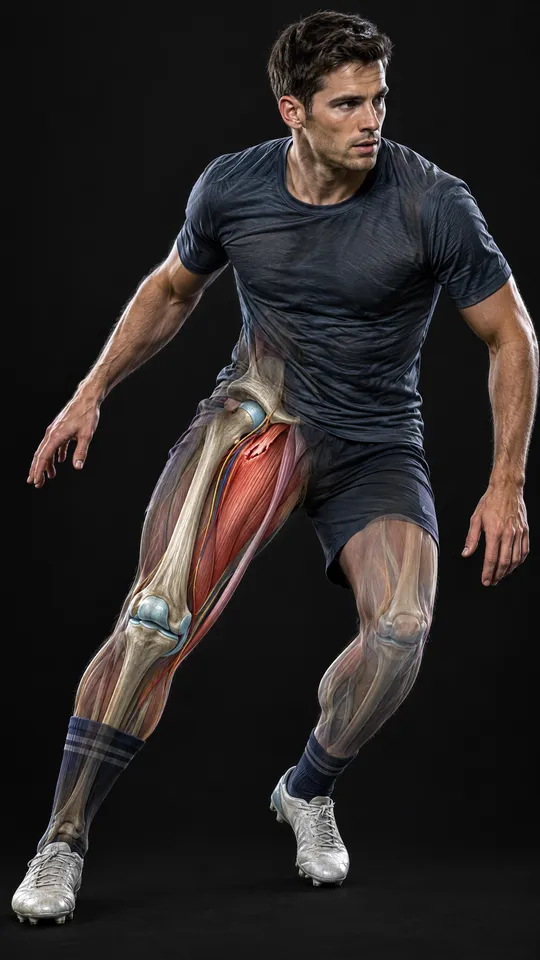

Footballer changing direction with the inner thigh muscles shown and a strain near the top

Adductor strain or another groin problem? How to tell the difference

Groin pain is messy to label: one review found 33 different diagnostic terms in use 6. An international consensus meeting in Doha in 2014 cut through that by sorting groin pain according to where it's coming from 6:

  • Adductor-related: tenderness over the adductors and pain on resisted squeezing or stretching, felt high on the inside of the thigh. This page.
  • Iliopsoas-related: pain more to the front of the thigh, sore when the hip flexor is pressed or when you lift your knee against resistance.
  • Inguinal-related: pain around the inguinal canal, often worse with coughing, sneezing or resisted sit-ups.
  • Pubic-related: tenderness right on the pubic bone at the front of the pelvis. See osteitis pubis.
  • Hip-related: pain coming from the hip joint itself.

More than one can be present at once. If you're not sure the adductors are the culprit, our groin strain page is the broader starting point.

How it's diagnosed

An adductor strain is a hands-on diagnosis. Under the international consensus on groin pain in athletes, it takes two findings together: tenderness when the adductors are pressed, and pain when you squeeze against resistance 6. There's a catch. The pain the test produces has to be the pain you came in with, and a merely sore spot doesn't count 6. Before any testing, a clinician asks how it happened and what you've noticed since, then checks for swelling, bruising and muscle strength 4.

Scans take a back seat for a reason. Imaging findings are common in athletes with no symptoms at all, which makes scans a difficult way to diagnose groin pain 6. A clinician also stays alert to other causes, such as a hernia, a stress fracture or a trapped nerve 6.

How we treat it

1
Confirm it's the adductors. We press along the muscle from the pubic bone down, test a resisted squeeze with your knees at two angles, and check whether stretching reproduces the pain 6,10. For most people that's enough, no scan needed. Our sports physiotherapy page explains how an appointment runs, or you can see us at Engadine, Mount Annan, Narellan or Appin.
2
Settle a fresh strain first. Rest, ice (20 minutes at a time, several times a day, never straight on the skin), compression and elevation. Skip heat, alcohol and massage in that early window; massage can increase swelling 4.
3
Start loading early and gently. Squeezing a ball between your knees while lying on your back is a better starting point than it looks. Legs straight, or hips bent to 45°, were the positions that produced the strongest activity in three of the main adductor muscles in one study 10.
4
Build it up in stages. From those holds into resisted band work, then slower lowering (eccentric) exercises, then the Copenhagen adduction exercise, which has its own three progression levels 9,5. Our exercise prescription and conditioning page covers how we progress programs like this.
5
Move up on criteria, not the calendar. Pulling the leg inwards against gravity without pain is one of the milestones used to decide when you're ready for the next phase 9.

Why lean on loading? In a randomised trial of 68 athletes with long-standing adductor-related groin pain, 23 of those given active strength and coordination training returned to sport without groin pain, against 4 of those given physiotherapy without active training 2.

We'd be doing you a disservice if we stopped there. A Cochrane review found only two eligible trials, 122 people in total, both at high risk of bias, and concluded the evidence was insufficient to recommend any one conservative treatment 3. The exercise advantage wasn't statistically significant on patients' own overall rating at 16 weeks, or on treatment success at 8 to 12 years 3. The fair summary: active loading is the best-supported first-line approach, but the evidence base is small and people respond differently. That's an argument for an individual assessment, not a program off the internet.

Other treatments we may use

Hands-on treatment.

Not in the first few days 4. After that, manual therapy is a reasonable companion to loading. In the second Cochrane trial, a combined approach using heat, manual therapy and stretching did as well as exercise therapy alone, and got athletes back to full sport about 4.5 weeks sooner on average 3. Small trial, but a real one.

Stretching.

Gentle adductor stretching is a standard part of rehab 1. On their own, they fall short: a program built around stretching, electrotherapy and friction massage did worse than exercise therapy at 16 weeks 3.

Imaging.

Rarely needed. Ultrasound can show the damaged area if the diagnosis is unclear, and an X-ray may be used to rule out a fracture 4.

Surgery.

Rarely required for a strain 4.

Strengthening to stop it coming back.

In a trial of 35 semi-professional Norwegian men's football teams, one exercise (the Copenhagen adduction, done three times a week preseason and once a week in season) cut the risk of reporting groin problems by 41% 5. A prevention study, not a treatment trial, but a good reason to keep the exercise going once you're back.

Your recovery path: Reset, Rebuild, Return

An adductor strain is worked through The Well Motion Recovery Path™. What moves you up a phase is what the inner thigh can take, not the week count.

  • Reset: the first few days of a fresh strain. Rest, ice, compression and elevation, with heat and massage left out 4. Expect walking to be sore. If the pain has been there for months, this phase is brief. We move you on once walking is comfortable and a gentle ball squeeze doesn't make the pain build.
  • Rebuild: the longest phase. Ball squeezes, band work, slow lowering exercises, then the Copenhagen adduction exercise 9,5, with manual therapy alongside after the first few days 4. Expect the muscle to feel worked the next day. We move you on when you can pull the leg inwards against gravity without pain 9.
  • Return: running, changing direction and kicking, or whatever your work asks of the leg. We test those tasks at the speed you need them. You leave with the Copenhagen exercise to keep going 5.

How long it usually takes. In a 2023 systematic review, athletes with partial adductor tears returned to play 1 to 7 weeks after injury with physiotherapy. Complete tears averaged 8.9 weeks without surgery and 14.2 weeks with it 11, a choice that rests with a specialist. Those figures come from low-level studies of athletes, so treat them as a guide.

Reducing your risk of it coming back

Prevention has been trialled for groin injuries, so this list is firmer than most:

  • Keep the Copenhagen exercise in your week. The trial that found 41% fewer groin problems ran it three times a week through a 6 to 8 week preseason, then once a week across a 28 week season 5. The players were semi-professional men. How well it carries over to other groups isn't known.
  • Don't read one trial as the whole picture. Seven earlier trials of groin prevention programs, pooled across 4,191 athletes, showed a 19% drop in injuries that wasn't statistically significant 8.
  • Protect your adductor strength. Reduced adductor strength, on its own or relative to the muscles on the outside of the hip, is a recognised risk factor for groin injury. So is a previous groin injury 7. If you've strained it once, the strength you built in rehab is worth keeping.
  • Don't let sport-specific training lapse. Lower levels of it are linked with more groin injuries 7. When you've had time off, increase the intensity gradually 4.

When to get it checked properly

Most adductor strains are straightforward. Get it assessed properly if:

  • The pain is severe, or a fracture or dislocation can't be ruled out 4
  • It isn't getting better within a week 4
  • It keeps flaring every time you return to full training
  • The pain sits on the pubic bone rather than the inner thigh
  • You also have urinary, bowel or gynaecological symptoms: groin pain doesn't always come from a muscle, and these need a medical review 1,6

None of that is cause for alarm. It usually just means the right structure hasn't been identified or loaded yet, and that's fixable.

Your first appointment

We start by listening: how it began, what makes it worse, and what it's stopping you from doing. Then we examine the area, explain what we find in plain English, and agree a plan with you. Your first visit is 40 minutes at Engadine and 30 minutes at our other clinics.

We see patients at Engadine, Mount Annan, Narellan and Appin, and at home through our mobile physiotherapy service. If you have private health cover, here's how health fund rebates work for physiotherapy.

FAQs

How long does it take for an adductor strain to heal?

It depends on the grade (little loss of strength at grade 1, a partial tear with weakness at grade 2, a complete tear at grade 3 1) and on how the rehab is progressed. We couldn't find good-quality research giving reliable timeframes for each grade of adductor strain, so we won't invent one. The bigger risk is leaving it: athletes in one trial had lived with it for a median of 40 weeks before treatment 2. Our groin strain page covers typical timeframes.

What does adductor strain feel like?

A sudden, severe pain in the groin or high on the inside of the thigh that gets worse with activity. Moderate to severe strains can bruise or swell. The spot is tender to press 1.

What is the adductor squeeze test?

You lie on your back and squeeze your knees together against resistance 1, and one study found hips at 0° or 45° the best positions to test in 10. Pain on squeezing, together with tenderness over the adductors, is how adductor-related groin pain is identified 6. It's also used to track progress.

How to release a tight adductor muscle?

It depends on timing. On a fresh strain, don't: healthdirect advises against massage on a mild strain because it can increase swelling 4, whether it's your own hands or someone else's. Once the early phase has settled, gentle stretching 1 and hands-on treatment 3 are options. For pain that keeps coming back, a program built around stretching and massage did worse than exercise therapy in one trial 3.

What exercise strengthens adductors?

A ball squeeze is the usual starting point 9, progressing through resistance bands to the Copenhagen adduction exercise, which cut groin problems by 41% in one football trial 5. Where you start depends on your grade and your pain: that's what an assessment sorts out.

More Groin conditions

Groin

Groin Strain

A strain of the adductor muscles that pull the leg inward, common in sports with sudden changes of direction.

Read more

An inner-thigh strain that keeps coming back usually isn't asking for more rest.

It's asking for the right load, in the right order. Book an appointment and we'll confirm what's involved and build the program from there, or head back to the groin injury guide.

Book an Assessment
Ahmed Elsayed, Principal Physiotherapist
Reviewed by Ahmed Elsayed Principal Physiotherapist at Well Motion

References

  1. Opara K, Pinkerman S, Kaiser K. Adductor Strain. StatPearls (NCBI Bookshelf), StatPearls Publishing; last updated December 2025. https://www.ncbi.nlm.nih.gov/books/NBK493166/
  2. Hölmich P, et al. Effectiveness of active physical training as treatment for long-standing adductor-related groin pain in athletes: randomised trial. The Lancet, 1999;353(9151):439-43. PMID 9989713. https://doi.org/10.1016/S0140-6736(98)03340-6
  3. Almeida MO, et al. Conservative interventions for treating exercise-related musculotendinous, ligamentous and osseous groin pain. Cochrane Database of Systematic Reviews, 2013;(6):CD009565. PMID 23740671. https://doi.org/10.1002/14651858.CD009565.pub2
  4. Sprains and strains. healthdirect Australia (Australian Government-funded; last reviewed June 2024). https://www.healthdirect.gov.au/sprains-and-strains
  5. Harøy J, et al. The Adductor Strengthening Programme prevents groin problems among male football players: a cluster-randomised controlled trial. British Journal of Sports Medicine, 2019;53(3):150-157. PMID 29891614. https://doi.org/10.1136/bjsports-2017-098937
  6. Weir A, Brukner P, Delahunt E, et al. Doha agreement meeting on terminology and definitions in groin pain in athletes. British Journal of Sports Medicine, 2015;49(12):768-74. PMID 26031643. https://pmc.ncbi.nlm.nih.gov/articles/PMC4484366/
  7. Whittaker JL, Small C, Maffey L, Emery CA. Risk factors for groin injury in sport: an updated systematic review. British Journal of Sports Medicine, 2015;49(12):803-9. PMID 25833903. https://doi.org/10.1136/bjsports-2014-094287
  8. Esteve E, Rathleff MS, Bagur-Calafat C, Urrútia G, Thorborg K. Prevention of groin injuries in sports: a systematic review with meta-analysis of randomised controlled trials. British Journal of Sports Medicine, 2015;49(12):785-91. PMID 25730819. https://doi.org/10.1136/bjsports-2014-094162
  9. Tyler TF, Silvers HJ, Gerhardt MB, Nicholas SJ. Groin injuries in sports medicine. Sports Health, 2010;2(3):231-6. PMID 23015943. https://pmc.ncbi.nlm.nih.gov/articles/PMC3445110/
  10. Lovell GA, Blanch PD, Barnes CJ. EMG of the hip adductor muscles in six clinical examination tests. Physical Therapy in Sport, 2012;13(3):134-40. PMID 22814446. https://doi.org/10.1016/j.ptsp.2011.08.004
  11. Farrell SG, Hatem M, Bharam S. Acute Adductor Muscle Injury: A Systematic Review on Diagnostic Imaging, Treatment, and Prevention. The American Journal of Sports Medicine, 2023;51(13):3591-3603. PMID 36661128. https://doi.org/10.1177/03635465221140923