Ice, used properly.
A cold pack for 20 minutes at a time, several times a day 1, or every two waking hours early on 2, always with damp towelling between the pack and your skin.
You lifted something awkwardly, or reached at full stretch for a ball, and felt something pull across the front of your stomach. Since then, getting out of bed sideways is the only way that works, and coughing is worse. It hurts in one spot you can put a finger on, and settles the moment you stop using it. That's the pattern of an abdominal wall strain, and why it's worth knowing what's torn and how much.
Your abdominal wall is layered. The one most people know is rectus abdominis, the "six-pack" muscle running from your lower ribs and breastbone down to your pubic bone. It bends your trunk forward and braces every time you cough, lift or push. Either side of it sit the obliques, which handle twisting.
A strain happens when that muscle or its tendon is stretched or torn 1. In the abdominal wall it's usually a sudden, forceful contraction against resistance, or a sudden stretch while the muscle is already working hard. The clearest published description is a young athlete who tore the right rectus abdominis during plyometric box jumps: severe pain low on the right side, tender to press, with the muscle guarding and movement making it worse 3.
How much damage is done sits on a scale. Australian guidance now uses a six-step grading for muscle injuries 2:
| Grade | What it means |
|---|---|
| 0a | A focal injury you can feel, but imaging looks normal |
| 0b | Generalised soreness, the kind that follows unfamiliar work |
| 1 | Small local tears, limited loss of power |
| 2 | Moderate localised tears, moderate loss of power |
| 3 | Extensive tearing, significant loss of power |
| 4 | A complete tear of the muscle, or where muscle meets tendon |
That grading covers muscle injuries generally, because there's very little research on abdominal strains specifically: fewer than a dozen ultrasound-diagnosed rectus abdominis tears have ever been written up 3. Anyone quoting confident numbers for this exact injury is going beyond the evidence.
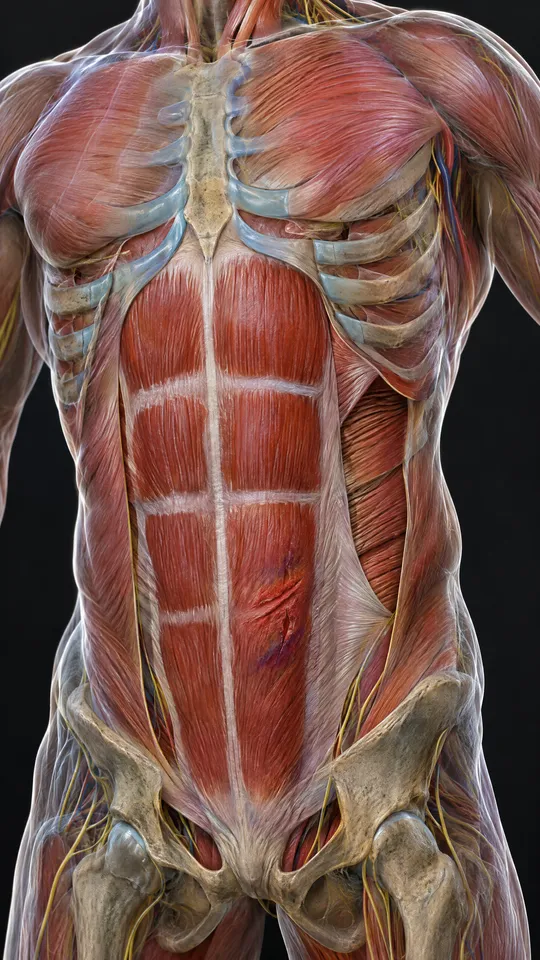
Several things sit in the same place and behave differently enough to matter.
A strain is usually worked out from your story and an examination, with scans used only sometimes 1. You'll be asked how it happened and what you're feeling, then checked for swelling, bruising, pain and muscle strength 1. How much power you've lost feeds into the grade 2.
What hurts tells the clinician a lot. In tennis players with a strained rectus abdominis, the tender spot is usually below the belly button. Pain on a sit-up movement points to a moderate strain. Pain on simply bearing down, or reaching overhead, points to a more severe one 7. If the picture still isn't clear, an ultrasound can show the damaged area and an X-ray can rule out a fracture 1.
A cold pack for 20 minutes at a time, several times a day 1, or every two waking hours early on 2, always with damp towelling between the pack and your skin.
No heat, no alcohol, and no firm direct massage in the first 72 hours. The Australian guidance is explicit that massage "can cause more swelling" at this stage 1,2. Running goes on the same list 2.
For moderate to severe strains, a few weeks of support is part of standard management alongside strengthening 1.
A Cochrane review of 61 studies found topical anti-inflammatories do beat placebo for acute strains, but the benefit depends heavily on the product: diclofenac Emulgel, ketoprofen gel and ibuprofen gel performed best, every other drug and formulation combination was meaningfully weaker, and benzydamine didn't beat placebo at all 4. Oral pain relief carries its own warning in the Australian guidance: these medicines "can sometimes disrupt the healing of soft tissue injuries" 2. That's a conversation for your GP or pharmacist; Well Motion physiotherapists don't prescribe or administer medication.
Surgery is rarely required for a strain 1, and even for the most severe grade, medium-to-long-term function turns out similar whether someone has surgery or immobilisation followed by physical therapy 2.
An abdominal strain is treated in the order set out in The Well Motion Recovery Path™. You move up a phase on what your trunk can tolerate, not on a date.
How long it usually takes. No large study has measured recovery time for this injury. Soft tissue injuries generally take a few weeks 2. In the one published grade 2 rectus abdominis tear managed without surgery, the athlete was back at sport at 5 weeks and a scan confirmed healing at 3 months 3. That is a single case, so your grade matters more than that figure.
No trial has tested how to prevent an abdominal strain, so these lean on what's known about when they happen and why they recur:
There's no official five-item checklist for this, whatever a search result suggests. What the Australian guidance actually flags:
Imaging isn't automatic, but it has a role: ultrasound can show the damaged area, and an X-ray can rule out a fracture 1.
Most abdominal strains are none of the above. They're a muscle asked to do more than it was ready for, and they respond well to being rebuilt in the right order.
We start by listening: how it began, what makes it worse, and what it's stopping you from doing. Then we examine the area, explain what we find in plain English, and agree a plan with you. Your first visit is 40 minutes at Engadine and 30 minutes at our other clinics.
We see patients at Engadine, Mount Annan, Narellan and Appin, and at home through our mobile physiotherapy service. If you have private health cover, here's how health fund rebates work for physiotherapy.
Sharp or pulling pain in one identifiable spot, worse when you cough, laugh, sneeze, sit up or twist. It's tender to press on, and the muscle often guards, tightening protectively as you move 3. Swelling, bruising and difficulty using the area can come with it 1.
In two stages: protection, relative rest, ice, compression and elevation early 1,2, then graded trunk-stabilisation strengthening 3. The first stage settles it; the second stops it recurring.
Mostly by how much power you've lost, which is why the modern grading runs on a scale rather than a yes-or-no 2. "Pulled" and "torn" are the same injury at different points on the grading table above, from soreness with a normal scan through to a complete tear.
It depends on the grade, and we won't quote a number the evidence can't support. Soft tissue injuries generally take a few weeks 2. In the one published conservatively managed grade 2 rectus abdominis tear, the athlete returned to sport pain-free at five weeks, with imaging confirming healing at three months 3. Hamstring strains, better studied, average about three weeks with tails beyond 100 days 2. The range is wide, and your grade matters more than any average.
For an abdominal wall muscle injury: pain in a specific spot you can reproduce by loading the muscle, tenderness when you press on it, and difficulty using the area normally 1,3. Swelling, bruising and stiffness commonly come with those 1,2.
Muscular pain has a location you can point to, is tender to press, and changes predictably with what you ask the muscle to do: a sit-up, a twist or a cough provokes it, unloading eases it 3,5. Pain that ignores all of that, or arrives with fever, vomiting or bleeding, needs a doctor, not a physiotherapist 1,2.
Pain around or between the lower ribs on one side, worse on a deep breath, a twist or an overhead throw. In cricket and throwing sports it's called a side strain.
Read moreSeparation of the abdominal muscles down the midline after pregnancy. Often noticed as a gap or doming through the middle of your belly, and a core that feels like it won't switch on.
Read more
How would you like to reach us?
Message us on WhatsAppFor bookings and enquiries. Please don't send medical details. Call (02) 8111 5633Request a call-back
Request sent
Thank you. We'll call you back on the number you gave us.
This is a preview, so nothing was actually sent.