Carpal Tunnel Syndrome
Numbness, tingling or pins and needles through your thumb, index and middle fingers, often worst overnight. It's a nerve compressed at the wrist, and there's usually plenty worth trying before surgery comes up.
Read moreMaybe it's crept up over months at a keyboard, or it's the kind of ache that shows up in a trade that has you gripping and twisting tools all day, or it's turned up since you've been carrying and settling a new baby constantly. However it's arrived, that nagging ache along the thumb-side of your wrist that gets worse with use and doesn't fully settle with a weekend off is a genuinely common presentation, and a very treatable one.
The tendons that move your thumb pass through a narrow tunnel on the thumb side of your wrist. Repeated thumb and wrist movement, particularly gripping while bending your wrist side to side, can irritate and thicken the sheath around those tendons, which is what creates the pain and sometimes a "catching" feeling with thumb movement2.
This specific condition, De Quervain's tenosynovitis, is significantly more common in women than men, and particularly common in pregnancy, postpartum, and while breastfeeding, likely from the repetitive wrist positions involved in lifting and holding a baby. It's also strongly linked to repetitive wrist movements more broadly: the classic occupational picture, whether that's computer work, trade work involving repeated gripping and twisting, or repetitive hobbies like knitting1.
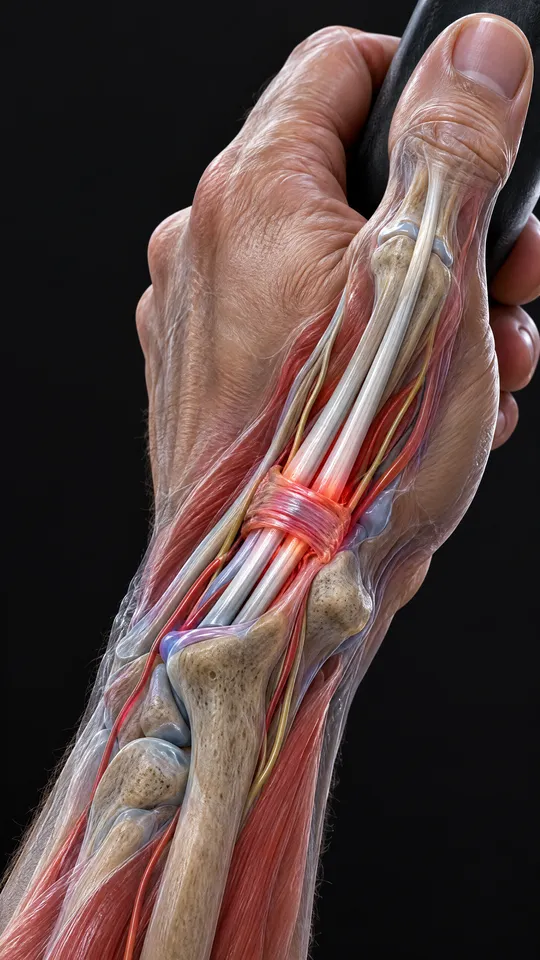
Not necessarily. They're both common, both linked to repetitive wrist use, and both genuinely confused with each other, but they're different conditions. Carpal tunnel involves pressure on the median nerve, and typically causes numbness, tingling or a "pins and needles" feeling in your thumb, index and middle fingers, often worse at night. De Quervain's tenosynovitis is a tendon problem, not a nerve one, so pain, not numbness, along the thumb side of the wrist and thumb movement is the more typical picture. If numbness or tingling is your main symptom, our Carpal Tunnel Syndrome page is likely the more relevant one to read.
This is usually a straightforward clinical diagnosis: no scan needed in most cases. The classic test involves tucking your thumb into your palm and bending your wrist toward your little finger; sharp pain along the thumb side of the wrist during that movement is a strong indicator1.
If this is a work-related injury (repetitive strain from tool use or manual tasks is a real, recognised WorkCover claim category), see our WorkCover Physiotherapy page for how that process works.
Once it's settled, a few practical changes genuinely reduce the chance of it flaring up again:
Most cases respond well to the approach above. But it's worth a proper assessment rather than persisting with self-management if:
We start by listening: how it began, what makes it worse, and what it's stopping you from doing. Then we examine the area, explain what we find in plain English, and agree a plan with you. Your first visit is 40 minutes at Engadine and 30 minutes at our other clinics.
We see patients at Engadine, Mount Annan, Narellan and Appin, and at home through our mobile physiotherapy service. If you have private health cover, here's how health fund rebates work for physiotherapy.
No, the damage usually isn't permanent, and it heals with the right approach. The key is actually addressing what's driving the irritation (load, technique, workstation setup) rather than just resting until it flares up again the moment you go back to normal activity.
For De Quervain's tenosynovitis specifically, recovery can genuinely take 2 to 5 months with conservative treatment: it has a reputation for being stubborn1. That's longer than a lot of people expect, and exactly why understanding what's actually driving the irritation matters more than just waiting for a typical "sprain" timeline to pass.
Numbness, tingling or pins and needles through your thumb, index and middle fingers, often worst overnight. It's a nerve compressed at the wrist, and there's usually plenty worth trying before surgery comes up.
Read morePain on the little-finger side of the wrist, often after a fall onto an outstretched hand, racquet sports, or repeated twisting and loading. Usually managed conservatively first.
Read moreWrist pain that started with a fall onto an outstretched hand and hasn't settled. Scaphoid fractures are commonly missed on an early X-ray, so it's taken seriously even when imaging looks clear.
Read moreA wrist sprain means a ligament, one of the tough bands holding your wrist bones together, has been stretched or torn. It usually happens during sport, a sudden movement or a fall
Read moreTrigger finger is a finger or thumb that catches, gets stuck bent, or straightens with a click or snap
Read moreA ganglion cyst is a benign (non-cancerous) collection of fluid on a joint or tendon. It's the most common lump on the hand, usually on the back of the hand or wrist
Read moreWith mallet finger, the tip of your finger stays bent and you can't straighten it yourself
Read more
How would you like to reach us?
Message us on WhatsAppFor bookings and enquiries. Please don't send medical details. Call (02) 8111 5633Request a call-back
Request sent
Thank you. We'll call you back on the number you gave us.
This is a preview, so nothing was actually sent.