Traction.
A gentle, controlled pull along the neck. Traction was one of the components linked to less pain 3, and the guideline pairs intermittent traction with exercise and joint treatment for longer-standing arm pain 2. We don't use it on its own.
It usually starts in your neck, but what bothers you most is your arm: a deep ache behind the shoulder, pins and needles into a couple of fingers, a hand that feels oddly weak lifting the kettle.
That's what most people mean by a pinched nerve in the neck. The clinical name is cervical radiculopathy. It's miserable while it lasts, but it usually gets better 1.
The nerves that supply your arm leave the spine through small gaps between the vertebrae in your neck. When one is irritated, you feel it wherever that nerve goes, so your arm can hurt more than your neck 1.
There are three common reasons for the irritation 1:
"Pinched" isn't quite the right word. Inflammation around the nerve can be enough to cause symptoms, even without something pressing hard on it 1. Symptoms can also ease and flare over weeks instead of staying the same 1.
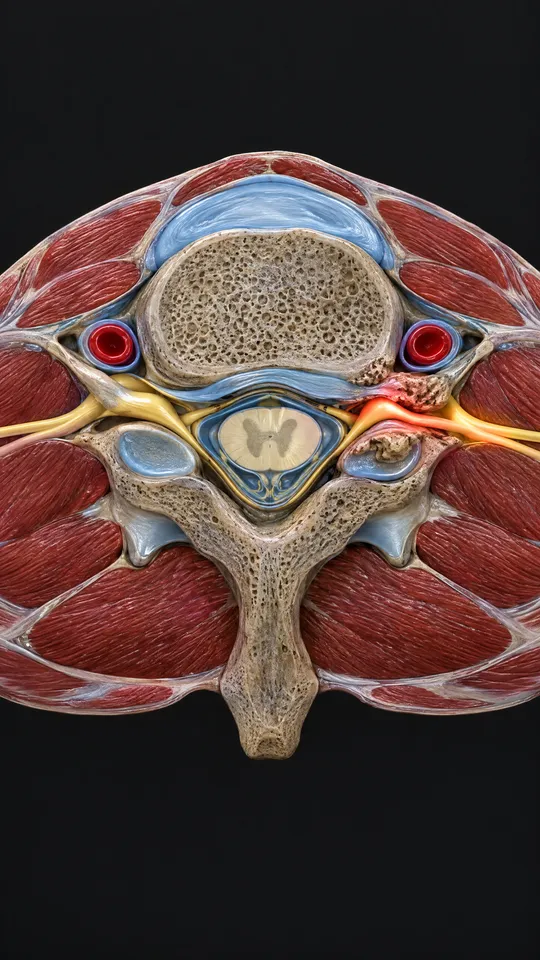
A pinched nerve affects a nerve root, where the nerve branches off the spinal cord. Less often, the pressure is on the spinal cord itself (myelopathy). Myelopathy needs urgent medical review, not a physio program. The signs to watch for are clumsy hands, poor balance or trouble walking, weakness in your arms or legs, and new changes to your bladder or bowel 1.
Arm pain and tingling don't always come from the neck. Shoulder problems, carpal tunnel syndrome and thoracic outlet syndrome can all overlap with it. If your pain stays in your neck and doesn't travel, neck pain is probably the better page for you.
No single hands-on test settles it. The evidence behind every one of them is very low certainty 6. So we look at the whole picture: where your symptoms travel, what sets them off, and your strength, sensation and reflexes.
Most of the time this is diagnosed from your story and a physical examination. X-rays and MRI scans usually aren't required 1. You'll be asked about your neck and arm symptoms, then have things like your neck movement and your arm and hand strength checked 1. The best-known test is the Spurling test: your head is turned and tipped back, which narrows the gap the nerve leaves through, to see whether that brings on your arm symptoms 7. No single test is reliable enough to settle it 6, so the overall pattern counts for more than any one result.
You may be offered a scan if your symptoms aren't improving, or if they're having a big effect on your quality of life 1.
First we check for anything that needs a doctor instead. Then, depending on what we find:
What the evidence can and can't tell us: combining these approaches gives the best-supported pain relief, with moderate confidence 3. For long-standing arm pain, the guideline's recommendation rests on moderate evidence. For a brand-new episode, it rests on expert opinion only 2.
We also won't tell you physio is as good as surgery. Surgery is usually kept for people who don't improve or whose nerve signs are severe or getting worse 4. One review found no clear difference in arm pain or disability, on low-certainty evidence 4. A 2026 review of five trials found surgery did better for neck and arm pain, mainly in disc herniation 5. Physio is a sound place to start, and we'll refer you on if you need it.
A gentle, controlled pull along the neck. Traction was one of the components linked to less pain 3, and the guideline pairs intermittent traction with exercise and joint treatment for longer-standing arm pain 2. We don't use it on its own.
In the 2025 review it looked very effective, but so few trials used it that the authors couldn't draw firm conclusions 3. If we use it, it's an add-on to the rest of your treatment.
Pain relief medicine can help 1; ask your GP or pharmacist. Surgery is a conversation with your GP and a specialist.
With a pinched nerve in the neck, The Well Motion Recovery Path™ settles the nerve first, then builds up your neck and arm. You move up a phase on how the arm behaves, not on a date.
How long it usually takes. Most people start to improve within 12 weeks, though settling can take up to a year 1. A review of disc-related cases, built on only three sound studies, found substantial improvement within 4 to 6 months, with complete recovery taking 24 to 36 months in about 83% of patients 8.
Preventing a pinched nerve in the neck hasn't been tested in trials. What has been studied is who tends to get one, and that's where most of this comes from:
Get urgent medical care by seeing a GP the same day, or an emergency department if you can't get in, if you notice 1:
Weakness or numbness in one arm, with none of the signs above, is something we assess: call us the same day.
Book an assessment if you're not improving after about 6 weeks, or if your symptoms are getting worse 1.
None of this is a reason to panic. Most people improve 1. The point is spotting the few who need something different, early.
We start by listening: how it began, what makes it worse, and what it's stopping you from doing. Then we examine the area, explain what we find in plain English, and agree a plan with you. Your first visit is 40 minutes at Engadine and 30 minutes at our other clinics.
We see patients at Engadine, Mount Annan, Narellan and Appin, and at home through our mobile physiotherapy service. If you have private health cover, here's how health fund rebates work for physiotherapy.
Usually, yes. Most people start to improve within 12 weeks, although full recovery can take up to a year and symptoms can come and go 1. If nothing has shifted by 6 weeks, or it's getting worse, get it assessed 1.
Don't stay in one position for long, don't rest completely, and don't go straight back to everything at full load. Build up gradually 1. Stepping back from work and exercise altogether isn't the aim either 2.
There's no instant fix, and we'd be wary of anyone offering one. The best-supported route is nerve-gliding, joint treatment, traction and strengthening together 3, plus sensible pacing 1. Expect to measure progress in weeks.
No source we trust names one best position, so we won't pretend one does. In practice, choose a comfortable, supported position that keeps your neck roughly in line with your body and doesn't bring on arm symptoms.
Stiff, aching, recurring neck pain that builds through the day at a desk or on the tools.
Read moreNeck pain, stiffness or headache that started after a car accident, often a day or two later.
Read moreYou've woken with your head stuck tilted to one side, and a spasm that won't let you straighten it. Infants too.
Read moreArm symptoms coming from compression in the narrow space between your neck and shoulder, often worse overhead.
Read moreA headache that starts in the neck joints and muscles rather than in your head.
Read moreAching at the base of your neck and between your shoulder blades after hours looking down at a screen.
Read more
How would you like to reach us?
Message us on WhatsAppFor bookings and enquiries. Please don't send medical details. Call (02) 8111 5633Request a call-back
Request sent
Thank you. We'll call you back on the number you gave us.
This is a preview, so nothing was actually sent.