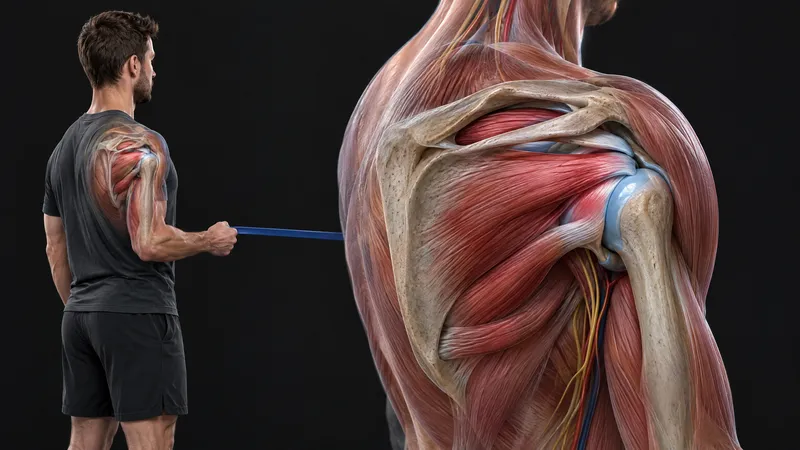
Is this the right page for you?
Rotator cuff pain has a fairly recognisable pattern. It sits in the shoulder and the upper arm, it's worse when you lift your hands above your head, and it's worse lying on that side at night 1. It can feel deep in the joint, or at the front or back of the shoulder, and some people describe it as a catching pain 2.
What doesn't fit that pattern is worth knowing too. Pins and needles or a burning pain is more likely to be coming from your neck than from the shoulder joint itself 2. And if that's what you've got, the exercises below aren't the right starting point.
It's also worth being calm about scans. An ultrasound can give clues about where the pain is coming from, but a diagnosis can't be made from the ultrasound alone 2. And many investigations show "changes" to a shoulder that represent the normal passage of time (even by 45 years of age) rather than damage 2. A finding on a report isn't automatically your problem.
If you'd like the full picture on what a torn cuff is and how it's diagnosed, that's on our rotator cuff tear page. This one is about what to do with it.
What the research actually says about rotator cuff exercises
Most articles on rotator cuff exercises will hand you "the 7 best exercises". We're not going to, because the evidence doesn't support ranking them that way.
The most direct comparison available pooled 22 randomised trials and 1,281 people. Motor control programs (the ones focused on how well you control the movement rather than how much you lift) came out slightly ahead of non-specific exercise for disability, in both the short and medium term. For pain in the short term, the difference didn't hold up. Evidence for eccentric programs and for scapula-focused programs, and for training hard versus training light, was low to very-low certainty, and no trial has compared different frequencies or durations at all 3.
The line that matters most is the authors' own: it's unclear whether the effects came from the motor-control exercise itself, or from other features of those programs: the progression and the tailoring 3.
Then there's the uncomfortable one. In a large randomised trial, 708 adults with a rotator cuff disorder were split between a progressive exercise program of up to six physiotherapy sessions and a single best-practice advice session with a physiotherapist. Over 12 months, there was no evidence of a difference between them in shoulder pain and disability 4. Every group improved from baseline, and there were no serious adverse events 4. But more supervised sessions didn't win.
That's inconvenient for a physiotherapy website, and it's here anyway. What it tells you is where the value sits: in getting the right plan for your stage, not in the number of appointments. So that's how the rest of this page is organised.
Stage 1 (Early): movement without load
The goal here isn't strength. It's getting the shoulder moving again without the cuff having to work to make it happen.
Pendulum swings. This is the standard warm-up before the rest of the program. Lean forward onto a table, supporting yourself with your good arm, and let the injured arm hang. Swing it gently forwards and backwards, then across your body. Repeat 2 to 3 times for one minute 5.
Then lie down. The reason the early exercises start on your back is specific: with gravity taken out, the arm isn't working to lift itself, which stops you shrugging or "hitching" the shoulder up to get the arm moving 5. That hitching habit is one of the harder things to unlearn later, so it's worth not building it now.
Lying on your back, the usual early work is assisted elevation (using your good hand or a light stick to bring the injured arm up overhead and back down slowly) and gentle rotation with the elbow tucked in at your side. Add some scapular setting: with your arms by your sides, draw the shoulder blades gently down and back, hold a few seconds, release.
Short of range is fine at this stage. Sharp pain isn't.
Stage 2 (Mid): rebuilding control
Stage 2 is where gravity comes back. The same movements shift from lying to sitting and standing, which is a real step up in demand even though the movement looks identical.
Typical work here is isometric holds (pressing gently outwards or inwards against a wall or your other hand and holding, without the arm moving) then banded rotation with the elbow at your side, then rowing work for the muscles around the shoulder blade. Range gradually increases, and you start asking the arm to control the movement down as well as up.
This is the stage where the motor-control idea from the research 3 comes in. It isn't a special exercise. It's the quality of the movement, in a range your shoulder can currently manage.
If stiffness or guarding is the thing blocking progress rather than weakness, manual therapy alongside the program can help the shoulder tolerate the loading work, as part of a plan, not as a treatment on its own.
Stage 3 (Late): load, overhead, and back to what you do
The last stage is the one most home programs never get to, and it's the one that decides whether the shoulder holds up.
Here the arm works through fuller range, against real resistance: loaded rotation, controlled lowering, and a graded return to overhead, often starting on an incline before going fully vertical. Then the part that's specific to you, because a painter, a swimmer and a grandparent lifting a toddler need different end points.
A note on one popular piece of advice: eccentric programs (the slow-lowering ones) are widely recommended, but the evidence comparing them to other exercise was rated low to very-low certainty 3. They're a reasonable tool, not a proven edge.
Building this stage properly is what our exercise prescription and conditioning work is for: progressive load, matched to what your shoulder is currently doing rather than to a generic protocol.
How often, and how you know you've earned the next stage
A typical rotator cuff tear program is done 2 to 3 times a day, for 3 to 6 months, with a physiotherapist reviewing progress and changing the exercises as you get stronger 5. That check-in is the point: someone watching how the shoulder is moving and adjusting what you're doing, which is the "progression and tailoring" the research review couldn't separate from the exercise type itself 3.
If nobody is reviewing you, the workable rule is this: a mild ache during and shortly after is acceptable; pain that's sharp, that lingers into the next day, or that's steadily getting worse week to week means you've moved up too fast. Drop back a stage rather than pushing on.
What to avoid while it's still irritable
Two things stand out in the sources, and they're both about load above shoulder height: avoid repetitive overhead activity, and avoid lifting heavy objects above shoulder height 1. Modifying the activities that are aggravating it is a first-line part of treatment, not an optional extra 1,2.
Beyond that, the list is short. Don't push through weakness assuming it'll strengthen itself: a partial-thickness tear can progress to a full-thickness one over time 1. And don't rest it completely either; resting from the aggravating activity is what the sources describe 1, not shutting the shoulder down.
Smoking and carrying extra weight are both recognised risk factors for rotator cuff injury, alongside repetitive overhead activity and age-related wear 1.
When to stop and get it looked at
Call 000 immediately if shoulder pain comes with chest tightness, shortness of breath, or pain radiating down the arm. Discomfort around the front of one or both shoulders can be a sign of a heart attack 2. That's rare, and it's the one thing on this page that can't wait.
Otherwise, book an assessment rather than starting a program if:
- You can't lift the arm away from your body. Both a complete rotator cuff tear and an axillary nerve injury cause that, and telling them apart needs a close clinical examination 2
- The pain is severe, or it started recently after a fall or a specific injury
- Night pain is regularly waking you 1
- You've been working at it and nothing is shifting: physiotherapy plus activity modification is usually the first approach tried 1,2, and if it isn't working, the plan needs changing rather than repeating
None of that is meant to worry you. For most people, shoulder pain improves over time with appropriate conservative treatment 2, and it's common for older people with rotator cuff injuries to have no symptoms at all 1.
FAQs
Should I exercise my rotator cuff if it hurts?
Usually yes, within limits: physiotherapy is often the first treatment approach used for a rotator cuff injury, and it typically combines resting from the activities that make the pain worse with stretching and strengthening work 1. The point isn't to avoid all movement, it's to change what's aggravating it while you rebuild 2. If the pain is severe, recent, or followed a fall, get it assessed before you start.
What is the best exercise for rotator cuff pain?
There isn't one, and the research is fairly clear about why. Motor-control style programs were only slightly better than general exercise for disability and no better for short-term pain, and the authors couldn't separate the exercise type from the progression and tailoring that came with it 3. Start at the stage your shoulder is at, load it a little more over time, and the specific movement matters far less than people think.
What is the fastest way to heal a rotator cuff?
There's no shortcut worth chasing. A trial of 708 people compared a progressive exercise program against a single best-practice advice session with a physiotherapist and found no difference at 12 months 4: more intervention didn't speed anything up. The best-supported route is the ordinary one: get assessed, start physiotherapy 1, and work through it consistently over months 5.
How long does it take a rotator cuff to heal?
Longer than most people expect. A typical rotator cuff tear exercise program runs 2 to 3 times a day for 3 to 6 months 5, which is a reasonable planning horizon for the exercise side of things. More generally, shoulder pain can take weeks or months to settle 2. The encouraging part is that for most people it does improve with appropriate conservative treatment 2.
What are two warning signs of a rotator cuff tear?
The two that matter most are weakness and night pain. A cuff injury causes weakness of the shoulder and pain when sleeping on the affected side, alongside pain in the shoulder and upper arm and limited movement, often first noticed during overhead activities like washing or brushing your hair 1. Being unable to lift the arm away from your body is the one that needs a proper examination, because a complete tear and an axillary nerve injury both do it 2.
What happens if a rotator cuff tear goes untreated?
Partial-thickness tears can progress to full-thickness tears over time 1. Rotator cuff problems can also contribute to shoulder osteoarthritis or frozen shoulder down the track 1. That's not a reason to panic; it's the reason to deal with what's loading the shoulder rather than working around it for another year.
Can sleeping position affect rotator cuff pain?
Pain when sleeping on the affected side is a recognised symptom of rotator cuff injury 1, so yes, it's real and it's common. Beyond that, the "best sleeping position" advice you'll find online isn't something we can point to a solid source for. What we suggest in the clinic is practical rather than proven: try not to lie directly on the sore shoulder, and support the arm on a pillow so it isn't hanging or rolled inwards overnight.