Passive treatments.
Ultrasound, iontophoresis, shock wave therapy and low-level laser all come up. The evidence for them is rated weak 4, so we don't lean on them.
It starts as an ache at the front of your shoulder. You notice it reaching for a high shelf, lifting the shopping out of the boot, or pouring the kettle. Overhead presses at the gym have started to catch, and a session of swimming or volleyball leaves it sore the next day. There was no fall and no single moment it went. It just crept in.
That pattern is typical of biceps tendinopathy, often called bicep tendonitis. It's a common cause of pain at the front of the shoulder, and it's usually best managed with physiotherapy and changes to how you load the arm 1. Here's what's going on, how we treat it, and where the evidence is thinner than you might expect.
Your biceps bends your elbow. It also turns your forearm palm-up and helps hold your shoulder in the right position 1. The part that causes trouble here is the long head of the biceps tendon, where it runs across the front of the shoulder 3.
When the load going through that tendon rises faster than it can adapt, it becomes thickened and painful 1. Think a new training block, a jump in overhead work, or a weekend of heavy lifting. Tendon problems in general are more likely if you're active or play sport, and especially if you ramp up intensity over a short period 2.
Your general health matters too. Conditions that affect blood supply to the tendon, such as diabetes, high blood pressure and high cholesterol, can make you more prone to shoulder pain, and so can general deconditioning 1. That's one reason we look at the whole person as well as the sore spot.
Biceps tendinopathy on its own, with nothing else going on in the shoulder, is the less common version. It accounts for only about 5% of cases and is typical of young athletes in overhead sports such as swimming, volleyball, gymnastics and baseball 3. Far more often, the biceps tendon is irritated alongside the rotator cuff, the subscapularis (a deep rotator cuff muscle at the front of the shoulder), impingement or a SLAP injury 3.
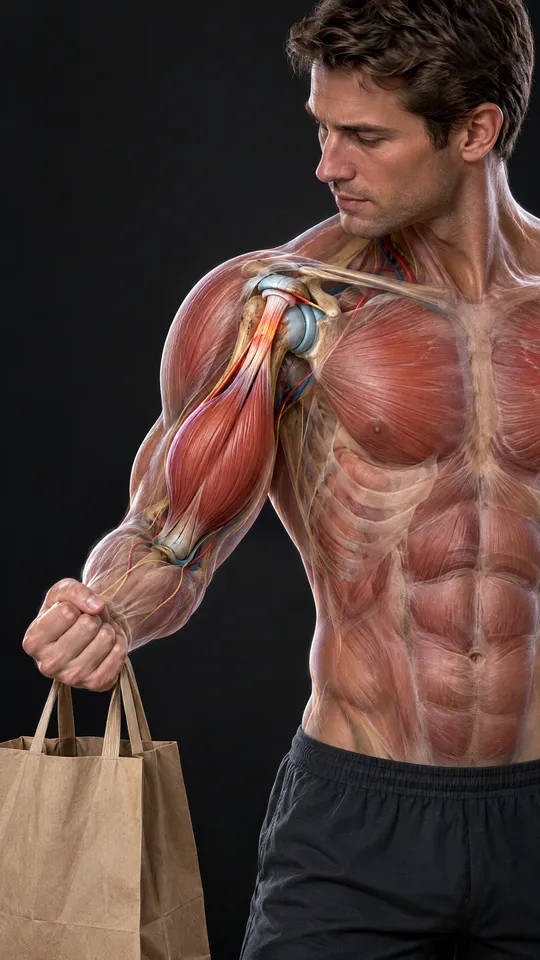
It's often hard to tell by feel, and no single test settles it. Clinicians commonly use two tests called Speed's and Yergason's, but they aren't accurate enough to settle the diagnosis without other findings 4. Scans aren't a shortcut either. MRI has low sensitivity for biceps problems and often misses or misreads them 5. The most reliable approach is putting your history, a hands-on examination and, where needed, imaging together 5.
Because biceps pain so often comes with company 1,3, these are the problems we check for:
Mostly this gets worked out by talking through your symptoms and examining the shoulder. Tests are there to rule other things out 2. We check how far the shoulder moves, how strong it is and whether it feels unstable, then press on the front of the shoulder right over the biceps tendon. In this condition that spot is tender 6.
An X-ray only shows bone, and small changes on it are common and may have nothing to do with your pain 1. An ultrasound or MRI might be worth doing if a more complex soft tissue problem is suspected. Blood tests usually aren't needed 1.
An honest caveat. The research here is thin. A 2023 review screened more than 4,000 records on physiotherapy for this condition and found only 14 studies that met its criteria. Its authors describe a "dearth of evidence" on conservative care, and there's little agreement on the best approach 4. Our loading-first plan follows current NHS guidance 1 and the standard rehab progression 3. It's sensible and low-risk, but it hasn't been proven to beat every alternative.
Ultrasound, iontophoresis, shock wave therapy and low-level laser all come up. The evidence for them is rated weak 4, so we don't lean on them.
Simple over-the-counter painkillers taken regularly can help. Check with your pharmacist or GP if you're unsure, or if you need them for more than two weeks 1.
These can help reduce pain and make rehab easier for some people 1, and they're usually considered when symptoms persist despite other treatment 3. They're given by a doctor, not a physiotherapist, so that's a conversation with your GP.
Procedures called tenotomy and tenodesis are reserved for people who haven't improved with conservative care 3. It's uncommon, and it isn't our call.
Biceps tendinopathy is a load problem, so we plan it along The Well Motion Recovery Path™. You step up a phase on what the tendon tolerates, not on a date.
How long it usually takes. Mild to moderate cases usually settle in 6 weeks to 3 months, and persistent ones can take up to 6 months 1. After sudden overuse, 6 to 12 weeks is usual once the shoulder is deloaded 1. These figures are from NHS patient guidance, and a scoping review found little research behind conservative care 4.
Prevention hasn't been tested on the biceps tendon alone, so the best evidence comes from overhead athletes' shoulders:
None of this means your shoulder is in trouble. A high proportion of shoulder problems resolve with time, relative rest, exercise and pain relief 1.
We start by listening: how it began, what makes it worse, and what it's stopping you from doing. Then we examine the area, explain what we find in plain English, and agree a plan with you. Your first visit is 40 minutes at Engadine and 30 minutes at our other clinics.
We see patients at Engadine, Mount Annan, Narellan and Appin, and at home through our mobile physiotherapy service. If you have private health cover, here's how health fund rebates work for physiotherapy.
Lighten the load first with relative rest, then progressively reload the tendon with a graded exercise program 1,3, ideally guided by a physiotherapist 1. We'd avoid promising a "fix". The research on the best approach is limited 4, but this is the standard, low-risk starting point.
Often, yes, if you give it the right conditions. When it started from sudden overuse, it usually settles within 6 to 12 weeks if you can deload the shoulder 1. "On its own" doesn't mean doing nothing, though. Relative rest, exercise and pain relief are what help most shoulder problems resolve 1. If it hasn't improved after 6 to 12 weeks, see a physio or your doctor 1.
Usually pain at the front of the shoulder, worse when reaching up or out to the side, lifting, or rotating the arm, like driving or pouring the kettle 1. Tendon problems can also bring aching, weakness and difficulty moving 2.
Tendinopathy is the umbrella term. Tendinitis means inflammation of the tendon, and tendinosis means degeneration 2. When biceps tendons are examined under a microscope, they tend to show degenerative changes like other tendinopathies, not simple inflammation 5. That's why "tendinopathy" is the preferred term. Some sources still describe it as thickening and/or inflammation 1. Either way, the treatment is the same.
For most people, yes. Mild to moderate biceps tendinopathy usually settles in 6 weeks to 3 months, and persistent cases can take up to 6 months 1. Long-standing cases are harder to treat, and the research on them is limited 4, which is a good reason to start managing it early.
Mainly other shoulder problems: rotator cuff pain, impingement, and labral injuries such as SLAP tears 1,3. They often occur together, the common tests aren't accurate enough to separate them 4, and MRI can miss biceps problems 5. That's why we assess the whole shoulder.
Weakness or pain lifting the arm out to the side, reaching behind you, or sleeping on that shoulder. Often after a fall, or after years of overhead work.
Read moreStiffness in every direction, including when someone else moves the arm for you. Comes on gradually and moves through stages.
Read moreA pinch or catch through one particular part of the range as the arm goes up, often easing once you're past it.
Read moreSLAP stands for Superior Labrum, Anterior to Posterior. The labrum is the rim of cartilage that deepens your shoulder socket. The long head of the biceps tendon attaches to it at the top, and that's where these tears happen
Read moreA rupture at the shoulder usually follows tendon wear that's been building for a while. Uncommonly, a severely worn tendon gives way altogether
Read moreA dislocated shoulder is the ball at the top of your upper arm bone coming out of its shallow socket. Most often it comes out the front.
Read moreYour AC joint is where the far end of your collarbone meets the top of your shoulder blade. A sprain means the ligaments holding that joint together have been stretched or torn.
Read moreSubacromial bursitis is inflammation of a small, fluid-filled cushioning sac (a bursa) under the bony point at the top of your shoulder
Read more
How would you like to reach us?
Message us on WhatsAppFor bookings and enquiries. Please don't send medical details. Call (02) 8111 5633Request a call-back
Request sent
Thank you. We'll call you back on the number you gave us.
This is a preview, so nothing was actually sent.