Taping.
We may use Sports Taping for short-term comfort. The sources here don't show how much it adds, so it's a support, not a fix.
Maybe it was on an ultrasound report. Maybe your GP said it. Either way, you now have a name for the ache at the side or front of your shoulder. It catches when you reach up to a high shelf, and it wakes you when you roll onto that side at night 2. What you may not have yet is a clear picture of what helps.
Bursae are small, fluid-filled sacs that cushion tendons where they pass close to bone 1. The subacromial bursa sits under the acromion, the bony roof at the top of your shoulder. When it becomes inflamed, you get pain, swelling, tenderness and reduced movement 1.
The usual causes are overuse, repetitive movements or an injury 1. An infection can also cause it 10. Gout, diabetes and rheumatoid arthritis are listed as risk factors 1 2.
One pattern is fairly typical: lifting your arm out to the side hurts most through the middle of the movement, from below shoulder height to above it 9.
The name leaves something out. It makes the bursa sound like the whole story, and often it isn't. Bursitis commonly occurs alongside impingement and rotator cuff tendinopathy 9, and biceps tendon problems can be part of the picture too 6. Much of the strongest research studies subacromial shoulder pain as a group, which includes bursitis, rather than bursitis on its own 3.
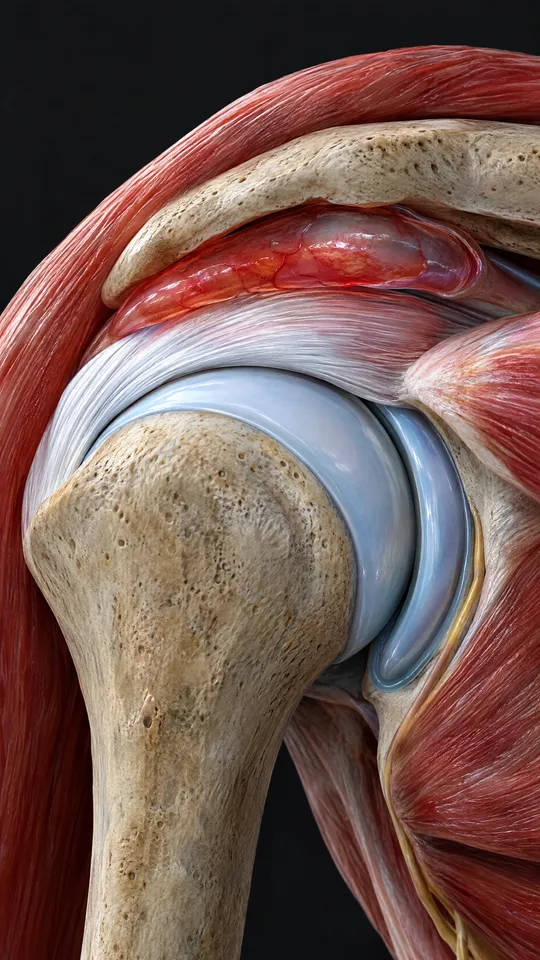
Often you can't cleanly, and you don't need to. The two share the same space at the top of the shoulder, and bursitis commonly occurs alongside shoulder impingement 9. Both hurt as the arm goes up. What changes the plan is what else is involved: an irritated rotator cuff tendon, the biceps tendon, or a shoulder that's become stiff rather than just sore 6. If your main problem is that the shoulder won't move where you send it, Frozen Shoulder is the closer match.
Bursitis is usually diagnosed with a physical examination, sometimes with an X-ray or ultrasound 1. The assessment matters more than the label, because it shows which movements to work on.
Most of the diagnosis happens in the examination. We press on different parts of your shoulder to find where it's tender, ask you to move your arm in several directions and test your arm strength. We may check your neck as well, in case the pain is coming from a pinched nerve there 6.
Scans are an extra. An X-ray doesn't show soft tissue like the bursa and is usually normal, so its job is to look for other possible causes 1 6. An ultrasound or MRI can show fluid or inflammation in the bursa 6. If infection or another condition is suspected, a doctor may take a sample of the fluid or order a blood test 1.
The aim is to settle the pain first, then rebuild your shoulder's capacity so it copes with the load that flared it 2.
We may use Sports Taping for short-term comfort. The sources here don't show how much it adds, so it's a support, not a fix.
Medication is a standard part of bursitis care, and injection is generally kept for more severe cases 1. Both are for your GP, pharmacist, sports physician or specialist. Two findings are worth knowing first. Compared with PRP (platelet-rich plasma) injections for rotator cuff problems, steroid did slightly better early on, but the difference was never clinically meaningful 5. And having the injection ultrasound-guided probably adds little or no meaningful benefit over an unguided one 4.
Surgery is also kept for severe cases 1, and the best evidence doesn't support rushing to it. A trial of 210 adults with subacromial shoulder pain lasting more than three months compared keyhole decompression surgery against placebo surgery and exercise therapy. At 10 years, surgery gave no benefit over either 3. That group had the broader diagnosis, not bursitis alone, but the message holds: give rehab a proper go first. That decision sits with you and a surgeon.
Shoulder bursitis is treated in the order set out in The Well Motion Recovery Path™. What your shoulder tolerates decides when you step up a phase. The calendar doesn't.
How long it usually takes. No study we found gives a healing time for bursitis on its own. In one trial of 77 people with a closely related shoulder tendon problem, pain, strength and function had improved by week 4 of a rehabilitation program lasting 12 weeks 11. That trial is small, dates from 2011 and had no untreated group, so read it as a guide, not a deadline.
Prevention hasn't been trialled for shoulder bursitis on its own. The closest evidence comes from workers and overhead athletes with shoulder problems in general:
Get it assessed if:
If you have gout, diabetes or rheumatoid arthritis, mention it to whoever assesses you 1 2.
Most of the time it's none of that, and self-care often improves things 1. An early assessment mostly saves you guesswork.
We start by listening: how it began, what makes it worse, and what it's stopping you from doing. Then we examine the area, explain what we find in plain English, and agree a plan with you. Your first visit is 40 minutes at Engadine and 30 minutes at our other clinics.
We see patients at Engadine, Mount Annan, Narellan and Appin, and at home through our mobile physiotherapy service. If you have private health cover, here's how health fund rebates work for physiotherapy.
Settle the pain with rest, ice and a break from overhead lifting, keep the shoulder gently moving, then build strength progressively 1,2. Injection is kept for more severe cases 1.
There's no reliable number: the sources behind this page don't give one, and an exact timeframe for your shoulder would be a guess. Whether it's trending the right way matters more than the calendar.
Often it settles with self-care 1, especially once you cut back the activity that irritated it 2. Keeping the shoulder gently moving is part of that 2.
Get assessed for what's travelling with it: impingement and rotator cuff tendon problems commonly sit alongside bursitis 9, and biceps tendon problems can too 6. Then follow a structured, progressive exercise program. Any injection benefit is short-term 5, and decompression surgery did no better than placebo surgery or exercise at 10 years 3.
Overuse, repetitive movement and injury are the common causes 1, and infection is another 10. If it came on with redness, heat or fever, see your GP 2.
Don't keep repeating the overhead lifting that flares it, and avoid lying on that side 2. Don't stop moving it altogether either 2. On heat, ice is the usual choice for the first two to three days, and after that you may find heat more relaxing 2.
Weakness or pain lifting the arm out to the side, reaching behind you, or sleeping on that shoulder. Often after a fall, or after years of overhead work.
Read moreStiffness in every direction, including when someone else moves the arm for you. Comes on gradually and moves through stages.
Read moreA pinch or catch through one particular part of the range as the arm goes up, often easing once you're past it.
Read moreSLAP stands for Superior Labrum, Anterior to Posterior. The labrum is the rim of cartilage that deepens your shoulder socket. The long head of the biceps tendon attaches to it at the top, and that's where these tears happen
Read moreA rupture at the shoulder usually follows tendon wear that's been building for a while. Uncommonly, a severely worn tendon gives way altogether
Read moreBiceps tendinopathy is thickening and irritation of the biceps tendon at the front of the shoulder. It often starts without any known injury.
Read moreA dislocated shoulder is the ball at the top of your upper arm bone coming out of its shallow socket. Most often it comes out the front.
Read moreYour AC joint is where the far end of your collarbone meets the top of your shoulder blade. A sprain means the ligaments holding that joint together have been stretched or torn.
Read more
How would you like to reach us?
Message us on WhatsAppFor bookings and enquiries. Please don't send medical details. Call (02) 8111 5633Request a call-back
Request sent
Thank you. We'll call you back on the number you gave us.
This is a preview, so nothing was actually sent.