Need urgent care? 24/7 Mobile & After-Hours Emergency Physiotherapy Call (02) 8111 5633 For life-threatening emergencies, always call 000
Chest

Pectoral Strain

5.0 average rating on Google
Registered NDIS Provider
SIRA Registered Provider

You were partway through a heavy bench press set when something gave at the front of your shoulder. Maybe you heard a snap. Now there's an ache across the chest and up towards the armpit, bruising coming through, and pushing anything away from your body feels wrong.

That's the classic picture of a pectoral strain, also called a chest muscle strain or a pulled chest muscle. But one thing comes first.

Chest pain is not something to self-diagnose. Call triple zero (000) immediately if your chest pain 1:

  • is severe, is getting worse, or has lasted longer than 10 minutes
  • feels heavy, crushing or tight
  • comes with breathlessness, nausea, dizziness or a cold sweat
  • comes with pain in your jaw, or down your left arm
  • comes with palpitations

Chest pain should be treated as heart-related until proven otherwise, and any type of chest pain should be checked by a doctor right away 1. Heart attack symptoms can differ between men and women, and they can be mild rather than dramatic 1. If that's a possibility, stop reading and get help. Don't book a physiotherapy appointment.

What's actually causing it

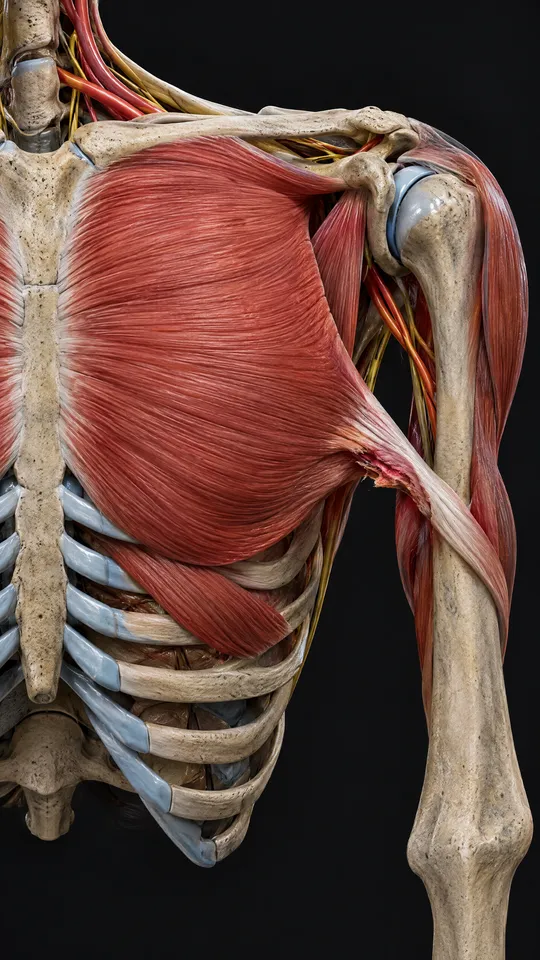
The pectoralis major is the big fan-shaped muscle across the front of your chest. It pulls your arm in towards your body, rotates it inwards and brings it forwards 11. That's a bench press.

Most descriptions have its tendon twisting before it attaches to the arm bone, so the lower fibres of the muscle insert higher on the humerus 5. At the bottom of a press, through the final 30 degrees, those short lower fibres lengthen disproportionately 10. Stretched and loaded at once is when muscle tears.

That's why it fails at the bottom of the lift, in what's called an eccentric contraction: the muscle working hard while being forced to lengthen 3.

In a series of 19 pectoralis major ruptures at two US military academies, bench press was the most common single mechanism, at 53%, and the tear sat most often at the musculotendinous junction, where muscle becomes tendon 4. Those were young male cadets aged 19 to 23, though, not a general population. Contact and combat sports, including football, rugby and wrestling, appear in the literature too 4,12, but far less often than the barbell.

Chest wall and shoulder showing the large chest muscle with a tear where it narrows into its tendon near the armpit

Pulled chest muscle, or something else? How to tell the difference

Costochondritis is inflammation of the cartilage joining your ribs to your breastbone, usually the second to fifth 6. Unlike a muscle strain, the pain develops slowly, sits to one side of the breastbone, affects more than one rib, and comes with no swelling 6. Coughing, sneezing, deep breathing and pressure on the chest aggravate it, and it's more likely between 40 and 50 6. Exercise or lifting can trigger it too, which is why it gets mistaken for a pulled muscle 6.

Bony injury to a rib needs a different assessment. Start at our Rib Fracture page instead.

And some chest pain has nothing to do with the chest wall. Reflux, pleurisy, chest infection and anxiety are among the common non-cardiac causes, alongside muscle strains 1. Costochondritis itself can resemble heart attack and lung problems 6, which is why the box at the top of this page exists.

How it's diagnosed

Diagnosis starts with the story and an examination. You'll be asked how it happened and what you've noticed since, because that says a lot about the type of injury and how bad it is 7. The examination checks for swelling, bruising and pain, how well the joint moves and how strong the muscle is 7, always against your uninjured side 3.

That places the injury on a grading scale. At one end are small local tears with little loss of power. At the other is a complete tear, with significant loss of power and sometimes a visible change in the muscle's shape 2. An ultrasound is sometimes used to see the damaged area more clearly, and an X-ray can rule out a fracture 7.

How we treat it

Assessment starts with comparing sides.

Examination should always compare the injured side with the uninjured one 3. We're looking for swelling, bruising and, specifically, loss of the anterior axillary fold: the ridge of muscle at the front of your armpit 3,5. Weakness when you pull your arm in or rotate it inwards against resistance is typical too 5. MRI can show where the tear is, though it detects complete tears more reliably than partial ones 11.

Relative rest, not shutdown.

Avoid the activities that significantly increase your pain, but otherwise stay gently active 2.

Graded loading back to your goal.

Once the acute phase settles, the work is rebuilding the muscle's tolerance for the exact position that injured it: arm back, under load. Our exercise prescription and conditioning programs build that progression around your presentation and goal, not a handout. If the goal is a barbell, a court or a field, sports physiotherapy is the right front door; otherwise general physiotherapy covers it.

Other treatments we may use

First aid in the first 72 hours. Stop the activity. Rest, ice, compress, elevate: ice for 20 minutes every two waking hours, separated from your skin by wet towelling 2. For those 72 hours, avoid heat, alcohol, running and firm massage 2.

Manual therapy and soft-tissue work. Useful after that initial window for settling protective guarding through the shoulder and chest wall. None of the sources behind this page singles it out as a proven treatment for pectoral strain, so it's an adjunct, not the treatment.

Pain-relieving medication. A real option in the literature, with a caution: pain relievers can sometimes disrupt the healing of soft-tissue injuries, so talk to your doctor or pharmacist before taking any 2. Physiotherapists don't prescribe or administer medication.

Surgery, and why the answer isn't settled. For a full rupture the evidence is mixed. One review finds that repairing an acute rupture beats non-surgical care for function and return to work and sport, but it names rerupture, persistent pain and wound infection as ongoing concerns, and notes that chronic tears may need graft reconstruction 3. Across 603 repairs in one meta-analysis, the complication rate was about 14% 5. Tears managed without surgery ended up weaker than repaired ones 5, yet another review describes fair to good function after non-surgical care 11. For grade III injuries generally, longer-term outcomes look similar with or without surgery 2. And repair isn't a reset button: in that military series, mean push-ups fell from 73.2 to 66.5 after rupture and repair 4. That's 19 cadets, so read it as a caution rather than a prediction.

Whether a given tear needs surgery is a clinical judgement driven by grade, location, your age and your demands. It isn't a default.

Your recovery path: Reset, Rebuild, Return

A pectoral strain follows The Well Motion Recovery Path™. You move up a phase when the chest and arm can do more, not when a week ticks over.

  • Reset: the first days. First aid for 72 hours and relative rest 2, plus the side to side examination that grades the injury 3. Signs of a full rupture mean a surgical opinion, and the surgeon then sets the timeline. We move you on once everyday arm use no longer builds the pain.
  • Rebuild: the longest phase. Graded loading through exercise prescription and conditioning, working gradually deeper into the stretch, with manual therapy as an adjunct. Expect pushing strength to lag behind how the chest feels. We move you on when the arm does what your daily tasks ask of it.
  • Return: the gym, your sport or a physical job. We test the movement you are going back to, the bottom of the press included, because that is where the muscle is injured 3. You leave with a plan for adding load in small steps 2.

How long it usually takes. Most soft-tissue injuries take a few weeks, with wide variation 2. No study we found gives a time for each grade of pectoral strain. After surgical repair of a full rupture, a review of 18 small case series without comparison groups found 90% of patients returned to sport, at a mean of 6.1 months 13. Full strength may take a year or more 14.

Reducing your risk of it coming back

Nobody has trialled a way to prevent pec strains. What's known is how they happen, so that's what this list works from:

  • The bottom of the bench press. The muscle is injured while it's working and being lengthened at the same time, most often in a bench press 3. A review of 365 published pec injuries found most came from that kind of indirect force, and about half happened during weight training 9. So lower the bar under control, and leave maximal lifts until your rehab is finished.
  • Sudden jumps in load. Many strains happen when you suddenly increase how much or how hard you're training 7. Add weight and volume in small steps, and bring activities back to normal levels gradually 2.
  • Anabolic steroids. A review of these ruptures names anabolic steroid use among the reasons they're being seen more often 8. If that applies to you, say so at your assessment.
  • Unfinished rehab. Soft-tissue injuries that recur or get worse over time usually do so because treatment and rehabilitation fell short 2.

When to get it checked properly

The triple zero criteria at the top come first, always. Beyond those, book an assessment if:

  • function hasn't returned, or pain and swelling aren't settling, after a couple of days 2
  • you can see a visible hollow, deformity or asymmetry in the chest or front of the armpit 5
  • there's significant loss of strength pushing or drawing your arm across your body 2,5
  • bruising is extensive, or the pain isn't settling the way a minor strain should

The reassuring part: strains and tears in the muscle belly are generally managed without surgery 11, and most soft-tissue injuries settle over a few weeks 2. Getting checked early isn't about it being serious. It's that the grade sets the whole plan, and guessing it costs people months.

Your first appointment

We start by listening: how it began, what makes it worse, and what it's stopping you from doing. Then we examine the area, explain what we find in plain English, and agree a plan with you. Your first visit is 40 minutes at Engadine and 30 minutes at our other clinics.

We see patients at Engadine, Mount Annan, Narellan and Appin, and at home through our mobile physiotherapy service. If you have private health cover, here's how health fund rebates work for physiotherapy.

FAQs

How long will it take for a pulled chest muscle to heal?

It depends on the grade. Most soft-tissue injuries take a few weeks, with large variation between people 2. Muscle injuries are graded from a focal injury with normal imaging up to a complete tear of the muscle belly, tendon or musculotendinous junction 2. A low-grade strain and a true rupture are different recovery pathways 3,11.

What does a pulled chest muscle feel like?

Usually a sharp tearing sensation during a heavy effort, sometimes with bruising at the front of the upper arm 5, and tenderness when you press the spot 2. The catch: a tear is identified by structural signs, like a defect you can feel at the front of the armpit 5, not by how much it hurts.

How can I tell if chest pain is muscular?

You can't reliably tell on your own, and that's the answer that matters. Chest pain should be considered heart-related until proven otherwise and checked by a doctor right away 1. Once someone qualified has ruled out cardiac causes, the musculoskeletal pattern is usually a clear injuring event, pain reproduced by a specific movement or by pressing the spot, and tenderness to touch 2,6.

What should I do if I've pulled a muscle in my chest?

Rule out your heart first, using the triple zero criteria above 1. Then stop the activity, rest relatively rather than totally, and follow the 72-hour first-aid steps above 2. If function hasn't returned, or pain and swelling aren't settling after a couple of days, get it assessed 2.

How to tell if a chest muscle is torn?

Look for structural signs, not pain levels: loss of the anterior axillary fold with a visible hollow where the muscle has pulled back 3,5, bruising, and weakness pulling your arm in or rotating it inwards against resistance 5. MRI can confirm and locate a tear, though it's less sensitive for partial tears than complete ones 11.

When can I go back to bench pressing after a pec strain?

Criteria-based, not calendar-based: full pain-free range, strength matching the other side, and a graded rebuild of load at the bottom of the press. That's where the lower fibres are stretched most 10. Bench press is the documented primary mechanism 3,4, so returning to it is the highest-risk point of rehab. Even surgical repair didn't fully restore push-up performance in one small series of young athletes 4.

More Chest conditions

Chest

Costochondritis

Sharp, tender pain where your ribs meet your breastbone, often worse on a deep breath or when you press on it, usually with no injury behind it.

Read more
Chest

Rib Fracture

A cracked rib after a direct knock, a fall or a long run of hard coughing, with pain that bites when you breathe in or laugh.

Read more

If something let go in your chest and you're not sure whether it's a strain you can train around or a tear that needs a proper plan, book an assessment at Engadine, Mount Annan, Narellan or Appin, or browse the Chest section of our Injury Finder.

Book an Assessment
Ahmed Elsayed, Principal Physiotherapist
Reviewed by Ahmed Elsayed Principal Physiotherapist at Well Motion

References

  1. Chest pain. healthdirect (Australian Government). Last reviewed September 2025. https://www.healthdirect.gov.au/chest-pain
  2. Sprains and strains. Better Health Channel, Victorian Department of Health, in consultation with the Australian Physiotherapy Association. Reviewed 02-10-2023. https://www.betterhealth.vic.gov.au/health/conditionsandtreatments/sprains-and-strains
  3. Kowalczuk M, Elmaraghy A. Pectoralis Major Rupture: Evaluation and Management. Journal of the American Academy of Orthopaedic Surgeons, 2022;30(7):e617-e627. https://doi.org/10.5435/JAAOS-D-21-00541
  4. Chan AG, Balazs GC, Haley CA, et al. Pectoralis Major Rupture in Military Academy Athletes. Orthopaedic Journal of Sports Medicine, 2019;7(7). https://doi.org/10.1177/2325967119860157
  5. Bodendorfer BM, McCormick BP, Wang DX, et al. Treatment of Pectoralis Major Tendon Tears: A Systematic Review and Meta-analysis of Operative and Nonoperative Treatment. Orthopaedic Journal of Sports Medicine, 2020;8(2). https://doi.org/10.1177/2325967119900813
  6. Costochondritis. healthdirect (Australian Government). Last reviewed September 2024. https://www.healthdirect.gov.au/costochondritis
  7. Sprains and strains. healthdirect (Australian Government), 2024. https://www.healthdirect.gov.au/sprains-and-strains
  8. Thompson K, Kwon Y, Flatow E, et al. Everything pectoralis major: from repair to transfer. The Physician and Sportsmedicine, 2020;48(1):33-45. https://doi.org/10.1080/00913847.2019.1637301
  9. ElMaraghy AW, Devereaux MW. A systematic review and comprehensive classification of pectoralis major tears. Journal of Shoulder and Elbow Surgery, 2012;21(3):412-422. https://doi.org/10.1016/j.jse.2011.04.035
  10. Wolfe SW, Wickiewicz TL, Cavanaugh JT. Ruptures of the pectoralis major muscle. An anatomic and clinical analysis. The American Journal of Sports Medicine, 1992;20(5):587-593. https://doi.org/10.1177/036354659202000517
  11. Lake MG, Skalski MR, Chiu MK, et al. Magnetic resonance imaging of pectoralis major injuries: a radiologist's essential guide. Emergency Radiology, 2025;32(5):797-807. https://doi.org/10.1007/s10140-025-02370-1
  12. Kowalczuk M, Rubinger L, Elmaraghy AW. Pectoralis Major Ruptures: Tear Patterns and Patient Demographic Characteristics. Orthopaedic Journal of Sports Medicine, 2020;8(12). https://doi.org/10.1177/2325967120969424
  13. Yu J, Zhang C, Horner N, et al. Outcomes and Return to Sport After Pectoralis Major Tendon Repair: A Systematic Review. Sports Health, 2019;11(2):134-141. PMID 30543493. https://doi.org/10.1177/1941738118818060
  14. Pectoralis Tendon Tear. OrthoInfo, American Academy of Orthopaedic Surgeons. Peer reviewed 2025. https://www.orthoinfo.org/diseases--conditions/pectoralis-tendon-tear/