Need urgent care? 24/7 Mobile & After-Hours Emergency Physiotherapy Call (02) 8111 5633 For life-threatening emergencies, always call 000
Lower Back

Sacroiliac Joint Dysfunction

5.0 average rating on Google
Registered NDIS Provider
SIRA Registered Provider

The pain sits low. It's just below your belt line, usually on one side, near the dimple at the back of your pelvis. It's worse after a long drive, on the stairs, or when you roll onto that side at night. One person has told you it's your lower back. Someone else thought it was your hip.

It may be neither. It could be the joint in between.

What's actually causing it

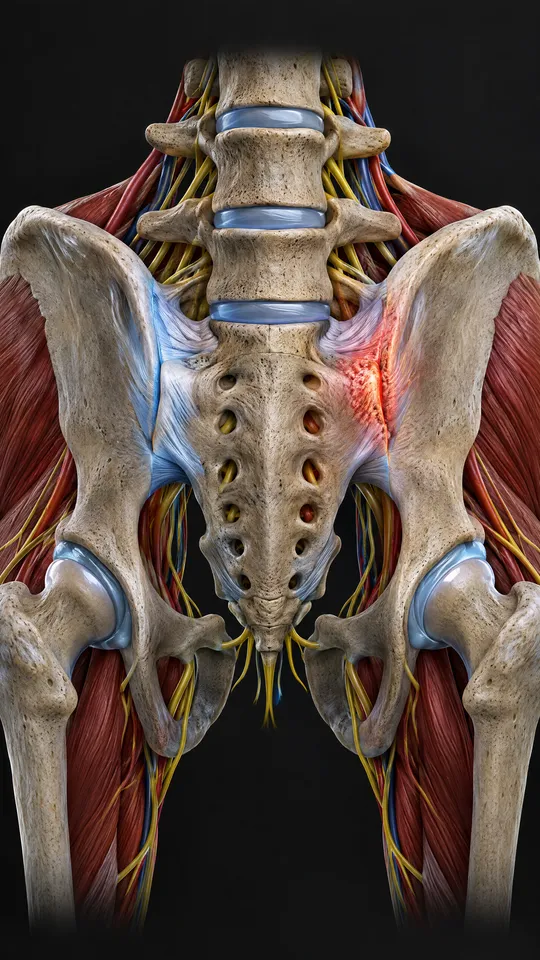
The SI joint links the sacrum, the triangular bone at the base of your spine, to the ilium, the large wing of your pelvis 1. It's built for stability rather than big movement, and it transfers load between your upper body and your legs.

Several things can make it painful 1:

  • Wear and ageing, including osteoarthritis
  • A fall or other trauma
  • Repetitive or one-sided movements, at work or in sport
  • Pregnancy
  • Previous back or pelvic surgery
  • Inflammatory conditions such as ankylosing spondylitis, rheumatoid arthritis and inflammatory bowel disease, and, rarely, infection

Where you'll feel it. Usually over the buttock, sometimes spreading into the groin, the back of your thigh or the lower leg, and the pattern varies a lot from person to person 3. It can also reach the outside of your hip, and the area just below that dimple is often tender to press 2. It can be sharp or dull, and on one side or both 1. It tends to flare with prolonged sitting or walking, stairs, lying on the painful side, or standing on one leg 1.

Back of the pelvis showing the two sacroiliac joints either side of the sacrum, one shown irritated

SI joint pain or lower back pain? How to tell the difference

This is the hard part. SI joint pain looks a lot like other low back pain 1,2, and the usual tools don't settle it cleanly.

A careful history and examination come first, to rule out look-alikes 2. Three or more positive pain-provocation tests point towards the SI joint 2. But those tests are better at ruling it out than confirming it. If they're negative, the SI joint is very unlikely to be the problem. If they're positive, it's a strong lead, not a verdict 2. Scans are of limited help for this kind of pain 2. A local anaesthetic injection into the joint, done by a doctor, is the closest thing to confirmation 1,2.

There's also a trap worth knowing about. Research suggests pain in the SI region is often referred from the spine above it, yet a review of 43 treatment trials found 74% never checked the spine before diagnosing SI joint pain 6. So we check your back first. Stiffness that bites when you arch backwards may point to facet joint pain. Pain travelling down the leg with numbness, tingling or weakness points more to a nerve in the spine 2 and is worth ruling out as sciatica.

How it's diagnosed

A physiotherapist or doctor can make this diagnosis 1. Expect questions first: old accidents or injuries, how you exercise, even your diet and your sleep 1. Then we watch how you walk and move 1.

The provocation tests come next. We move you into a series of positions, one at a time, and you tell us whether any of them brings on your pain 1. Blood tests, or a scan such as an MRI or CT, are ordered case by case 1.

How we treat it

The first job is confirming the SI joint is really the source, and working out what in your week keeps loading it.

1
Understanding it. Education is a core part of treatment 2. Knowing what's irritating the joint, and what isn't dangerous, changes how you move.
2
Pelvic stability and strength. Exercise for the muscles that steady your pelvis, including the abdominals, the pelvic floor and the gluteal muscles, is a central part of care 2, combined with focused stretching 1,2. This is what our exercise prescription and conditioning work is built around.
3
Hands-on treatment, as part of the plan. Manual therapy is part of the recommended combined program 2. But a review of 16 trials found hands-on therapy didn't clearly reduce pain compared with other physiotherapy or a sham treatment. It may help day-to-day function, and the certainty was low 4. So we use it alongside exercise, not instead of it.
4
Changing the load. If it came from sport or repetitive one-sided work 1, we look at what's driving it. Our sports physiotherapy approach covers the return-to-sport side.

There's no internationally agreed treatment plan for SI joint pain, and the research is limited and inconsistent 5. A combined, conservative program is the sensible first step 2,5, not a guaranteed fix.

Other treatments we may use

Pelvic belts.

A stabilising belt may help, particularly after pregnancy 1,2. The evidence is mixed, though: how well belts and other non-surgical measures work varies 3. If your pain began in pregnancy, our symphysis pubis dysfunction page covers pregnancy-related pelvic pain in more detail.

Medicines.

These are a GP or pharmacist conversation, not something we prescribe. There's little direct evidence that pain medicines treat an inflamed SI joint 1.

Injections, radiofrequency and surgery: what a doctor may offer, not us.

When conservative care hasn't helped, doctors may offer a corticosteroid injection into the joint, radiofrequency treatment to the nerves, or, as a last resort, surgical fusion of the joint 1,2,5.

Your recovery path: Reset, Rebuild, Return

SI joint pain has no agreed treatment algorithm 5, so we give it an order with The Well Motion Recovery Path™. You move up a phase when the joint tolerates more, not when a week number comes round.

  • Reset: the first visits. Education, manual therapy and easing the loads that provoke it, sometimes with a pelvic belt 2. Expect good days and bad days. We move you on once sitting, stairs and rolling over in bed set it off less easily.
  • Rebuild: the longest phase. Pelvic stability exercise and stretching 2, with hands-on treatment tapering. Expect slow gains: in one trial, exercise showed its clearest effect at 12 weeks, later than manipulation did 10. We move you on when the joint does what your daily tasks ask of it.
  • Return: back to long drives, a full work day, lifting or sport. We test the one-sided and repetitive movements that can irritate the joint 1. You leave with a home program and a plan for flare-ups.

How long it usually takes. It varies. Most people with an inflamed SI joint recover within two to four weeks 1. For SI joint dysfunction, one trial of 51 people found pain and disability had improved at 6, 12 and 24 weeks, whether treatment was exercise, manipulation or both 10. It was small and had no untreated comparison group.

Reducing the risk of flare-ups

Symptoms can return if nothing about your routine changes 1. No trial has tested prevention for the SI joint itself, so this is the nearest evidence:

  • Stay active, and stretch. These head healthdirect's list for preventing a recurrence 1. For low back pain in general, an Australian trial of 701 adults found people given a walking program that built up over six months went a median of 208 days before pain next limited their activity. Without it, 112 7.
  • Change the one-sided, repetitive loads. Repetitive movements, and movements that load one side of your body, are listed causes of an irritated SI joint 1. If your work or sport is built around one, bring it to your assessment.
  • If it began in pregnancy. Pooled trials found exercise during pregnancy didn't lower the odds of getting pelvic girdle or low back pain, though women who exercised had less severe pain 8. A separate review rated the evidence that pelvic belts ease lumbopelvic pain in pregnancy as strong 9, and a belt may help after the birth too 2.

When to get it checked properly

A physiotherapist or doctor can assess SI joint pain 1. Book an assessment with us if 1:

  • The pain started after an accident, or is getting worse
  • It has lasted more than four weeks
  • It wakes you at night

See your GP if you've lost weight without trying, or have a history of cancer 1.

Call 000 if you lose feeling or movement in your legs, or have problems controlling your bladder or bowels 1. That's rare, and it's not typical of SI joint pain, but it needs emergency care.

Most SI joint pain is manageable. The earlier it's properly assessed, the sooner you stop guessing.

Your first appointment

We start by listening: how it began, what makes it worse, and what it's stopping you from doing. Then we examine the area, explain what we find in plain English, and agree a plan with you. Your first visit is 40 minutes at Engadine and 30 minutes at our other clinics.

We see patients at Engadine, Mount Annan, Narellan and Appin, and at home through our mobile physiotherapy service. If you have private health cover, here's how health fund rebates work for physiotherapy.

FAQs

How do you fix SI joint dysfunction?

Usually with a combined program: understanding the problem, pelvic stability exercise with focused stretching, and hands-on therapy as part of the plan 2. If that doesn't help, a doctor may discuss injections or other procedures 2. The evidence for any single technique is mixed 4,5.

How long does it take for the sacroiliac joint ligament to heal?

There's no reliable ligament-specific timeframe in the research. For an inflamed SI joint, most people recover within two to four weeks, but symptoms can return without changes to how you move and load it 1.

How to self release a SI joint?

There's no good evidence that you can "release" or "pop" an SI joint back into place yourself. What is supported is stretching and stability exercise 1,2, which is a better use of your effort.

What is the best sleeping position for SI pain?

No research we've found names a single best position. Lying on the painful side often aggravates it 1, so start by avoiding that and see what's comfortable.

More Lower Back conditions

If your pain sits low and to one side, and nobody has given you a clearer answer than "back" or "hip", it's worth a proper look.

Book an assessment and we'll work out where it's really coming from. You can see us at Engadine, Mount Annan, Narellan or Appin. Or head back to the Lower Back section of our Injury Finder.

Book an Assessment
Ahmed Elsayed, Principal Physiotherapist
Reviewed by Ahmed Elsayed Principal Physiotherapist at Well Motion

References

  1. Sacroiliitis. healthdirect (Australian Government-funded). Last reviewed February 2026. https://www.healthdirect.gov.au/sacroiliitis
  2. Newman DP, Soto AT. Sacroiliac Joint Dysfunction: Diagnosis and Treatment. American Family Physician, 2022;105(3):239-245. PubMed PMID 35289578. https://pubmed.ncbi.nlm.nih.gov/35289578/
  3. Barros G, McGrath L, Gelfenbeyn M. Sacroiliac Joint Dysfunction in Patients With Low Back Pain. Federal Practitioner, 2019;36(8):370-375. https://pmc.ncbi.nlm.nih.gov/articles/PMC6707638/
  4. Trager RJ, et al. Efficacy of manual therapy for sacroiliac joint pain syndrome: a systematic review and meta-analysis of randomized controlled trials. Journal of Manual & Manipulative Therapy, 2024;32(6):561-572. PubMed PMID 38353102. https://doi.org/10.1080/10669817.2024.2316420
  5. Migliorini F, et al. Management of sacroiliac joint pain: current concepts. European Journal of Orthopaedic Surgery & Traumatology, 2025;35(1):208. PubMed PMID 40397173. https://doi.org/10.1007/s00590-025-04308-2
  6. Schumacher MR, Kovash DT, Forkin KT, Bylund DB. Screening of the thoracolumbar spine is almost completely absent in trials evaluating conservative management for sacroiliac joint pain: a systematic review of 43 randomized controlled trials. Journal of Manual & Manipulative Therapy, 2025;34(2):118-127. PubMed PMID 40720882. https://doi.org/10.1080/10669817.2025.2539783
  7. Pocovi NC, Lin CC, French SD, et al. Effectiveness and cost-effectiveness of an individualised, progressive walking and education intervention for the prevention of low back pain recurrence in Australia (WalkBack): a randomised controlled trial. The Lancet, 2024;404(10448):134-144. https://pubmed.ncbi.nlm.nih.gov/38908392/
  8. Davenport MH, Marchand AA, Mottola MF, et al. Exercise for the prevention and treatment of low back, pelvic girdle and lumbopelvic pain during pregnancy: a systematic review and meta-analysis. British Journal of Sports Medicine, 2019;53(2):90-98. https://pubmed.ncbi.nlm.nih.gov/30337344/
  9. Gutke A, Betten C, Degerskär K, Pousette S, Olsén MF. Treatments for pregnancy-related lumbopelvic pain: a systematic review of physiotherapy modalities. Acta Obstetricia et Gynecologica Scandinavica, 2015;94(11):1156-1167. https://pubmed.ncbi.nlm.nih.gov/26018758/
  10. Nejati P, Safarcherati A, Karimi F. Effectiveness of Exercise Therapy and Manipulation on Sacroiliac Joint Dysfunction: A Randomized Controlled Trial. Pain Physician, 2019;22(1):53-61. PubMed PMID 30700068. https://pubmed.ncbi.nlm.nih.gov/30700068/