Need urgent care? 24/7 Mobile & After-Hours Emergency Physiotherapy Call (02) 8111 5633 For life-threatening emergencies, always call 000
Lower Back

Lumbar Disc Bulge / Herniated Disc

5.0 average rating on Google
Registered NDIS Provider
SIRA Registered Provider

Most people meet this diagnosis on a page, not in their body. You went in for back pain and came out with a report full of phrases like "broad-based disc bulge at L4-L5", which starts to sound like a structural problem only a surgeon can fix.

That report leaves something out. Disc bulges are extremely common in people with no back pain at all: in pain-free adults they turn up in around 30% of 20-year-olds and 84% of 80-year-olds 3. The scan describes the shape of your disc. On its own it doesn't explain your symptoms, and it isn't a sentence.

What's actually causing it

The discs between the bones of your spine work like shock absorbers. Each has a tough outer wall and a soft gel-like centre. When that centre pushes outward against the wall, the disc changes shape; that's the bulge. If the gel presses on a nearby nerve, it can cause pain, numbness or weakness 1.

Two things follow, and they're the two most people aren't told.

The first: the pain usually comes from nerve irritation, not from the disc being "out of place". Nothing has slipped out of your spine, despite the name.

The second: a bulge visible on a scan and a bulge causing your symptoms aren't automatically the same thing. Plenty of people have one and will never know 2. In the largest review of its kind, covering 3,110 people with no symptoms, the authors concluded these findings "are likely part of normal aging and unassociated with pain," and must be read in the context of the patient's clinical condition 3.

That isn't us dismissing your scan. It's why a physical assessment matters more than the report: we need to know whether the finding on the page matches the pattern in your back and your leg.

As for why it happened: a lot of heavy lifting and forceful bending are recognised risk factors 1. Often there's no single dramatic moment to point at.

A disc bulge can also set off a sudden back spasm, where the muscles around it clamp down to guard the area.
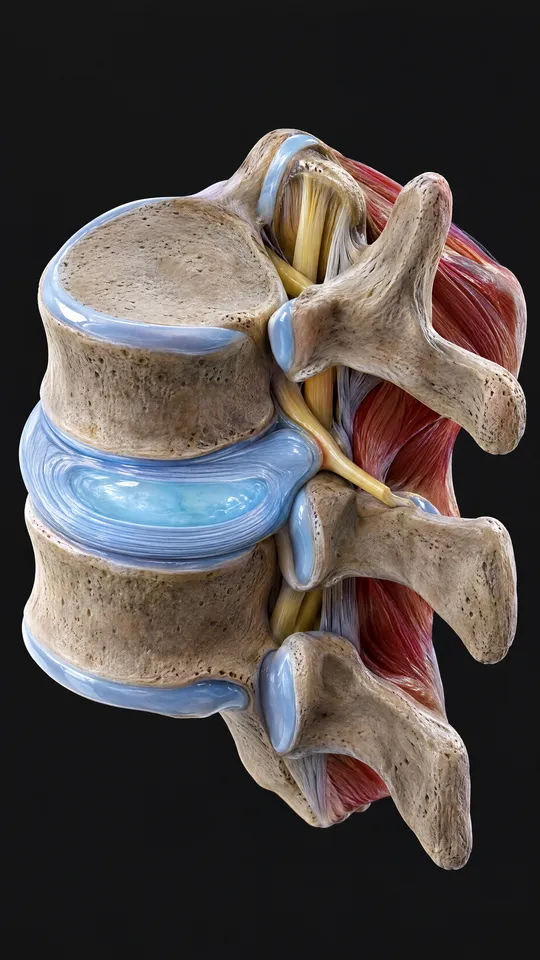

Two lower back vertebrae with the disc between them bulging back toward a nerve root

Bulge or herniated disc: which one is worse?

This is the question we get asked most, and the answer is that the label on your report is a shape description, not a prognosis.

Bulge, protrusion, extrusion and sequestration describe increasing degrees of the same thing: how far the inner material has pushed out, and whether it has separated. Most people assume the bigger ones are worse news. The evidence points the other way: in a review of studies tracking what happens without surgery, spontaneous regression occurred in 96% of sequestrations and 70% of extrusions, but only 41% of protrusions and 13% of bulges 4.

Read that alongside the asymptomatic prevalence data 3 and the conclusion is straightforward: severity on a scan doesn't track severity of symptoms. What matters clinically is what your symptoms are doing: where they sit, whether they radiate, whether they're improving.

If your main problem is pain travelling down the back of the leg rather than in the back itself, the Sciatica page covers that pattern in more detail.

How it's diagnosed

A disc problem can usually be diagnosed from your symptoms 2. The examination adds detail. You might be asked to do some simple leg movements to help work out where the problem is 2, and we check how your spine and legs move, your muscle strength and your reflexes 1.

A scan comes later, if at all. Further tests such as an MRI are for symptoms that aren't getting better 2. When imaging is ordered, it also helps rule out rare or serious causes such as a fracture, an infection, cancer or a narrowed spinal canal 1.

How we treat it

Keep moving: the first and most important thing.

If the pain is bad you may need to rest at first, but you'll get better more quickly by gradually starting gentle exercise such as walking or swimming as soon as you can. The type matters far less than people think, as long as it doesn't cause pain or make your back worse 2. Staying active is listed as a treatment in its own right by Australian government health guidance, alongside physiotherapy and heat or cold packs 1.

A structured exercise programme carries the most evidence.

A systematic review of 18 trials and 1,671 participants found moderate evidence that stabilisation exercises outperform no treatment for disc herniation with nerve symptoms 6. That's what Exercise Prescription & Conditioning is for: a programme built for you that starts inside what your back tolerates now and progresses as symptoms settle, not a generic sheet of exercises.

Hands-on treatment, used selectively.

The same review found moderate evidence that spinal manipulation outperforms sham manipulation in people with acute symptoms and an intact disc wall 6: a specific group, not everyone with back pain, which is why we assess before we treat. That's where Manual Therapy fits: alongside the programme, not instead of it.

Advice and reassurance do real work.

In that review, advice was less effective than microdiscectomy short-term but equally effective long-term 6, which is most of why this page exists.

If pain has been there for months.

Persistent back pain needs a different approach from acute back pain, and our Chronic Pain Management programme is built around that. If you do end up having surgery, Post-Surgical Rehabilitation is the structured path back afterwards.

Other treatments we may use

Traction, laser and therapeutic ultrasound: named honestly.

The best available review found no difference among traction, laser and ultrasound 6, three commonly offered passive treatments that didn't separate from each other. Traction also carried real adverse events in those trials: pain, anxiety, lower limb weakness and fainting 6. We'd rather tell you that than present every option as equally proven.

Heat and cold packs.

Listed as a reasonable self-management measure by Australian government health guidance 1. Low risk, modest expectations, useful for some people.

Medication and injections: real options, but not ours.

Pain relief medication, muscle relaxants and steroid injections appear across the literature as part of the picture 1,2,6. They're prescribed and administered by your GP or a specialist; prescribing sits outside a physiotherapist's scope of practice, so we'll never be the ones offering them. You should know they exist, and it's a fair conversation to have with your doctor.

Surgery, stated in full.

Surgery is not usually needed 2, and is generally considered only if you have severe nerve symptoms or aren't improving with other treatment 1. The evidence deserves both halves: one large, low-risk-of-bias trial found early surgery gave faster pain relief than prolonged conservative treatment in people with 6 to 12 weeks of radicular pain, and found no differences at one and two years 5. Another found no significant difference on any primary outcome at one and two years 5. Surgery buys speed for some people. It doesn't reliably buy a better outcome, which makes an unhurried conservative trial a defensible first choice, not a delay.

Your recovery path: Reset, Rebuild, Return

A disc bulge is treated along The Well Motion Recovery Path™. You move up a phase when your back and leg can do more, not when a date arrives or a scan changes.

  • Reset: the first days to weeks. Short walks, heat or cold packs 1 and Manual Therapy if the assessment shows you fit the group it suits 6. Expect good and bad days. We move you on once you can sit, walk and sleep without the pain building.
  • Rebuild: the longest phase. Stabilisation work 6 through Exercise Prescription & Conditioning, progressed toward bending and lifting. We move you on when your back does what your daily tasks ask of it. If nerve pain isn't easing, we raise a scan or surgical opinion with your GP 1,2.
  • Return: work, lifting, driving and sport at your normal load. You leave with a walking and exercise plan, the pairing that reduced repeat episodes in low back pain trials 7,8.

How long it usually takes. One 2024 review reports symptoms resolving within 6 to 12 weeks in 60% to 80% of people with a herniated disc, and in 80% to 90% over a year or more 10. Those figures come from a guideline quoted in a narrative review, not a single trial. About 30% of people who don't have surgery still report intermittent pain at one year 10.

Reducing your risk of it coming back

Disc bulges haven't had prevention trials of their own. Low back pain has, and smoking has been studied in disc herniation directly:

  • Walk, and build it up. In a trial of 701 Australian adults just over a bout of low back pain, half got a walking and education programme that built up over six months. They went a median of 208 days before pain next limited their activity. The untreated group went 112 7. The trial was in back pain with no specific diagnosis.
  • Add exercise to the advice. Across 21 trials, exercise combined with education cut the risk of a new back pain episode by 45%. Education alone made no difference 8.
  • Don't lean on a back belt. Belts didn't reduce back pain episodes in that review 8. Heavy lifting and forceful bending do raise your chance of a disc problem 1, and the NHS still advises safe lifting technique 2.
  • If you smoke, quit. In pooled studies, current smokers had 45% higher odds of hospital admission or surgery for a herniated disc or sciatica. For ex-smokers the gap was small and uncertain 9.

When to get it checked properly

Some symptoms need urgent medical assessment, not physiotherapy. Go to your nearest emergency department immediately if your back pain comes with 1:

  • a fever
  • trouble controlling your urine or bowel motions
  • numbness around your genitals or buttocks

Difficulty moving an arm or a leg, or numbness in an arm or leg, with none of the signs above: call us the same day. We assess it and tell you plainly if it needs a hospital.

Call 000 if you lose feeling or movement in your limbs, or lose bowel or bladder control 1. These can signal cauda equina syndrome, a rare complication where the nerves at the base of the spine are compressed 1. It's uncommon, and it's the one thing here that can't wait.

Book an assessment instead of waiting it out if:

  • the pain hasn't started improving after a few weeks 1
  • muscle weakness or numbness is getting worse rather than better 2
  • leg symptoms are spreading, or becoming more constant
  • you've had to stop working, driving or sleeping properly
  • you've been handed a scan report and nobody has explained what it means for you

That last one is a legitimate reason to come in on its own. Most people in this position aren't heading for surgery; they're heading for a few weeks of feeling cautious about their own back, and a clear explanation usually shortens that.

If this starts after hours, on a weekend or a public holiday, and you have none of the warning signs on this page, our after-hours emergency physiotherapy can come to you. Call (02) 8111 5633.

Your first appointment

We start by listening: how it began, what makes it worse, and what it's stopping you from doing. Then we examine the area, explain what we find in plain English, and agree a plan with you. Your first visit is 40 minutes at Engadine and 30 minutes at our other clinics.

We see patients at Engadine, Mount Annan, Narellan and Appin, and at home through our mobile physiotherapy service. If you have private health cover, here's how health fund rebates work for physiotherapy.

FAQs

Can a bulging disc heal on its own?

That's really two questions. Your symptoms very often settle by themselves: most of the time, pain gets better without needing scans or surgery 1. The bulge itself is less likely to disappear: only about 13% of bulges regressed spontaneously, against 70% of extrusions and 96% of sequestrations 4. So we won't tell you yours will shrink away. Feeling better doesn't require it to, because the finding is common in people with no pain at all 3.

What should you not do with a bulging disc?

The main thing to avoid is prolonged bed rest. If the pain is severe you may need to rest initially, but you'll recover more quickly by returning to gentle movement as soon as you're able 2. Heavy lifting and forceful bending are recognised risk factors worth moderating 1. We won't publish a list of forbidden exercises, because the evidence doesn't support one: what matters is whether an activity causes pain or makes your back worse 2. If something leaves your back or leg angrier for hours afterwards, that's information about the dose, not proof you've damaged something.

Is walking good for a lumbar disc bulge?

Yes, walking and swimming are the specific examples given, and the type of exercise isn't important as long as it doesn't cause pain or worsen your back 2. Walking earns its place mainly because the dose is so easy to adjust: shorter and flatter on a bad day, longer as things settle.

How long does it take to recover from an L5-S1 disc bulge?

We'd rather give you a real answer than a confident one. None of the sources behind this page gives a defensible recovery timeframe for a specific disc level, so we won't invent one. Two useful anchors: Australian government guidance suggests seeing a doctor if pain hasn't improved after a few weeks 1, and the major surgical trials recruited people still in nerve pain at 6 to 12 weeks 5, so persisting that long is common enough to be studied, not a sign something has gone wrong. Our physio can assess it at any point in that window: book an appointment, and if it needs a doctor we'll tell you.

What is the best sleeping position for a bulging disc?

No source behind this page names one, and we're not going to make one up. Find the position that eases your symptoms and use it, and take the same approach to pillows. If night pain is consistently wrecking your sleep, raise it at an assessment; poor sleep makes pain harder to manage, whatever your disc is doing.

More Lower Back conditions

If you've been handed a scan report and you're not sure what it actually means for your back, that's a good reason to come in: most of the work here is matching what's on the page to what's happening in your leg, and then building the programme around it.

Book an assessment, or browse the rest of the Lower Back section of our Injury Finder.

Book an Assessment
Ahmed Elsayed, Principal Physiotherapist
Reviewed by Ahmed Elsayed Principal Physiotherapist at Well Motion

References

  1. Spinal disc problems. healthdirect (Australian Government-funded). Last reviewed November 2024. https://www.healthdirect.gov.au/spinal-disc-problems
  2. Slipped disc. NHS. Page last reviewed 24 April 2024. https://www.nhs.uk/conditions/slipped-disc/
  3. Brinjikji W, Luetmer PH, Comstock B, et al. Systematic literature review of imaging features of spinal degeneration in asymptomatic populations. American Journal of Neuroradiology, 2015;36(4):811-816. doi:10.3174/ajnr.A4173. https://pmc.ncbi.nlm.nih.gov/articles/PMC4464797/
  4. Chiu CC, Chuang TY, Chang KH, et al. The probability of spontaneous regression of lumbar herniated disc: a systematic review. Clinical Rehabilitation, 2015;29(2):184-195. doi:10.1177/0269215514540919. https://pubmed.ncbi.nlm.nih.gov/25009200/
  5. Jacobs WCH, van Tulder M, Arts M, et al. Surgery versus conservative management of sciatica due to a lumbar herniated disc: a systematic review. European Spine Journal, 2011;20(4):513-522. doi:10.1007/s00586-010-1603-7. https://pmc.ncbi.nlm.nih.gov/articles/PMC3065612/
  6. Hahne AJ, Ford JJ, McMeeken JM. Conservative management of lumbar disc herniation with associated radiculopathy: a systematic review. Spine, 2010;35(11):E488-E504. doi:10.1097/BRS.0b013e3181cc3f56. https://pubmed.ncbi.nlm.nih.gov/20421859/
  7. Pocovi NC, Lin CC, French SD, et al. Effectiveness and cost-effectiveness of an individualised, progressive walking and education intervention for the prevention of low back pain recurrence in Australia (WalkBack): a randomised controlled trial. The Lancet, 2024;404(10448):134-144. https://pubmed.ncbi.nlm.nih.gov/38908392/
  8. Steffens D, Maher CG, Pereira LSM, et al. Prevention of Low Back Pain: A Systematic Review and Meta-analysis. JAMA Internal Medicine, 2016;176(2):199-208. https://pubmed.ncbi.nlm.nih.gov/26752509/
  9. Shiri R, Falah-Hassani K. The Effect of Smoking on the Risk of Sciatica: A Meta-analysis. The American Journal of Medicine, 2016;129(1):64-73. https://pubmed.ncbi.nlm.nih.gov/26403480/
  10. Kögl N, Petr O, Löscher W, Liljenqvist U, Thomé C. Lumbar Disc Herniation: The Significance of Symptom Duration for the Indication for Surgery. Deutsches Ärzteblatt International, 2024;121(13):440-448. doi:10.3238/arztebl.m2024.0074. PMID 38835174. https://pmc.ncbi.nlm.nih.gov/articles/PMC11465477/