Heat.
Heat wraps or hot packs are a simple, low-risk pain-relief option 2,3.
You had an X-ray or MRI for your back, and the report came back saying "degenerative disc disease". It's an alarming phrase. "Degenerative" sounds like something that only gets worse, and "disease" sounds like something you've caught.
Neither word describes what's usually going on. These disc changes show up in 37% of pain-free 20-year-olds and 96% of pain-free 80-year-olds 1. Your pain is real. The scan finding just rarely explains all of it.
The discs between the bones of your spine act as shock absorbers. Each one has a tough outer shell around a soft, jelly-like centre 2. In childhood they're plump and full of water. Over the decades that water content drops, and the discs get thinner and stiffer 2. On a scan, this shows up as disc dehydration, loss of disc height or a disc bulge. Australian government health guidance calls these "normal, common age-related changes" 2.
Often they cause no problems at all. When some people do get pain, that's when the label "degenerative disc disease" tends to be used 2.
Then there's the gap between scan and symptoms. A review of 33 studies covering 3,110 people with no back pain concluded that many of these findings are likely part of normal ageing and must be read alongside the person's symptoms 1. What shows on imaging doesn't always match what you feel 1, and UK guidelines advise against routine scans for low back pain 4.
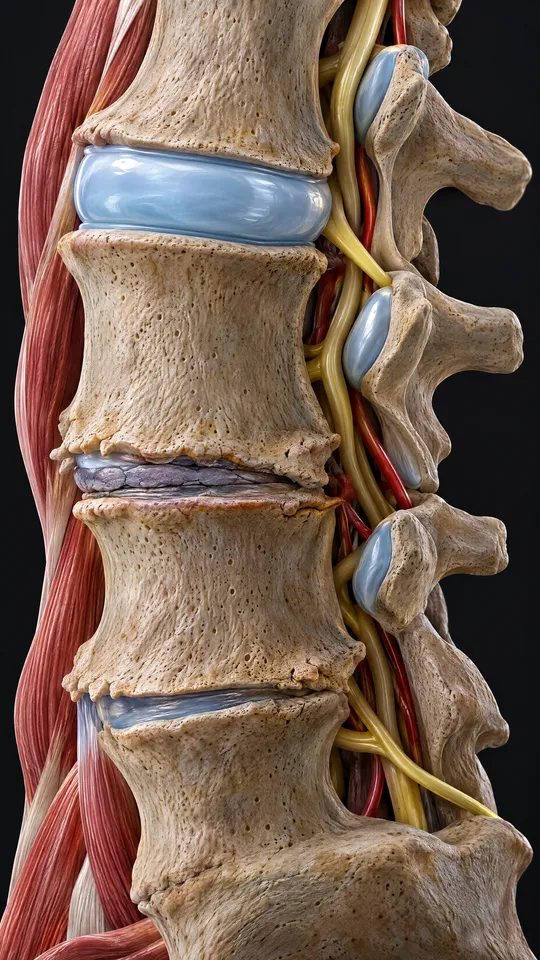
They often appear on the same report, and they overlap: a bulge is one of the age-related changes 2. What separates them is what your symptoms are doing.
Protrusions become less likely with age, because drier discs have less soft material to push out 2. If leg symptoms are your main problem, our Lumbar Disc Bulge and Sciatica pages cover those patterns.
You don't need a new scan to get started. A disc problem is worked out from your medical history and a physical examination 2. The history looks for risk factors and for any sign that a spinal nerve is involved 2. In the examination we check how your spine and legs move, your muscle strength and your reflexes 3.
Further tests are for two situations: symptoms that drag on past six weeks even though you've stayed active, or concern that a disc is affecting a nerve 2. When scans are ordered, part of their job is ruling out rare or serious causes such as a fracture, an infection, cancer or a narrowed spinal canal 3.
We start by assessing your history, how your back moves, your strength and whether a nerve is involved, because scans are often unhelpful for telling whether pain is coming from a disc 2. From there:
Heat wraps or hot packs are a simple, low-risk pain-relief option 2,3.
Paracetamol, anti-inflammatories and other pain medicines are part of standard management 2,3. Prescribing sits outside physiotherapy scope, so talk to your GP about them.
In severe cases, surgery to fuse two vertebrae may be considered, but severe cases are uncommon 2. One long-term follow-up of three trials compared fusion with an intensive exercise and cognitive-behavioural rehab program in 473 people with chronic low back pain. After about 11 years, disability was no different between the groups 5. There are two caveats: only just over half were followed up that long, and rehab was about equal to surgery, not better 5. If your pain has become persistent, our Chronic Pain Management program works along similar lines.
That idea rests on animal studies, not proven results in people 9. We recommend exercise to manage pain and keep you moving 2,4, not to change your scan.
With degenerative disc disease the scan is unlikely to change, so The Well Motion Recovery Path™ is measured on what your back can do. You move up a phase on function, not on a date.
How long it usually takes. No study gives a figure for degenerative disc disease by name. Across 33 cohorts of people with low back pain, pain fell most in the first six weeks and more slowly after that 10. Where pain was already persistent, average scores fell from 51 out of 100 to 33 at six weeks and 23 at one year 10. These are averages from observation, not a promise.
No trial has tested prevention for degenerative disc disease by name. The trials are in low back pain generally, so that's what these rest on:
Call 000 and ask for an ambulance if you have back pain and have lost feeling or movement in your limbs, or have problems controlling your bowels or bladder 3.
Go to the emergency department immediately if your back pain comes with any of these 3:
Difficulty moving an arm or a leg, or numbness in an arm or leg, with none of the signs above: call us the same day. We assess it and tell you plainly if it needs a hospital.
Book an assessment with us if:
See your GP if you've had unexpected weight or appetite loss, or you've had cancer before 2.
These situations are uncommon. For most people, this diagnosis is the start of a plan, not a warning sign.
We start by listening: how it began, what makes it worse, and what it's stopping you from doing. Then we examine the area, explain what we find in plain English, and agree a plan with you. Your first visit is 40 minutes at Engadine and 30 minutes at our other clinics.
We see patients at Engadine, Mount Annan, Narellan and Appin, and at home through our mobile physiotherapy service. If you have private health cover, here's how health fund rebates work for physiotherapy.
None of our sources suggests it is. Keeping active is a recommended treatment 3, and regular walking is named as something that may help strength and flexibility in people with back problems 2. Set the pace and distance by what your back tolerates, and build up gradually 2.
Mostly back pain that's worse with activity, prolonged sitting or repeated bending, or with coughing, sneezing or straining 2. An irritated nerve can add leg pain, numbness or pins and needles 2. A "moderate" grading on a scan doesn't predict how much pain you'll have 1.
The scan changes are a normal part of ageing 1,2, so we won't promise they'll disappear. The pain and restriction are different: most disc problems resolve without specific treatment 2 and usually improve by themselves 3. Recovery means getting back to what you want to do, not a different-looking MRI.
Prolonged sitting, repeated bending, and coughing, sneezing or straining can aggravate symptoms, and bending while twisting increases load on the discs 2. Risk factors for disc changes include older age, higher body weight, low fitness, smoking, poor posture, diabetes and heavy lifting. Often, though, there's no recognisable risk factor at all 2.
Pain radiating down the leg, often with pins and needles.
Read moreWhat a disc bulge on a scan actually means, and the recovery pathway.
Read moreStiffness from the small joints at the back of the spine, worse arching back.
Read moreTailbone pain after a fall, childbirth, or long stretches on a hard seat.
Read morePain from the joint linking spine to pelvis, often mistaken for general back pain.
Read moreNarrowing of the spinal canal, causing leg pain that worsens as you walk.
Read moreOne vertebra slipping forward over the one below, sometimes from a stress fracture.
Read moreA back spasm is the muscles of your back tightening suddenly and refusing to let go. It's one of the ways low back pain shows up
Read more
How would you like to reach us?
Message us on WhatsAppFor bookings and enquiries. Please don't send medical details. Call (02) 8111 5633Request a call-back
Request sent
Thank you. We'll call you back on the number you gave us.
This is a preview, so nothing was actually sent.