Need urgent care? 24/7 Mobile & After-Hours Emergency Physiotherapy Call (02) 8111 5633 For life-threatening emergencies, always call 000
Groin

Symphysis Pubis Dysfunction

5.0 average rating on Google
Registered NDIS Provider
SIRA Registered Provider

Rolling over in bed has become a three-step manoeuvre. Pulling on your pants standing up is out of the question, getting out of the car sends a sharp pain through the front of your pelvis, and the stairs are worse than they were a month ago. You're somewhere in the middle of your pregnancy, and someone has called it SPD. This page covers what it is, what helps, and what the evidence can and can't promise.

What's actually causing it

Your pelvis is a ring of bone. At the back, it joins your spine at the two sacroiliac joints. At the front, the two halves meet at the pubic symphysis, a small joint just above your pubic bone. Pelvic girdle pain can involve any of these joints; SPD is the name used when the front one is the main source 4.

Pregnancy changes several things at once. Your growing baby adds weight and pressure through the pelvis, and your posture shifts to compensate. Hormonal changes are also thought to soften the ligaments that hold the pelvis together. Combined, these put extra strain on the pelvic joints, which can become inflamed and painful 5.

What about relaxin? Almost everything you'll read about SPD blames the hormone relaxin for loosening your pelvic ligaments. It's a tidy story, but the research doesn't back it cleanly: studies haven't found a clear link between relaxin levels in the blood and either joint looseness or pelvic girdle pain 2. Hormones may still contribute alongside the physical changes 4; nobody yet knows how much.

It's more likely if you've had 1:

  • Lower back or pelvic girdle pain before, or a previous pelvic injury
  • Pelvic girdle pain in an earlier pregnancy
  • A physically demanding job

Where you'll feel it. Usually over the pubic bone at the front, but it can spread across one or both sides of your lower back, into the perineum (the area between your vagina and anus), and down into your thighs 1. The movements that set it off share a pattern: standing on one leg, moving your legs apart, or turning through the pelvis. Getting dressed, stairs, getting out of the car and rolling over in bed are the usual culprits 1,5.
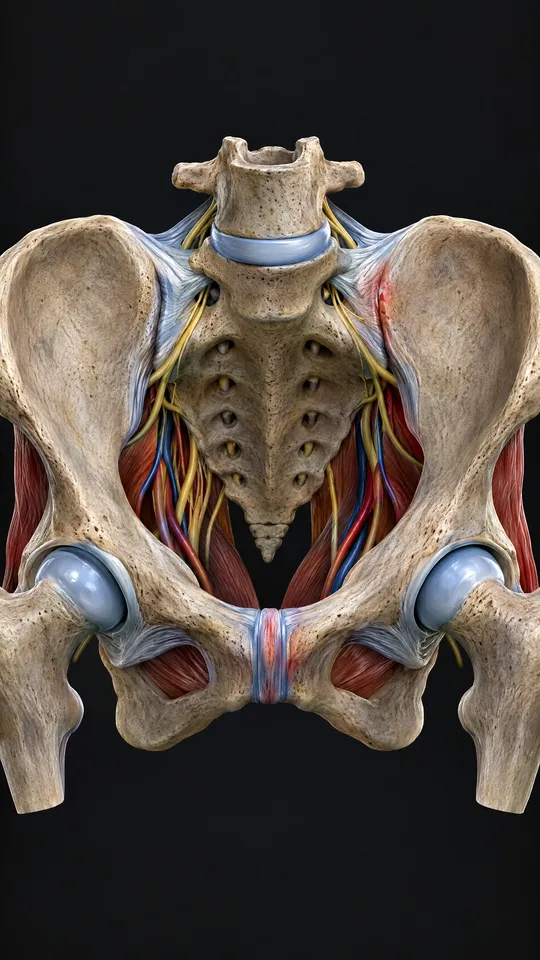

Pelvic ring showing the two joints at the back and the pubic joint at the front

SPD or osteitis pubis? How to tell the difference

Both cause pain at the pubic symphysis, and osteitis pubis is one of the conditions a clinician will want to rule out 2. The difference is mostly in the story:

  • SPD arrives during pregnancy, usually mid-pregnancy, often with pain at the back of the pelvis too, and it's set off by everyday movements like rolling over 1,2.
  • Osteitis pubis is typically a sport-related overload problem that builds over a season. If your pain started with training rather than pregnancy, that page, and our sports physiotherapy approach, is the better starting point.

A few other conditions can look similar in pregnancy and are worth excluding: sciatica, a separation of the pubic symphysis itself, transient osteoporosis of pregnancy, a urinary tract infection, a blood clot in the thigh, and early labour 2. Diagnosis is mostly hands-on. Pressing over the symphysis and a modified single-leg standing test (the modified Trendelenburg test) are the most accurate checks for this kind of pain, and scans are rarely needed 2,4.

How it's diagnosed

The reassuring part: tests usually aren't needed 4. A clinician asks about your pain and your pregnancy, and listens for one thing in particular. Is the pain mechanical? That means it comes on with activity and eases with rest. Pain that turns up without any movement is unlikely to be pelvic girdle pain 2. They then examine you, rule out your lower back as the source 4, and check whether specific movements bring on the pain where you feel it 2.

Scans don't show how severe it is. They're kept for rare cases, such as severe pain that isn't responding to treatment, or not being able to take weight through your legs 2. It's best to avoid X-rays in pregnancy unless one is needed 4. If your doctor recommends one, that's usually to check for another cause of the pain, or because severe pain isn't getting better 4. Most medical imaging is unlikely to harm a developing baby, and it's only done when the risk of going without it is greater 9. Remind whoever orders it that you're pregnant 4.

How we treat it

During pregnancy, the aim is to reduce pain and keep you moving, working and sleeping, rather than make the condition disappear 1. In practice that means:

  • A proper assessment first: confirming it's pelvic girdle pain, which joints are involved, and that nothing on the list above needs a different pathway 2.
  • Changing how you do the things that hurt: smaller steps, shorter walks, stairs one at a time, sitting down to get dressed, keeping your knees together when you roll over or get out of the car, sleeping on your side with a pillow between your legs, and breaking jobs like vacuuming into smaller pieces 4,5.
  • Strengthening: exercises for the muscles around your hips, back, deep abdominals and pelvic floor, progressed within what your pelvis will tolerate 1,5. Our women's health physiotherapy page covers how we work with you through pregnancy and after the birth, including when we'd refer you on for a specialised pelvic floor assessment.
  • Support where it helps: a pelvic support belt, fitted correctly and worn for short periods, not all day, and occasionally crutches 1,4,5.
  • After the birth: resting lying down instead of sitting, and keeping moving within your pain limits 5.

What the evidence can and can't promise. A large review of 34 trials in pregnant women found moderate-quality evidence that an 8 to 12 week exercise program reduced the number of women reporting pain where low back and pelvic pain occurred together 3. For pelvic pain on its own, the picture is weaker: two studies of group exercise plus pain-management advice found no difference compared with usual antenatal care, and that evidence was rated low quality 3. The authors concluded there isn't enough good-quality evidence to make confident decisions about these treatments 3.

So why see anyone? Because treatment from an experienced practitioner can still improve your symptoms during pregnancy, even when it can't make them disappear 1. And because this pain often goes unaddressed: one Australian study found only 25% of women who reported pelvic girdle pain were offered any treatment 2.

Other treatments we may use

Manual therapy.

Hands-on techniques for the pelvis, hips and lower back. Single studies have reported benefit from manual approaches, including as part of a combined program with exercise and education, but that evidence is moderate to low quality and hasn't yet been confirmed by further trials 3. We use it to ease pain enough for you to move, not as a stand-alone fix.

Ice or heat.

Use whichever feels better 4. For ice, 20 to 30 minutes on the painful area every 2 to 3 hours, wrapped so it isn't directly against your skin 5.

Pain relief medication.

Paracetamol may be an option, but check with your doctor or pharmacist first 4. Medication is a decision for your doctor or maternity team. It isn't something Well Motion physiotherapists prescribe.

Rest, but not bed rest.

Stay active, and avoid the specific things that make it worse 1. Don't push through pain 5, but extended bed rest without your doctor's guidance isn't recommended 4.

Your recovery path: Reset, Rebuild, Return

Treatment for SPD follows The Well Motion Recovery Path™, with one difference: the birth sets part of the timeline. You move up a phase when your pelvis copes with more, not when a week number arrives.

  • Reset: from your first assessment. Changes to how you roll over, dress and climb stairs 4,5, a support belt for short periods 1,5, ice or heat 4, and manual therapy when pain is stopping you moving. Expect the pain to ease, not vanish 1. We move you on once your usual triggers are manageable.
  • Rebuild: still during pregnancy for most women. Strengthening for your hips, back, deep abdominals and pelvic floor 1,5, progressed only as far as your pelvis tolerates. Expect good weeks and bad weeks as your baby grows. We move you on after the birth, once everyday tasks no longer flare the pain.
  • Return: after the birth. Here that means lifting and carrying your baby, walking further, and exercise if you want it. We check stairs, standing on one leg and carrying before building each one back up. You leave with a home program and a plan to get help early in any future pregnancy 4.

How long it usually takes. Symptoms rarely settle fully before the birth 1. One Australian review reports that 93% of women had symptoms resolve within three months afterwards 2. Pain continues past that point for some women 4, and it is worth being reassessed if it does.

Reducing the risk of flare-ups

Prevention has been tested here, and the answer is mixed:

  • Exercise won't reliably stop it starting, but it's linked with milder pain. Pooled trials found exercise started during pregnancy didn't lower the chance of having pelvic girdle pain 6 7, though only four small trials measured it on its own 6. Women who exercised did report less severe back and pelvic pain during pregnancy 7. Australian pregnancy guidance says regular exercise and strong abdominal and pelvic floor muscles can lower your chances 4. The pooled trials don't confirm that for pelvic girdle pain, but they all began exercise partway through pregnancy 6, and one large Norwegian study linked regular exercise before a first pregnancy with a lower chance of it 8. None of this is a reason to stop exercise your midwife, doctor or physio has recommended: it has other benefits in pregnancy 6.
  • Plan early if there's a next time. In one study, 68% of women with more than one pregnancy had it come back 2. Tell your health team early in your next pregnancy, because managing it early can help stop the pain worsening as the months go on 4.
  • Mind how long you stay put, and what you carry. Avoid long spells of sitting or standing, and heavy lifting such as shopping bags 1. When you sit, don't cross your legs 4.
  • Choose your shoes and take your rests. Supportive, low-heeled shoes are recommended 2 4, and so is resting between activities 5.

When to get it checked properly

Contact your midwife, doctor or maternity unit straight away, rather than booking a physio first, if you have 2,4:

  • Pain that comes on without any movement
  • A fever you can't explain
  • Vaginal bleeding or fluid leaking
  • Numbness or weakness in your legs, or numbness around your genitals, bottom or inner thighs
  • Difficulty controlling your bladder or bowels
  • Unexplained weight loss
  • A fall or other injury
  • Anything you think could be early labour

Book a physiotherapy assessment if:

  • Walking, stairs, sleeping or looking after other children is becoming hard to manage 4
  • The pain keeps building week to week despite changing how you move
  • It's still there more than three months after the birth, when most women have recovered 2

None of this is cause for alarm. Pelvic girdle pain isn't harmful to your baby, and for most women it settles in the months after the birth 1,2.

Your first appointment

We start by listening: how it began, what makes it worse, and what it's stopping you from doing. Then we examine the area, explain what we find in plain English, and agree a plan with you. Your first visit is 40 minutes at Engadine and 30 minutes at our other clinics.

We see patients at Engadine, Mount Annan, Narellan and Appin, and at home through our mobile physiotherapy service. If you have private health cover, here's how health fund rebates work for physiotherapy.

FAQs

What does SPD feel like?

Most often a sharp or aching pain over the pubic bone at the front, sometimes spreading to the lower back, perineum and thighs, occasionally with clicking, locking or grinding. It's usually worst on stairs, standing on one leg, rolling over in bed and moving your legs apart 1,5.

How do you fix symphysis pubis dysfunction?

It usually can't be fixed completely while you're pregnant. Symptoms tend not to fully settle until after the birth 1. You can reduce the pain and protect your day-to-day function: changing how you move, targeted strengthening, a correctly fitted support belt, and ice or heat 1,4,5.

Can SPD cause early labour?

No. Pelvic girdle pain isn't harmful to you or your baby 1,4. But pelvic pain in pregnancy can occasionally have other causes, including early labour, which is why a clinician will rule those out 2, and why the warning signs above matter.

How long does symphysis pubis dysfunction last?

Usually until the birth, and then it settles: around 93% of women report their symptoms have resolved within three months postpartum 2. It can continue after the birth for some women 4, and if it does, it's worth being reassessed.

Is walking good for pubic symphysis dysfunction?

Yes and no. Staying active is encouraged 1, but long or fast walks are common triggers. Take smaller steps, walk shorter distances, and don't push through pain 5.

Does SPD get worse with age?

Age itself isn't a risk factor 2. What matters more is having had it before: in one study, 68% of women with more than one pregnancy reported it came back, and 70% of those said it was worse the next time 2. A longer gap between pregnancies doesn't appear to change that risk 2.

More Groin conditions

Groin

Groin Strain

A strain of the adductor muscles that pull the leg inward, common in sports with sudden changes of direction.

Read more
Groin

Adductor Strain

A strain of the inner-thigh muscles, closely related to a groin strain but specific to the adductor group.

Read more

Pelvic pain can make pregnancy a lot harder than it needs to be, and you don't have to just put up with it.

Book an assessment and we'll work out what's driving it and how to keep you moving. You can see us at Engadine, Mount Annan, Narellan or Appin. Or head back to the groin injury guide if something else on that list sounds closer.

Book an Assessment
Ahmed Elsayed, Principal Physiotherapist
Reviewed by Ahmed Elsayed Principal Physiotherapist at Well Motion

References

  1. NHS. Pelvic pain in pregnancy (pelvic girdle pain). Page last reviewed 12 December 2022. https://www.nhs.uk/pregnancy/common-symptoms/pelvic-pain/
  2. Walters, West & Nippita. Pelvic girdle pain in pregnancy. Australian Journal of General Practice, 2018;47(7). doi:10.31128/AJGP-01-18-4467. https://www1.racgp.org.au/ajgp/2018/july/pelvic-girdle-pain-in-pregnancy
  3. Liddle SD, Pennick V. Interventions for preventing and treating low-back and pelvic pain during pregnancy. Cochrane Database of Systematic Reviews, 2015, Issue 9, CD001139. https://www.cochrane.org/evidence/CD001139_treatments-preventing-and-treating-low-back-and-pelvic-pain-during-pregnancy
  4. Pregnancy, Birth and Baby (healthdirect Australia). Pelvic girdle pain in pregnancy. Last reviewed August 2024. https://www.pregnancybirthbaby.org.au/pregnancy/body-changes-and-anatomy/pelvic-pain-during-pregnancy
  5. The Royal Women's Hospital, Physiotherapy Department. Pregnancy-related pelvic girdle pain (patient fact sheet). https://www.thewomens.org.au/images/uploads/fact-sheets/Pregnancy-related-pelvic-girdle-pain-210319.pdf
  6. Shiri R, Coggon D, Falah-Hassani K. Exercise for the prevention of low back and pelvic girdle pain in pregnancy: a meta-analysis of randomized controlled trials. European Journal of Pain, 2018;22(1):19-27. PMID 28869318. https://doi.org/10.1002/ejp.1096
  7. Davenport MH, Marchand AA, Mottola MF, et al. Exercise for the prevention and treatment of low back, pelvic girdle and lumbopelvic pain during pregnancy: a systematic review and meta-analysis. British Journal of Sports Medicine, 2019;53(2):90-98. PMID 30337344. https://doi.org/10.1136/bjsports-2018-099400
  8. Owe KM, Bjelland EK, Stuge B, Orsini N, Eberhard-Gran M, Vangen S. Exercise level before pregnancy and engaging in high-impact sports reduce the risk of pelvic girdle pain: a population-based cohort study of 39 184 women. British Journal of Sports Medicine, 2016;50:817-822. PMID 26435533. https://doi.org/10.1136/bjsports-2015-094921
  9. NSW Agency for Clinical Innovation, Emergency Care Institute. Medical imaging in pregnancy (patient fact sheet). Published July 2022. https://aci.health.nsw.gov.au/networks/eci/clinical/ed-factsheets/medical-imaging-in-pregnancy