Abdominal binders.
A supportive brace or special underwear can help support your back 1.
Your baby is six months old. The six-week check came and went, and everything is supposed to be back to normal. But there's still a ridge down the middle of your stomach when you sit up in bed, your lower back aches after a day of lifting, and your core won't switch on.
Nobody has looked at it properly, and you've half-decided this is just what happens now.
Two long muscles run down the front of your abdomen: the rectus abdominis, the ones people call a six-pack. They're joined down the middle by a band of connective tissue called the linea alba, and during pregnancy that band stretches to make room 2.
That's what diastasis recti is: the linea alba widening and thinning, so the two sides of the muscle sit further apart 5. It isn't a hernia, and there's no hole in the tissue 9. It's also very common: present in about a third of first-time mothers at 21 weeks 8, and most women develop it in the last trimester 9. An adaptation, not an injury you caused.
A common sign is a bulge along your midline 9, above, at or below your belly button. It shows when you lift your head and shoulders off the pillow or curl up 8.
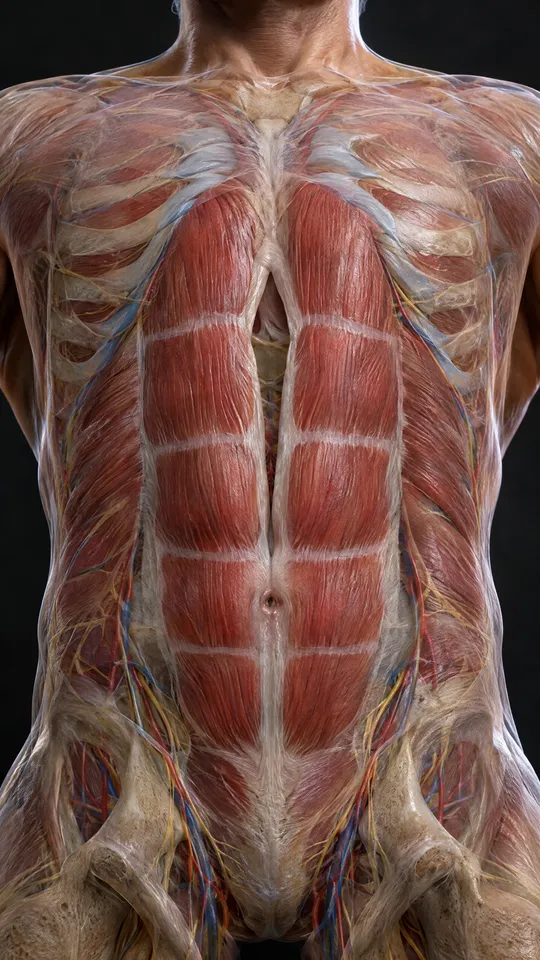
A soft lower belly at rest is a change in shape. Diastasis recti is an increased distance between the two sides of rectus abdominis 5, with a bulge that can show up on contraction, when you lift your head and shoulders 8.
There's no single agreed cut-off for diagnosing it, which is partly why reported rates vary between studies 8. A European guideline defines it as a gap wider than 2 cm, and classifies it partly by whether a hernia is also present 5.
That last point matters. A hernia can sit alongside a diastasis 5, and it needs its own medical assessment, not a rehab program. If you're not sure what you're feeling, or you've noticed a lump that nobody has checked, get it looked at properly.
A torn abdominal muscle is different again: a strain in the muscle itself, usually with a moment you remember.
This one is usually checked by hand. Your doctor, midwife or physio can feel for the gap and measure it with their fingers, a tape measure or an ultrasound scan 1. You lie on your back with your knees bent and lift your head and shoulders, and they feel across your midline above, at and below your belly button 8.
Fingers are quick, but two examiners won't always agree on the width, which is why ultrasound is preferred when an exact measurement matters 8. Studies don't share one cut-off either: one counted two finger-widths 8, another 28 mm on ultrasound 7.
What we will be honest with you about. The best available review (seven randomised trials, 381 women, formally graded) found very low-quality evidence to recommend any specific exercise program for diastasis recti after birth 4. Its largest, best-followed trial found no difference in how many women still had a separation at 6 or 12 months, whether or not they did a supervised 16-week program 4. So we work on your strength, function, load tolerance and the symptoms that brought you in. We won't promise the gap closes, because nobody can.
A supportive brace or special underwear can help support your back 1.
Some trials have tested curl-ups rather than deep abdominal work. That evidence comes from single trials at high risk of bias and is rated very low quality 4, and early advice is to avoid curling movements while the separation is there 1,3.
Worth doing for its own reasons, but be clear what it's for: the review found low to very low quality evidence that it is not more effective than minimal intervention for treating the separation itself 4.
Repair is a real option in the literature, but it isn't first-line after pregnancy. It may be considered where the separation limits function and reduces quality of life 2. That's a decision made with a surgeon, not something a physiotherapist provides.
Rehabilitation for a diastasis recti follows The Well Motion Recovery Path™. You move up a phase when your abdominal wall copes with the next load, not on a date.
How long it usually takes. Tissue recovery after birth can take 4 to 6 months 2. The separation can last longer. Among 300 first-time mothers, 60.0% had one at 6 weeks, 45.4% at 6 months and 32.6% at 12 months 8. That cohort had no comparison group, so it shows the natural course, not what treatment adds.
A separation is more likely if you've had more than one pregnancy 1, so this matters most if you're planning another. Some of it has been tested, some is standard advice:
Worth booking an assessment (with us, your GP or your midwife) if any of these apply:
None of that is an emergency. It's just worth someone looking at instead of waiting it out.
We start by listening: how it began, what makes it worse, and what it's stopping you from doing. Then we examine the area, explain what we find in plain English, and agree a plan with you. Your first visit is 40 minutes at Engadine and 30 minutes at our other clinics.
We see patients at Engadine, Mount Annan, Narellan and Appin, and at home through our mobile physiotherapy service. If you have private health cover, here's how health fund rebates work for physiotherapy.
Often, yes: it commonly settles in the weeks and months after your baby is born 1. But often isn't always. Around 60% of women have a separation at six weeks postpartum and 32.6% still do at 12 months 2. You'll see an 8-week benchmark quoted: that's the point to get checked if the gap is still obvious 3, a checkpoint, not a deadline your body is failing to meet.
Lie on your back, knees bent, feet flat. Place your fingertips flat across your midline at your belly button, lift your head and shoulders slightly, and feel for the gap between the muscle edges, above and below the belly button 1,3. A gap wider than one to two finger-widths suggests a separation 1,3. The caveat: two examiners won't always agree on a finger-width measurement 8, which is why callipers or ultrasound are suggested when a precise figure matters 5.
While the muscles are separated, skip sit-ups, crunches and oblique curls 1, and hold off on planks, some yoga poses and high-impact exercise to start with 1,3. Don't lift anything heavier than your baby, and roll onto your side to get out of bed rather than sitting straight up 1. Avoid straining on the toilet 3. The theme is a cautious, gradual return to load 2.
The evidence that any specific exercise program narrows the separation is very low quality (deep abdominal training showed an average reduction of about 0.63 cm, itself rated very low certainty 4), and one ultrasound study suggests a narrower gap isn't the only thing that matters for how the abdominal wall works 10. What we can work on is real: strength, control, load tolerance, and the back pain and weakness that usually brought you in. That's core rehabilitation, worth doing whether or not your midline ever measures the way it did before.
Mostly it's a problem of function, not danger. Lower back pain is the common consequence, because your abdominals also support your back 1, and a gap still obvious at 8 weeks may put you at risk of back problems 3. A diastasis may come with abdominal and lower back pain and weaker trunk muscles 9. You'll also see it linked to leaking urine and prolapse, but studies haven't found an association with pelvic floor problems after birth 4, so a separation doesn't mean you'll develop those.
A pulled or torn abdominal muscle, upper or lower. Sharp pain when you sit up, cough, twist or lift, usually traced back to a single hard effort.
Read morePain around or between the lower ribs on one side, worse on a deep breath, a twist or an overhead throw. In cricket and throwing sports it's called a side strain.
Read more
How would you like to reach us?
Message us on WhatsAppFor bookings and enquiries. Please don't send medical details. Call (02) 8111 5633Request a call-back
Request sent
Thank you. We'll call you back on the number you gave us.
This is a preview, so nothing was actually sent.