Carpal Tunnel Syndrome
Numbness, tingling or pins and needles through your thumb, index and middle fingers, often worst overnight. It's a nerve compressed at the wrist, and there's usually plenty worth trying before surgery comes up.
Read moreYou've noticed a smooth, rounded lump on the back of your wrist. Maybe it doesn't hurt. Maybe it aches when you bend your wrist or lean on your hand. Some weeks it looks bigger, some weeks smaller, and you're not sure whether to worry or leave it alone.
Very often, a lump like this is a ganglion cyst. Here's what that means and where physiotherapy fits.
A ganglion cyst is a small sac of fluid attached to a joint or to the sheath around a tendon 1. What causes it is unknown 1.
The most common explanation is that a small tear in a tendon's lining, or in the joint capsule (the sleeve of tissue that seals a joint), lets fluid collect in a pouch 2. Injury or overuse may play a part 2. Another theory is that tiny droplets of fluid gradually merge into one larger pocket 3.
They're more common in women and usually appear in young to middle-aged adults 1, most often between 20 and 40 2.
Many cause no symptoms 1. Some cause pain, tingling or muscle weakness, or press on a nerve, and a wrist cyst can send pain up into the arm 1. Pain often gets worse when the nearby joint moves 2, which is why tasks that bend or load your wrist are usually the ones that bother you.
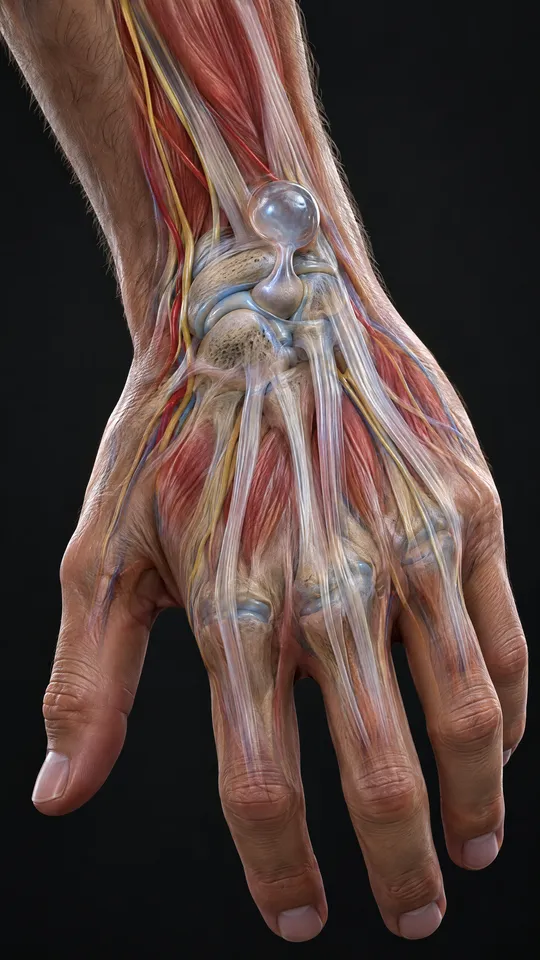
Some features point towards a ganglion: a smooth lump on the back of the hand or wrist that changes size over time 2, in a young to middle-aged adult 1,2. But those are clues. They aren't a diagnosis.
That's why a GP visit is the right first step for any new lump, to make sure it isn't something else 1. An ultrasound can show whether it's filled with fluid or solid 1. Once it's confirmed as a ganglion, we can help most.
No lump, just wrist pain? The Hand section of our Injury Finder covers other hand and wrist problems.
Most ganglion cysts are diagnosed by looking and feeling. It's rare to need more testing 6. Your doctor will ask how long you've had the lump, whether it changes size and whether it hurts, and may press on it to check for tenderness 6. There's a simple torch test too: a light held against a fluid-filled ganglion passes through it, and a solid lump blocks it 6.
Scans are for the less clear cases, such as wrist pain with no obvious lump 6. An MRI can find a small cyst that can't be seen or felt 1 6. An X-ray won't show the cyst itself, but it can show arthritis in the joint underneath 6.
We haven't found good evidence that physiotherapy, exercise or a splint on their own make a wrist ganglion disappear. A 2022 systematic review of treatment trials didn't study physiotherapy, and it rated the evidence it did find as low quality 4. What we can do is keep your hand working while the cyst runs its course, and help you recover if it's removed.
Wrist splints and braces. We may suggest one short-term for a painful task, but we're not aware of good evidence that a splint alone makes a ganglion go away. After a procedure, a splint is often worn for about a week. Longer can stiffen the joint 2.
Aspiration (not something we do). A doctor drains the fluid with a needle. It's quick, but roughly half of cysts come back 1. Across studies, recurrence has ranged from 7% to 72% 4. It's outside a physiotherapist's scope of practice, so that's a conversation with your GP.
Surgery (also not ours, but we're there afterwards). Cysts come back less often after removal: 6% to 41% after open surgery and 0% to 16% after keyhole surgery in the studies reviewed 4. But surgery has more complications 3, and a small number of people have ongoing pain and stiffness afterwards 1. Recovery usually takes two to eight weeks 2. That's where rehab comes in.
Therapy to stop it coming back. You may read that specialised hand therapy lowers the chance of a cyst returning. The 2022 review of treatment trials compared only drainage and surgery, not therapy 4. We'd rather tell you that than promise it.
No option is ideal, and one review says exactly that about every current treatment 3.
A ganglion does not heal on a schedule, so The Well Motion Recovery Path™ follows your wrist and not the lump. You move up a phase when the hand can do more, whether or not the cyst is still there.
How long it usually takes. After surgery, recovery usually takes two to eight weeks 2. Without a procedure the lump has no set time. In one study of adults followed for a mean of 70 months, 23 of 55 untreated cysts on the back of the wrist (58%) had gone 9. That is a single cohort answering a postal questionnaire.
Nobody knows what causes a ganglion, so there's no known way to stop the first one forming 1 2. Whether it comes back after treatment is a different question, and that one has been counted:
See your GP if it's a new lump that hasn't been diagnosed 1. Book an assessment with us if it's painful, or it's limiting how you use your hand or wrist.
Also get it assessed if:
Unsure whether it needs a visit? healthdirect's free helpline is open 24/7 on 1800 022 222 1.
A ganglion is benign, and plenty go away on their own 1,2. Getting it checked is for peace of mind. It isn't cause for alarm.
We start by listening: how it began, what makes it worse, and what it's stopping you from doing. Then we examine the area, explain what we find in plain English, and agree a plan with you. Your first visit is 40 minutes at Engadine and 30 minutes at our other clinics.
We see patients at Engadine, Mount Annan, Narellan and Appin, and at home through our mobile physiotherapy service. If you have private health cover, here's how health fund rebates work for physiotherapy.
Often, you don't need to. Many settle without treatment, so watching and waiting is a real option 1,2. If it's painful or in the way, a doctor can drain or remove it. Both can recur, and the research comparing them is low quality 1,4. Physio helps with the pain and function around it, and with rehab afterwards 2.
Hitting it with a heavy book, the old "Bible therapy", is a bad idea and can cause further injury 1,2. There's no clear guidance on gently pressing it. If pressing on it hurts, have it looked at.
Nobody knows for sure 1. The leading theory is a small tear in a tendon or joint lining that lets fluid collect, possibly after injury or overuse 2.
Yes, often. Figures vary: roughly 30% to 50% 2, or about half, with studies of adults running from 40% to 58% 3. In children, three in four go away within a year 1.
Numbness, tingling or pins and needles through your thumb, index and middle fingers, often worst overnight. It's a nerve compressed at the wrist, and there's usually plenty worth trying before surgery comes up.
Read morePain on the little-finger side of the wrist, often after a fall onto an outstretched hand, racquet sports, or repeated twisting and loading. Usually managed conservatively first.
Read moreWrist pain that started with a fall onto an outstretched hand and hasn't settled. Scaphoid fractures are commonly missed on an early X-ray, so it's taken seriously even when imaging looks clear.
Read moreAche, weakness or burning that builds through the day at a keyboard or on the tools. We see it across desk workers, tradies and new parents.
Read moreA wrist sprain means a ligament, one of the tough bands holding your wrist bones together, has been stretched or torn. It usually happens during sport, a sudden movement or a fall
Read moreTrigger finger is a finger or thumb that catches, gets stuck bent, or straightens with a click or snap
Read moreWith mallet finger, the tip of your finger stays bent and you can't straighten it yourself
Read more
How would you like to reach us?
Message us on WhatsAppFor bookings and enquiries. Please don't send medical details. Call (02) 8111 5633Request a call-back
Request sent
Thank you. We'll call you back on the number you gave us.
This is a preview, so nothing was actually sent.