Need urgent care? 24/7 Mobile & After-Hours Emergency Physiotherapy Call (02) 8111 5633 For life-threatening emergencies, always call 000
Hand

TFCC Injury (Triangular Fibrocartilage Complex)

5.0 average rating on Google
Registered NDIS Provider
SIRA Registered Provider

You put a hand out to break a fall, or took an awkward swing at a padel ball, and the wrist felt wrong afterwards. Not the middle of it: the far side, under the little finger. Weeks later it still catches when you turn a doorknob or push up out of a chair, sometimes with a click as your forearm rotates. That pattern has a name: an injury to the triangular fibrocartilage complex, usually shortened to TFCC.

What's actually causing it

Hold your forearm out and rotate your palm up and down. The two forearm bones pivot against each other while your wrist stays connected to both. The TFCC is what makes that possible: a small complex of cartilage and ligaments slung between the end of the ulna (the bone on your little-finger side) and the wrist, acting as cushion and stabiliser 4. It carries roughly a fifth of what you push, pull or carry 4.

Injuries arrive two ways. Suddenly: "a fall with a significant twist applied to the wrist joint", or "forcibly twisting the wrist with a high torque, such as a power drill jamming or hitting a golf ball awkwardly" 4. Or gradually, from "repetitive movements of the wrist and mechanical stress in general of the distal radio-ulnar joint" 2, which is why it turns up in tennis, padel, golf, table tennis, baseball and javelin 2.

The symptoms follow from the anatomy: ulnar-sided pain, tender at the small hollow past the end of the ulna, minimal swelling, pain against resistance, reduced movement, the joint sagging under load, and a click on rotation 2; grip weakness is common too 1, and some tears leave the joint unstable 5. One caveat: TFCC lesions "can be asymptomatic or pauci-symptomatic" 2, so a scan finding doesn't automatically mean it's causing your pain.
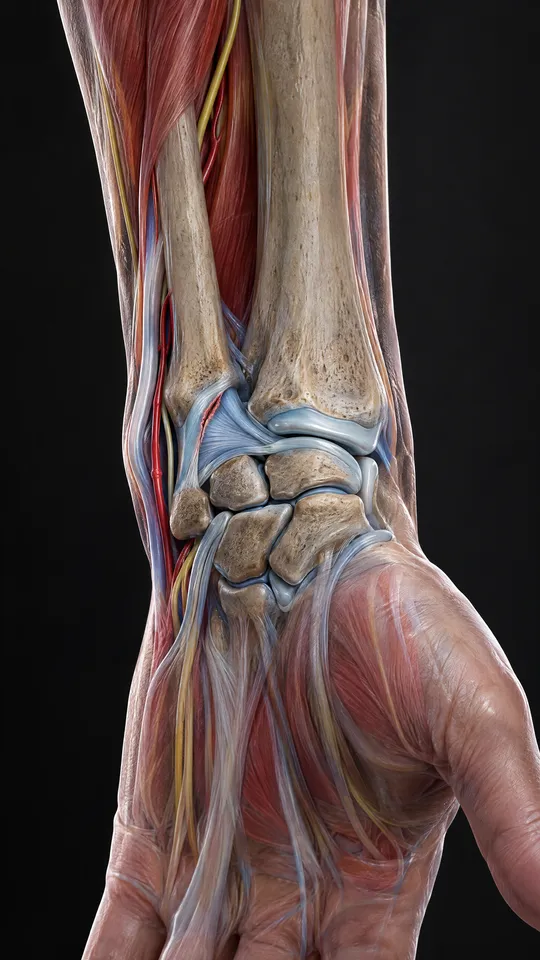

Wrist showing the two forearm bones and the small cartilage complex on the little-finger side

TFCC injury or carpal tunnel syndrome? How to tell the difference

These two get confused constantly.

TFCC injuryCarpal tunnel syndrome
Where you feel itLittle-finger (ulnar) side 2,4Palm, thumb, index and middle fingers 6
What it feels likePain, clicking, catching, giving way 2,4Tingling, numbness, weakness gripping 6
What sets it offTwisting, gripping, weight through the wrist 2,5Often worse at night; pressure-related, not load-related 6
What's wrongMechanical: ligament and cartilage under load 4A nerve problem: the median nerve compressed 6

If the main complaint is numbness and tingling on the thumb side, read carpal tunnel syndrome instead.

How it's diagnosed

A TFCC injury is usually diagnosed provisionally from your story and a hands-on examination, and scans come second 4. The examination centres on two joints: the one between your two forearm bones, and the one between the ulna and the wrist bones. Do they hold their position when force is applied, or shift 4?

A plain X-ray shows any bony injury and helps establish whether those joints are stable 4. An MRI usually follows, and high-resolution MRI is reported to be up to 97% accurate 2. Wrist arthroscopy, where a small camera is passed into the joint, is considered the gold standard 2. It's only occasionally recommended 4.

How we treat it

1
Assessment first, because it decides everything else. The question is whether your DRUJ is stable, answered by history and hands-on testing: the fovea sign, piano key test, compression and stress tests, and the press test 2,5. Confirmation usually adds imaging arranged through your GP: an X-ray plus MRI, which "will usually pick up a significant tear or injury to the TFCC" 4.
2
Settle the load before rebuilding it. For a stable injury the first phase is protection: "the wrist is immobilised in a splint or cast in order to help with pain relief whilst the body heals" 4, plus activity modification 5. How long varies: two weeks rigid then as-needed 1, two to four weeks 2, four weeks elsewhere 5.
3
Manual therapy to restore rotation. The progression is well described: immobilisation, then passive and active movement, then strengthening 2. Comfortable forearm rotation is the first milestone.
4
Hand rehabilitation for grip and control. Grip is where this injury shows itself in daily life. In the conservatively treated group in 1 it came back to 88% of the other side: good, and not quite symmetrical.
5
Graded loading, then a planned return to sport. The longest phase teaches the wrist to accept twisting and weight-bearing again in steps: full weight-bearing came at six weeks in that protocol 1, with three to six weeks out of sport suggested for athletes 2.

Other treatments we may use

Bracing and splinting.

A brace is a component, not the plan. In the study with the best conservative outcomes, a forearm orthosis held the wrist in slight extension for two weeks, then shifted to night-time and as-needed use 1. Good for settling symptoms early. It won't rebuild the strength or tolerance for twisting you need afterwards.

Medication and injections.

These appear in the literature: oral and topical anti-inflammatories, and steroid or hyaluronic acid injections 2; three of the sixteen conservatively treated patients in 1 also had a corticosteroid injection. Well Motion physiotherapists don't prescribe or administer any of these. That's a conversation for your GP or specialist.

Surgery, and the honest numbers.

If the DRUJ is unstable, surgical consultation is the right path rather than a longer conservative trial, and failure to improve conservatively is also a recognised indication 5. Surgery isn't a guaranteed fix, though: after debridement 92% of patients returned to work but "only 44% were free of pain", and after one common repair 68.3% returned to work with 41% reporting persistent pain 3. The rehabilitation afterwards is its own structured process: post-surgical rehabilitation.

How strong is the evidence?

Thin in both directions. One review concluded the literature "remains insufficient, making comparison between studies and techniques difficult" 3, and the study supporting conservative care most directly was retrospective, with its own authors calling for a randomised trial 1.

Your recovery path: Reset, Rebuild, Return

A TFCC injury with a stable joint is treated along The Well Motion Recovery Path™. The wrist earns each step by what it tolerates, not by a date.

  • Reset: the first weeks. A splint or brace and activity modification while the pain settles 4,5. Expect the wrist to feel stiff and weak when the splint comes off. We move you on once light everyday use no longer flares the little-finger side.
  • Rebuild: the longest phase. Manual therapy for forearm rotation first, then hand rehabilitation for grip and graded loading through twisting and weight-bearing 2. Expect grip to come back before you trust the hand to lean on. We move you on when the wrist does what your daily tasks ask of it.
  • Return: back to manual work or sport. We test the positions that used to hurt, at the load and speed you use them. You leave with a loading plan, because the repair keeps maturing after the pain has gone 4.

How long it usually takes. Healing takes around three months, and normal function often takes 6 to 12 months 4. In one study of 20 racquet sport players, with no comparison group, the 17 who got back to their usual activity took 134 days on average 9. In a review of 10 studies of athletes who had surgery, non-surgical care was tried first for 6 weeks to 6 months 8. After surgery, your surgeon sets the timeline.

Reducing your risk of it coming back

Prevention hasn't been tested for TFCC injuries, so these steps follow what's known about how they happen and heal:

  • Go easy on twisting under load. These injuries come mainly from load through the little-finger side of the wrist combined with rotation or side-to-side bending. While it settles, avoid whatever reproduces the way you hurt it 2.
  • Give the repair time. Healing takes around three months, and the scar tissue that fills the tear isn't quite as strong as the original. It takes around 18 months to mature 4.
  • Ask about support for your sport. Elite athletes use taping, a splint or a padded cast to take stress off the wrist, mostly after surgery. Not every sport allows it 2.
  • Don't read every scan finding as a new injury. The TFCC wears with age 4. When 84 adults with no wrist pain had an MRI, 23 of them had a defect in the disc 7.

When to get it checked properly

Seek emergency care for severe wrist pain, significant trauma to the wrist, hearing "a snap, grinding or pop", a wrist that looks pale or abnormal, or a sudden loss of strength 6. Otherwise, see your doctor if wrist pain has come on suddenly or lasted a few months 6.

Book an assessment, rather than waiting it out, if:

  • the pain sits on the little-finger side and returns every time you twist or load the wrist
  • there's a click, a catch, or a sense of the joint sagging when you rotate your forearm
  • pushing up out of a chair through your wrist reliably reproduces it
  • your grip has been quietly getting weaker
  • it hasn't meaningfully changed in six weeks of taking it easy

None of that means something is badly wrong. It means the question that decides your plan (whether that joint is stable) isn't one you can answer from home.

Your first appointment

We start by listening: how it began, what makes it worse, and what it's stopping you from doing. Then we examine the area, explain what we find in plain English, and agree a plan with you. Your first visit is 40 minutes at Engadine and 30 minutes at our other clinics.

We see patients at Engadine, Mount Annan, Narellan and Appin, and at home through our mobile physiotherapy service. If you have private health cover, here's how health fund rebates work for physiotherapy.

FAQs

How long does it take for a TFCC wrist to heal?

A long time. Healing takes roughly three months, but "it is often 6 to 12 months before normal function is regained" 4. Splinting usually runs two to four weeks 1,2,5; the strength work runs on for months after. A stable injury is reasonably treated conservatively first 5.

How do I know if my TFCC is torn?

You can't confirm it yourself, but the pattern is recognisable: ulnar-sided pain tender at the fovea, pain against resistance, reduced movement, the joint sagging under load, clicking on rotation 2. A physiotherapist adds specific tests 5, and confirmation usually comes from an X-ray plus MRI 4. The caveat: these lesions can be asymptomatic 2, so a scan alone doesn't prove it's your pain source.

Can a TFCC tear repair itself?

Many stable tears settle well enough with structured non-surgical care, not quite the same as the cartilage knitting back together. With a stable DRUJ, conservative treatment produced satisfactory to excellent results at around two years, not statistically different from surgery 1. Against that, only two of 43 articles in one systematic review indicated conservative therapy may be adequate 3.

How do I treat a TFCC tear at home, and what should I avoid?

The recognised measures are relative rest, activity modification, anti-inflammatories and splint immobilisation 2,5, with the usual rest-ice-compression-elevation approach for wrist pain 6. Just as important is what you stop: limit pronation (turning your palm down), gripping and ulnar deviation (bending the wrist towards the little finger) 2,5, so no press-ups, pushing out of chairs, stiff jars, racquet strokes or torque through a tool. You can't assess your own DRUJ stability at home, and that decides everything 5.

What is the best treatment for a TFCC tear?

There isn't one; there's a decision that depends on stability. Without DRUJ instability, conservative management is the first-line treatment; with it, the tear needs a surgical opinion 5. Where the DRUJ is stable, conservative care matched arthroscopic debridement on pain, movement, grip and function 1, and surgery has its own limits 3.

More Hand conditions

Hand

Carpal Tunnel Syndrome

Numbness, tingling or pins and needles through your thumb, index and middle fingers, often worst overnight. It's a nerve compressed at the wrist, and there's usually plenty worth trying before surgery comes up.

Read more
Hand

Scaphoid Fracture

Wrist pain that started with a fall onto an outstretched hand and hasn't settled. Scaphoid fractures are commonly missed on an early X-ray, so it's taken seriously even when imaging looks clear.

Read more
Hand

Wrist Sprain

A wrist sprain means a ligament, one of the tough bands holding your wrist bones together, has been stretched or torn. It usually happens during sport, a sudden movement or a fall

Read more
Hand

Trigger Finger

Trigger finger is a finger or thumb that catches, gets stuck bent, or straightens with a click or snap

Read more
Hand

Ganglion Cyst (Wrist)

A ganglion cyst is a benign (non-cancerous) collection of fluid on a joint or tendon. It's the most common lump on the hand, usually on the back of the hand or wrist

Read more

If the little-finger side of your wrist keeps catching or giving way and nobody has checked whether that joint is stable, that's the gap worth closing.

Book an assessment, read more about Hand Rehabilitation and Manual Therapy, or browse the other hand and wrist conditions we treat.

Book an Assessment
Ahmed Elsayed, Principal Physiotherapist
Reviewed by Ahmed Elsayed Principal Physiotherapist at Well Motion

References

  1. Sander AL, Sommer K, Kaiser AK, Marzi I, Frank J. Outcome of conservative treatment for triangular fibrocartilage complex lesions with stable distal radioulnar joint. European Journal of Trauma and Emergency Surgery 2021;47(5):1621-1625. PMID 32036393. https://pmc.ncbi.nlm.nih.gov/articles/PMC8476392/
  2. Review and update on the management of triangular fibrocartilage complex injuries in professional athletes. World Journal of Orthopedics 2024;15(2):110. https://pmc.ncbi.nlm.nih.gov/articles/PMC10921179/
  3. McNamara CT, Colakoglu S, Iorio ML. A Systematic Review and Analysis of Palmer Type I Triangular Fibrocartilage Complex Injuries: Outcomes of Treatment. Journal of Hand and Microsurgery 2020;12(2):116-122. PMID 32788827. Retrieved via PubMed. https://pubmed.ncbi.nlm.nih.gov/32788827/
  4. Injuries to the Triangular Fibro-Cartilaginous Complex (TFCC). Gloucestershire Hospitals NHS Foundation Trust. https://www.gloshospitals.nhs.uk/our-services/services-we-offer/trauma-orthopaedics/hand-clinic/wrist-trauma/injuries-to-the-triangular-fibro-cartilaginous-complex-tfcc/
  5. Pang EQ, Yao J. Ulnar-sided wrist pain in the athlete (TFCC/DRUJ/ECU). Current Reviews in Musculoskeletal Medicine 2017;10(1):53-61. https://pmc.ncbi.nlm.nih.gov/articles/PMC5344855/
  6. Carpal tunnel syndrome, and Wrist pain. healthdirect (Australian Government). https://www.healthdirect.gov.au/carpal-tunnel-syndrome and https://www.healthdirect.gov.au/wrist-pain
  7. Zhan H, Qian Z, Cui J, Wang P, Bai R, Yin Y. Relationships between age, gender, ulnar variance and triangular fibrocartilage disc on high-resolution MRI in asymptomatic adults' wrist. Journal of Orthopaedic Surgery and Research, 2025;20(1):201. PMID 40001224. https://doi.org/10.1186/s13018-025-05618-1
  8. Robertson G, Ang KK, Maffulli N, Simpson CK, Rust PA. Return to sport following surgical management of triangular fibrocartilage tears: a systematic review. British Medical Bulletin 2019;130(1):89-103. PMID 30943287. https://pubmed.ncbi.nlm.nih.gov/30943287/
  9. Astavans A, Beeram IR, LaPorte DM. Triangular Fibrocartilage Complex Injuries in Racquet Sport Players: Prevalence, Management, and Outcomes. Hand (New York, N.Y.) 2026. PMID 41693172. https://pmc.ncbi.nlm.nih.gov/articles/PMC12909140/