Need urgent care? 24/7 Mobile & After-Hours Emergency Physiotherapy Call (02) 8111 5633 For life-threatening emergencies, always call 000
Hand

Mallet Finger

5.0 average rating on Google
Registered NDIS Provider
SIRA Registered Provider

A netball pass you misjudged, or a cricket ball off the fingertips. It stings, you shake it out, and then you notice the tip of your finger drooping. You can push it straight with your other hand, but as soon as you let go, it drops again.

That's a mallet finger. It's a small injury with one strict treatment rule, and how well it heals depends mostly on how carefully you follow that rule.

What's actually causing it

The tendon that straightens your fingertip runs along the back of your finger and attaches to the last bone, just past the final knuckle. In a mallet finger, that attachment is disrupted 2. The tendon has torn or stretched away, or it has pulled off a fragment of the bone it's attached to.

The classic cause is a blow that suddenly forces a straightened fingertip to bend 3. Low-effort tasks like pulling up socks can do it too, as can a finger crushed in a door 2. It's seen most often in young men in their 20s and 30s, and the middle and ring fingers are affected most often 2.

With the tendon no longer pulling on the fingertip, the joint can still be pushed straight, but it won't stay there 2. That's why the treatment is about holding the ends together, continuously, for long enough to heal.
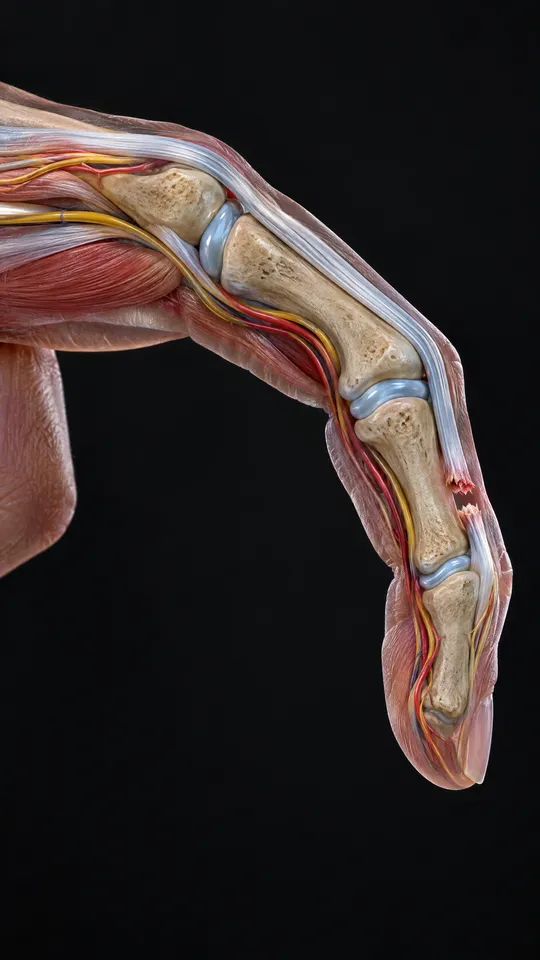

Side view of a finger with a drooping fingertip, showing the torn tendon at the last joint

Mallet finger or just a jammed finger? How to tell the difference

Plenty of finger injuries in ball sports get called "jammed". The tell for a mallet finger is specific: the fingertip droops and you can't lift it on your own, even though it can be pushed straight 2. If your fingertip straightens fully under its own power, it isn't a mallet finger.

What you can't tell at home is whether bone is involved. Some mallet injuries include a fracture at the joint surface, and the size of that fragment helps decide between splinting and surgery 3.

Pain somewhere else in the hand or wrist? Try the Hand section of our Injury Finder.

How it's diagnosed

The diagnosis itself is quick. After asking about the injury and your symptoms, your clinician holds the finger and asks you to straighten the tip on your own. That's the mallet finger test 6. A fingertip that sits bent and won't straighten under its own power is the defining sign 3.

An X-ray will most likely be ordered too, to look for a broken-off piece of bone and to check the joint is still lined up 6. The size of any fracture and the position of the end bone are among the things that decide between a splint and a surgical opinion 3. If there's any concern, early referral is recommended 3.

How we treat it

The core treatment is a splint. Your job is to wear it. Ours is to make sure the whole process works.

1
Assessment and the right next step. We confirm it's a mallet finger and point you toward an X-ray or a medical review if bone may be involved. Early referral is advised whenever there's any concern 3.
2
Getting the splinting right. The fingertip has to stay straight the whole time, including when the splint comes off for cleaning 1. We'll show you how to do that safely (resting the finger flat on a table) and check that the splint you've been given is holding the tip fully straight. Sticking to it strictly is essential 3.
3
Rebuilding movement after the splint. Once you're cleared to move it, a graded program restores bend, strength and control. For 3 to 4 weeks after the splinting period, the splint is usually still worn part of the time, often only at night 6.
4
Easing stiffness. If the neighbouring finger joints have stiffened, hands-on treatment can help alongside exercise. That's only once the tendon is cleared for movement, never during the splinting phase.
5
Getting back to sport. We plan your return to training and games around what the finger can safely handle.

Other treatments we may use

Which splint? The evidence doesn't pick a winner.

A Cochrane review found insufficient evidence from randomised trials that any splint type, custom-made or off-the-shelf, works better than another 4. Only a few small trials qualified, and the review dates from 2004. What guidelines stress instead is strict, continuous wear 3.

Night splinting and weaning.

Protocols vary. One common approach is 6 to 8 weeks full-time, then 3 to 4 weeks of part-time wear, often at night 6. Others use 8 weeks full-time 1,3. If it hasn't healed by then, the splint may be needed for another 8 weeks 1.

Surgery: uncommon, and not our call.

Surgery is rarely needed 1. It's considered when a fracture involves more than 30% of the joint surface, the end bone has slipped out of alignment, a fragment can't be put back in place, splinting has failed, or the fingertip can't be fully straightened even passively 3. A 2018 systematic review found excellent outcomes with both approaches 5, and the Cochrane review found no reliable trial evidence favouring either 4. A hand surgeon makes that call.

Your recovery path: Reset, Rebuild, Return

A mallet finger follows The Well Motion Recovery Path™ with a long, quiet first phase. You move up a phase when the fingertip holds itself straight, not because a date has passed.

  • Reset: the full-time splint phase. We check the splint is holding the tip straight and that you can change it safely 1. Expect hand sports to be off 1. We move you on once your splinting period is finished and the tip stays up on its own.
  • Rebuild: starts when you're cleared to bend the finger. Part-time splint wear, often at night 6, alongside a graded hand rehabilitation program and manual therapy for stiff neighbouring joints. Expect the bend to come back slowly. We move you on when the finger does what your daily tasks ask of it without the tip dropping.
  • Return: gripping, typing, tools, ball sport. We test the finger in the tasks you're going back to. You leave with a plan for sport and for a droop that returns.

How long it usually takes. Full-time splinting usually lasts 6 to 8 weeks 1,3,6, then 3 to 4 weeks part-time 6. A tendon that hasn't healed may need another 8 weeks 1. For athletes, one expert review, not trial data, advises 6 more weeks of splinting at night and during sport after the first 6, with or without surgery 9. After surgery, your hand surgeon sets the timeline. Feeling normal can take several months 1.

Reducing the risk of it happening again

Nothing has been tested for preventing the original knock. What has been studied is how to stop the droop coming back while the tendon heals:

  • Wear the splint exactly as you've been told. A Cochrane review couldn't pick a best splint, but it did underline how much sticking to the instructions matters 4. A later review of four trials linked poorer adherence with a fingertip that straightened less 7. If the tip droops at all, healing is disrupted and the splint stays on longer 6.
  • Change it with the finger flat on a table. That keeps the tip straight while the splint is off for cleaning 1.
  • Follow the weaning plan you were given. One common plan tapers the splint over 3 to 4 weeks, often down to nights only 6. Plans differ, though. In a trial of 51 people, an extra month of night splinting made no difference to the final droop 8.
  • Hold off hand sports. NHS advice during recovery is no sport or exercise that involves your hands 1.

When to get it checked properly

See someone promptly if:

  • your fingertip droops after a knock and you can't straighten it yourself
  • the finger was crushed, for example caught in a door 2
  • the skin over the last joint is cut. Splinting is the treatment for closed injuries 3, so that's a same-day medical visit
  • the tip bent while your splint was off. Tell your clinician rather than just putting the splint back on
  • the droop is still there when your splinting period ends 1

A mallet finger that's a few weeks old is still worth assessing. Fingers splinted as late as a month after the injury have still healed completely 6.

Tenderness, swelling and redness for the first few months are common, and the finger can take several months to feel normal 1. That's expected, not a setback. When the injury is treated promptly, most cases can be treated without surgery 6.

Your first appointment

We start by listening: how it began, what makes it worse, and what it's stopping you from doing. Then we examine the area, explain what we find in plain English, and agree a plan with you. Your first visit is 40 minutes at Engadine and 30 minutes at our other clinics.

We see patients at Engadine, Mount Annan, Narellan and Appin, and at home through our mobile physiotherapy service. If you have private health cover, here's how health fund rebates work for physiotherapy.

FAQs

How do you treat a mallet finger?

With a splint that keeps the fingertip straight full-time for about 6 to 8 weeks, then gradual weaning and exercises 1,3,6. The tip must never bend during that time, even while you clean the finger 1.

Will mallet finger go away on its own?

No. The droop doesn't improve without treatment 2. The tendon ends have to be held together long enough to heal, and that's what the splint does.

What happens if you ignore a mallet finger?

The fingertip is likely to stay bent. Poor management can lead to long-term loss of function and stiffness 2, or a permanent deformity 3.

How to know if a mallet finger needs surgery?

You can't tell yourself. It depends on things like the size of any fracture, whether the joint has slipped out of line, and whether splinting has failed 3. Surgery is rarely needed 1.

How to straighten a mallet finger at home?

You can't fix it for good at home. Until you're seen, NHS advice is to raise your hand, take painkillers if you need them, and remove any rings 1. Then get it assessed and properly splinted.

More Hand conditions

Hand

Carpal Tunnel Syndrome

Numbness, tingling or pins and needles through your thumb, index and middle fingers, often worst overnight. It's a nerve compressed at the wrist, and there's usually plenty worth trying before surgery comes up.

Read more
Hand

Scaphoid Fracture

Wrist pain that started with a fall onto an outstretched hand and hasn't settled. Scaphoid fractures are commonly missed on an early X-ray, so it's taken seriously even when imaging looks clear.

Read more
Hand

Wrist Sprain

A wrist sprain means a ligament, one of the tough bands holding your wrist bones together, has been stretched or torn. It usually happens during sport, a sudden movement or a fall

Read more
Hand

Trigger Finger

Trigger finger is a finger or thumb that catches, gets stuck bent, or straightens with a click or snap

Read more
Hand

Ganglion Cyst (Wrist)

A ganglion cyst is a benign (non-cancerous) collection of fluid on a joint or tendon. It's the most common lump on the hand, usually on the back of the hand or wrist

Read more

If your fingertip has dropped after a knock, don't wait to see if it straightens.

It won't. Book an appointment and we'll assess it, make sure it's being managed properly, and help you get full use back. You can see us at Engadine, Mount Annan, Narellan or Appin.

Book an Assessment
Ahmed Elsayed, Principal Physiotherapist
Reviewed by Ahmed Elsayed Principal Physiotherapist at Well Motion

References

  1. Mallet finger. NHS (nhs.uk). Page last reviewed 2 August 2023. https://www.nhs.uk/conditions/mallet-finger/
  2. Khera B, Chang C, Bhat W. An overview of mallet finger injuries. Acta Biomedica 2021;92(5):e2021246. doi:10.23750/abm.v92i5.11731. https://pmc.ncbi.nlm.nih.gov/articles/PMC8689306/
  3. Anderson D. Mallet finger: management and patient compliance. Australian Family Physician (RACGP), January-February 2011. https://www.racgp.org.au/afp/2011/january-february/mallet-finger
  4. Handoll HHG, Vaghela MV. Interventions for treating mallet finger injuries. Cochrane Database of Systematic Reviews 2004, CD004574. PMID 15266538. https://pubmed.ncbi.nlm.nih.gov/15266538/
  5. Lin JS, Samora JB. Surgical and nonsurgical management of mallet finger: a systematic review. Journal of Hand Surgery (American Volume), 2018;43(2):146-163.e2. PMID 29174096. https://doi.org/10.1016/j.jhsa.2017.10.004
  6. American Academy of Orthopaedic Surgeons. Mallet Finger (Baseball Finger). OrthoInfo. https://www.orthoinfo.org/en/diseases--conditions/mallet-finger-baseball-finger/
  7. Valdes K, Naughton N, Algar L. Conservative treatment of mallet finger: A systematic review. Journal of Hand Therapy, 2015;28(3):237-45. PMID 26003015. https://doi.org/10.1016/j.jht.2015.03.001
  8. Gruber JS, Bot AGJ, Ring D. A prospective randomized controlled trial comparing night splinting with no splinting after treatment of mallet finger. Hand (New York, N.Y.), 2014;9(2):145-50. PMID 24839414. https://doi.org/10.1007/s11552-013-9600-z
  9. Elzinga KE, Chung KC. Finger injuries in football and rugby. Hand Clinics, 2017;33(1):149-160. PMID 27886831. https://pmc.ncbi.nlm.nih.gov/articles/PMC5125556/