Need urgent care? 24/7 Mobile & After-Hours Emergency Physiotherapy Call (02) 8111 5633 For life-threatening emergencies, always call 000
Elbow

Cubital Tunnel Syndrome

5.0 average rating on Google
Registered NDIS Provider
SIRA Registered Provider

Maybe your GP has named it. Maybe you've worked it out yourself: your ring and little fingers go numb halfway through a phone call, or you wake with them tingling after a night with your arm tucked up. Either way, you want to know two things. What is this, and will the elbow brace you've seen online fix it?

What's actually causing it

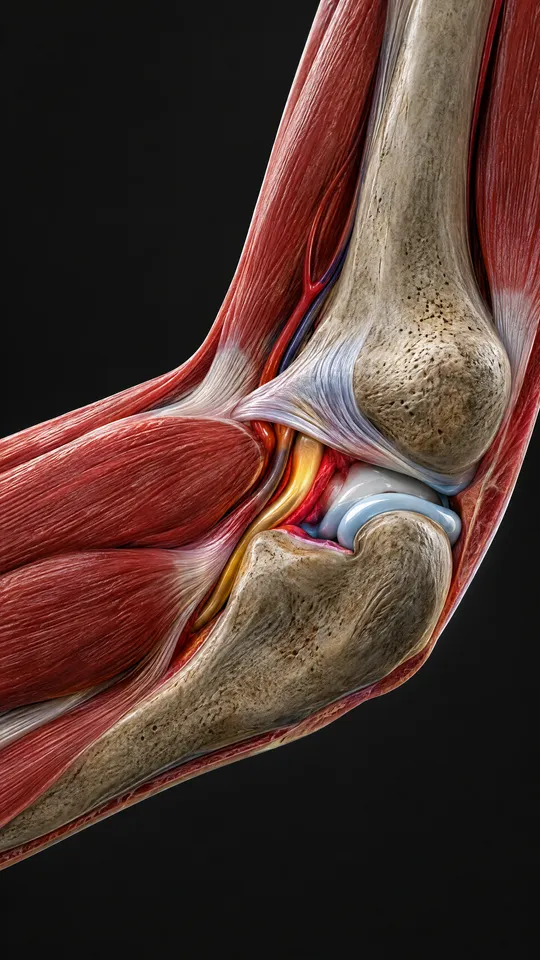
The ulnar nerve is your "funny bone" nerve. It passes behind the bony bump on your inner elbow, through a narrow channel called the cubital tunnel, on its way to your little and ring fingers and the small muscles of your hand. You may also hear it called ulnar nerve entrapment. It's the same problem 6, and our ulnar nerve entrapment page covers daily habits and sleeping positions in more depth.

Bending your elbow strains the nerve and raises the pressure inside the tunnel 5. A moment of that is harmless. Hours of it, day after day, and the nerve starts to complain. The usual culprits:

  • Long stretches with the elbow bent: phone calls, desk work, sleeping with your arm tucked up 2,5
  • Leaning on your elbows on a hard surface 2,6
  • Throwing sports such as baseball pitching 5,6
  • Carrying extra weight 8
Inner side of a bent elbow showing the ulnar nerve compressed in its narrow tunnel

Cubital tunnel syndrome or something else? How to tell the difference

Tingling in these fingers doesn't always start at the elbow. Other problems can feel similar and need a different plan 2:

  • A pinched nerve in the neck (cervical radiculopathy) 2
  • Thoracic outlet syndrome, with compression higher up 2
  • Diabetes-related nerve changes (diabetic polyneuropathy) 2
  • Compression at the wrist, in a channel called Guyon's canal. A clue: feeling on the back of your hand, little-finger side, is usually normal 2
  • Rarely, more serious conditions near the top of the chest 2. That's one reason symptoms that don't settle deserve a proper look

That's why we check your neck and whole arm as well as the elbow.

How it's diagnosed

Most of this gets worked out in the consulting room. A clinician asks how it started, where you feel it and what it's stopping you doing 2. Then they look for wasting in the small hand muscles, test the feeling in your little and ring fingers, and get you to grip a sheet of paper while they pull it away. That's Froment's sign, a check for thumb weakness 2. Moving your neck, shoulder and wrist shows whether other positions bring the symptoms on 6.

Nerve conduction studies measure how well the nerve is working and help pin down where it's being squeezed 6, but they aren't part of a first assessment 2. Most causes don't show on an X-ray, though one may be taken to look for bone spurs or arthritis 6.

How we treat it

First we confirm the problem really is at the elbow, with a careful history and simple clinical tests (see the FAQs). Then treatment usually involves:

1
Changing the positions that load the nerve. Less time fully bent, no leaning on the elbow, a different set-up for phone calls and desk work 2. It sounds like the soft option, but it's the best-supported one. In a small trial of mild cases, learning which positions to avoid reduced symptoms, though that evidence is low quality 1.
2
Protecting the elbow overnight. A towel wrapped around it, tape or a splint stops it folding right up while you sleep 2. Taping is one way we can set this up.
3
Managing load for throwers. Repeated throwing, as in baseball pitching, is a recognised risk factor 5. Our sports physiotherapy work adjusts throwing volume and technique rather than simply benching you.
4
Time, with check-ins. Mild to moderate cases often improve without surgery: in one trial, about nine in ten had improved at six months 4. We set review points so you know whether it's working.

Other treatments we may use

Night splints and elbow braces.

These are what most people search for first, and the evidence is less convincing than the marketing. Adding splints and nerve exercises to advice on positions made no further improvement 1. In one trial, a night brace worn for three months made no significant difference at six months 4. A brace can still be a simple way to stop your elbow bending overnight. It's a tool, not the treatment.

Nerve glides.

Gentle movements meant to help the nerve slide rather than get tugged. They're commonly prescribed, but added nothing measurable in trials 1, and their effect on this condition remains uncertain 4.

Manual therapy.

Hands-on manual therapy through the elbow, forearm and neck can help you move more comfortably. It's on the list of non-surgical options, but high-quality studies of conservative care here are scarce 4, so we use it alongside position changes, not instead of them.

Corticosteroid injection.

Physiotherapists don't prescribe, give or arrange injections, so this is only what the research reports: in one trial of 55 people, a steroid injection did no better than a placebo at three months 1.

Surgery.

Considered when conservative care hasn't worked, or if weakness or muscle wasting appears 5. The two main operations, releasing the nerve or moving it to the front of the elbow, work about equally well, though moving it led to more wound infections 1. Results are good for mild to moderate compression and less reliable when it's severe or long-standing 5. We can guide your rehab afterwards. Researchers still don't know exactly when to choose surgery over conservative care 1.

Your recovery path: Reset, Rebuild, Return

Cubital tunnel syndrome is a squeezed nerve, not a torn tissue, so The Well Motion Recovery Path™ is about calming the nerve and keeping it calm. You move up a phase when your hand copes with more, not when a date arrives.

  • Reset: the first weeks. Position changes by day, and a towel, tape or a splint to protect the elbow overnight 2. Expect the night tingling to ease before the daytime symptoms do. We move you on once the pins and needles are settling and you know which positions set them off.
  • Rebuild: we bring back the desk work, lifting or throwing that used to provoke it, a little at a time, with manual therapy where movement is stiff. Expect good days and bad days. We move you on when your arm does what your daily tasks ask of it without symptoms building.
  • Return: full work, unbroken sleep and, for throwers, sport. We test the positions that used to bring it on. You leave with a plan for your desk, phone and sleeping set-up, because avoiding provocation is what the trial evidence supports 9.

How long it usually takes. In one randomised trial of 70 people with mild or moderate symptoms, 51 of the 57 followed up (89.5%) had improved at six months 9. That is one small trial with no untreated group. After surgery, your surgeon sets the timeline, and nerves recover slowly 6.

Reducing the risk of flare-ups

Nobody has run a prevention trial for cubital tunnel syndrome, so this list leans on the one tested piece of advice and the known risk factors:

  • Cut the long bends and the leaning. In one small trial of people with mild to moderate symptoms, being told which positions and prolonged movements to avoid eased their discomfort, though the evidence is rated low quality 1.
  • Sort out the desk and the car. At a computer, check your chair isn't too low and keep your elbow off the armrest 6. Don't drive with your arm resting on the open window 6.
  • Quit smoking if you smoke. In a UK study of about 400,000 people, smoking was linked with roughly twice the odds of cubital tunnel syndrome 8. Australian guidance lists quitting among the risks you can control 7.
  • Keep diabetes and blood pressure managed. Diabetes with small blood vessel complications, high blood pressure and a higher body mass index were each linked with it in the same study 8. Treating an underlying condition such as diabetes, arthritis or an underactive thyroid is part of managing it anyway 2.

When to get it checked properly

Stop self-managing and get an assessment if:

  • Your hand feels weak or clumsy, or you're dropping things 2
  • Your hand muscles look wasted, or your ring and little fingers are starting to curl. This needs urgent attention 2
  • Symptoms have lasted beyond two to three months, or they're getting in the way of daily life 2

In one trial of conservative approaches, 89.5% of people improved 5. Timing still matters, because long-standing compression tends to recover less well 5.

Your first appointment

We start by listening: how it began, what makes it worse, and what it's stopping you from doing. Then we examine the area, explain what we find in plain English, and agree a plan with you. Your first visit is 40 minutes at Engadine and 30 minutes at our other clinics.

We see patients at Engadine, Mount Annan, Narellan and Appin, and at home through our mobile physiotherapy service. If you have private health cover, here's how health fund rebates work for physiotherapy.

FAQs

How do I know I have cubital tunnel syndrome?

The pattern is pins and needles or numbness in your little finger and the little-finger half of your ring finger, often brought on by a bent elbow 2. We confirm it with simple tests, such as holding your elbow fully bent for a minute, or tapping over the nerve 2. In one study, the elbow-bend test was positive in 75% of affected arms and rarely positive in people without the condition 3.

Should I keep my arm straight with cubital tunnel syndrome?

Not rigidly. The aim is to avoid keeping it bent for long periods 2. At night, a towel, tape or a splint can stop it folding right up 2. A night brace gave no extra benefit in one trial 4, so your habits matter more than any product.

Is cubital tunnel syndrome typically worse in the morning?

It can be. If you sleep with your elbow tucked up, symptoms can build overnight and still be there when you wake 2.

How long does it take for cubital tunnel syndrome to go away?

Mild to moderate cases often improve over a few months: in one trial, about nine in ten had improved at six months 4. If yours hasn't settled within two to three months, or it's interfering with daily life, get it reviewed 2. Severe or long-standing cases take longer and recover less fully 5.

More Elbow conditions

Elbow

Tennis Elbow

Pain and tenderness on the outside of the elbow, usually worst when you grip something, lift a full kettle, or turn a doorhandle. It builds through repeated load rather than all at once, and you don't have to play tennis to get it.

Read more
Elbow

Golfer's Elbow

The same pattern of overuse, on the inside of the elbow instead. Common in golfers, and just as common in tradies and anyone who grips hard all day.

Read more

If your ring and little fingers have been going numb for a few weeks, or your hand is starting to feel clumsy, don't wait another month to see if it settles.

Get it assessed. Book an appointment with the Well Motion team at Engadine, Mount Annan, Narellan or Appin, or head back to the Elbow section of our Injury Finder if you're not yet sure which part of the elbow is the problem.

Book an Assessment
Ahmed Elsayed, Principal Physiotherapist
Reviewed by Ahmed Elsayed Principal Physiotherapist at Well Motion

References

  1. Caliandro P, La Torre G, Padua R, Giannini F, Padua L. Treatment for ulnar neuropathy at the elbow. Cochrane Database of Systematic Reviews, 2016;11:CD006839. Retrieved from PubMed. https://pubmed.ncbi.nlm.nih.gov/27845501/
  2. Cubital tunnel syndrome (CBTS). NHS Scotland Right Decisions, RefHelp NHS Ayrshire and Arran. https://www.rightdecisions.scot.nhs.uk/refhelp-nhs-ayrshire-and-arran/orthopaedicsmsk/elbow/cubital-tunnel-syndrome-cbts/
  3. Novak CB, Lee GW, Mackinnon SE, Lay L. Provocative testing for cubital tunnel syndrome. The Journal of Hand Surgery (American Volume), 1994;19(5):817-820. PMID 7806810. https://doi.org/10.1016/0363-5023(94)90193-7
  4. Ulnar neuropathy at the elbow: from ultrasound scanning to treatment. Frontiers in Neurology, 2021. https://pmc.ncbi.nlm.nih.gov/articles/PMC8160369/
  5. Nerve entrapment around elbow (review). https://pmc.ncbi.nlm.nih.gov/articles/PMC8190494/
  6. American Academy of Orthopaedic Surgeons. Cubital Tunnel Syndrome (Ulnar Nerve Entrapment at the Elbow). OrthoInfo. https://www.orthoinfo.org/en/diseases--conditions/ulnar-nerve-entrapment-at-the-elbow/
  7. Ulnar nerve entrapment. healthdirect (Australian Government funded). https://www.healthdirect.gov.au/ulnar-nerve-entrapment
  8. Lucey M, Lassen FH, Furniss D, Wiberg A. The epidemiology of cubital tunnel syndrome: a UK Biobank case-control study. The Journal of Hand Surgery, European Volume, 2026;51(8):992-1002. PMID 41808616. https://doi.org/10.1177/17531934261426700
  9. Svernlöv B, Larsson M, Rehn K, Adolfsson L. Conservative treatment of the cubital tunnel syndrome. The Journal of Hand Surgery, European Volume, 2009;34(2):201-207. PMID 19282413. https://pubmed.ncbi.nlm.nih.gov/19282413/