Need urgent care? 24/7 Mobile & After-Hours Emergency Physiotherapy Call (02) 8111 5633 For life-threatening emergencies, always call 000
Hand

Wrist Sprain

5.0 average rating on Google
Registered NDIS Provider
SIRA Registered Provider

You put a hand out as you went down. Maybe you slipped on wet tiles, landed badly at netball or came off a bike. Now your wrist is swollen, sore to bend, and turning a door handle makes you wince. Nothing looks out of place, so you've been calling it a sprain.

Often, that's exactly what it is. But the same fall can cause an injury you really don't want to mistake for a sprain, so it's worth knowing the difference.

What's actually causing it

Ligaments are the tough bands that hold the bones of a joint together. A sprain is an injury to those ligaments and the capsule that wraps the joint 2. In the wrist, the usual cause is a sudden twist or wrenching movement, whether from a fall, a quick change of direction or repetitive strain 1.

How much damage is done decides the grade 1:

GradeWhat's happened to the ligamentWhat you tend to notice
1A small number of fibres are tornMild pain, slight swelling
2A partial tearMore swelling and tenderness, some loss of movement
3A complete tearSevere pain, swelling, an unstable wrist. A "pop" at the time may suggest this grade

Common wrist sprain symptoms are swelling, heavy bruising, pain and tenderness, difficulty moving the wrist, weakness or instability, and sometimes a "pop" when it happened 1.

The grade matters because the risks run both ways. A moderate or severe sprain that isn't treated well can leave you with chronic ligament instability, a wrist that keeps feeling loose 1. But not using the wrist enough can lead to muscle wasting, and with a severe injury or too much rest, fibrosis can set in 1. Fibrosis is a build-up of thick, stiff, scar-like tissue. Good treatment sits between the two: protect it early, then get it moving and loaded again.
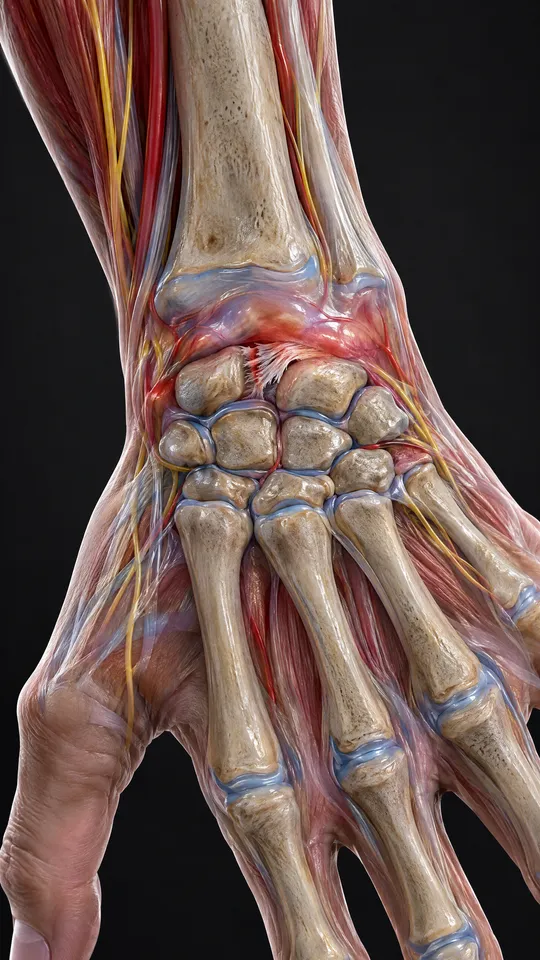

Back of the wrist showing the small wrist bones and a stretched ligament between two of them

Wrist sprain or scaphoid fracture? How to tell the difference

The scaphoid is a small bone on the thumb side of the wrist. After a fall onto an outstretched hand, a sore wrist needs proper assessment to rule out a scaphoid fracture 3.

The most sensitive clinical sign is tenderness in the anatomical snuffbox, the small hollow on the thumb side of the back of your wrist. Across 13 studies, it picked up 87 to 100% of scaphoid fractures 3. But its specificity ranged from 3% to 98%, so plenty of people with snuffbox tenderness turn out not to have a fracture 3. Combining tests helps, but the research is weak 3.

X-rays have a blind spot too. A normal first X-ray doesn't rule out a scaphoid fracture 4. In studies of people with a clear first X-ray whose fracture was still suspected, about one in five turned out to have one 4. Follow-up MRI, CT or a bone scan settles it, and catching it early lowers the risk of the bone not healing (non-union) while sparing people casts they don't need 4.

In practice: if the pain sits on the thumb side after a fall, get it assessed, even if you can still move your wrist and even if an X-ray was clear. If we think something needs imaging, we'll tell you plainly and point you to your GP.

How it's diagnosed

Most wrist sprains are diagnosed from your story and an examination. You'll be asked what happened, what you're feeling and how long it's been going on, and about any earlier wrist injuries 1 5. Then the wrist is checked for pain, movement and instability, which is how the severity gets judged 1.

An X-ray can't show a ligament. It's there to rule out other injuries, although wrist bones that don't line up properly can be a sign of a ligament injury 1 5. If that still leaves questions, a doctor may suggest an MRI or ultrasound. Occasionally it's an arthroscopy, where a small camera goes inside the wrist to check for hidden damage 1.

How we treat it

First we work out what you've actually done: which part of the wrist is involved, roughly what grade it is, and whether anything else needs ruling out. We also ask what your wrist has to get back to, whether that's typing all day, lifting a toddler or taking your weight in a push-up.

1
Getting the first few days right. Protection, relative rest, ice, compression and elevation, then gentle movement from about day two or three as pain allows 1,2. Details are in the FAQs.
2
Restoring movement. Moderate to severe sprains may need physiotherapy to improve movement and strengthen the wrist 1. Our hand rehabilitation work gets back range through the wrist and forearm, and the grip you use every day.
3
Rebuilding strength. Exercises are a core part of sprain treatment 2, and muscle wasting from underuse is a recognised complication 1. We build load back gradually rather than waiting for the wrist to feel perfect.
4
Hands-on treatment where it helps. Manual therapy, meaning mobilisation and massage, is one treatment option for sprains 2. We use it to ease stiffness so the exercises are easier, not as a substitute for them, and never firm massage in the first 72 hours 2.
5
A graded return to sport and work. A gradual return to normal activity is part of the plan 2. If your sport loads your hands or grip, our sports physiotherapy work builds you back up to it.

To be upfront: we found no strong trials comparing physiotherapy approaches for simple wrist sprains. The approach above follows Australian government health guidance 1,2 and our own clinical reasoning, not a single trial-proven protocol.

Other treatments we may use

Braces, wraps and supports.

A bandage or brace supports the wrist and helps bring down swelling. It should be snug without cutting off blood flow 1. Bracing is a recognised part of sprain treatment 2. We treat a wrist brace as a short-term support, not a replacement for rebuilding strength, since underuse brings its own problems 1.

Electrotherapy.

It's listed for sprains generally 2, but we found no strong evidence it speeds recovery from a wrist sprain. If we use it, it's an add-on, never the plan.

Pain relief medicines.

The guidance differs. One source says paracetamol and anti-inflammatory medicines may help 1; another says some pain medicines can disrupt soft tissue healing 2. Physiotherapists don't prescribe medication, so check with your GP or pharmacist.

Your recovery path: Reset, Rebuild, Return

A sprained wrist is treated along The Well Motion Recovery Path™. The grade sets the pace 5, and you move up a phase when the wrist can do more, not when another week has passed.

  • Reset: the first days. Protection, relative rest, ice, compression and elevation, a brace or wrap for support 1,2, then gentle movement from about day two or three 1. Thumb-side pain after a fall gets checked for a scaphoid fracture first 3. Expect swelling, bruising and stiffness. We move you on once you can move the wrist without the pain building.
  • Rebuild: range first, then grip and load. Hand rehabilitation exercises carry this phase, with manual therapy where stiffness holds them back 2. Expect weight bearing through the hand to return later than bending. We move you on when the wrist does what your daily tasks ask of it.
  • Return: back to whatever loads your hands: typing, lifting, a push-up, a racquet. We build up gradually 2 and test grip against that task. You leave with wrist exercises to keep doing 1.

How long it usually takes. Mild sprains often recover fully over several weeks, and moderate ones can take longer 5. After surgery for a complete tear, your surgeon sets the timeline: the ligament usually heals in 8 to 12 weeks, though full recovery can take 6 to 12 months 5. These figures are surgeons' guidance, not trial results.

Reducing the risk of it happening again

Most wrist sprains come from a fall onto an outstretched hand 5, and one piece of protective gear has been properly tested against that:

  • Wear wrist guards on a snowboard. A review pooling six studies found riders wearing guards had about a sixth of the risk of a wrist sprain 6.
  • Wear them on skates too. Among injured inline skaters in a US study, those who skated without wrist guards had about ten times the odds of a wrist injury 7. Guards are advised for skateboarding as well 5.
  • Finish your rehab. When a soft tissue injury recurs or gets worse over time, it's usually put down to treatment and rehab that fell short 2. Wrist exercises help protect the wrist and keep it moving easily 1.
  • Watch your footing. Take care on wet or slippery ground, stairs, kerbs and uneven surfaces. If you walk a dog, never wrap the lead around your hand or wrist 5.

When to get it checked properly

Book an assessment rather than keep managing it yourself if:

  • You heard or felt a "pop" when it happened, or the wrist feels unstable 1
  • Pain, swelling or loss of movement hasn't eased after a couple of days 2, or symptoms last more than a few days or get worse 1
  • You have pain on the thumb side of the wrist after a fall, even with a normal X-ray 3,4
  • You still can't use the wrist fully about a week on. A doctor's follow-up at around a week is part of the standard advice 1

Seek urgent help if you have pain or tightness in the muscles along with tingling, numbness or trouble moving the hand or wrist. That can be a sign of acute compartment syndrome, which is an emergency: call triple zero (000) 1.

If you're unsure whether it can wait, the healthdirect helpline (1800 022 222) is staffed by registered nurses 24 hours a day 1. For most people, though, a wrist sprain is a short detour, not a long-term problem.

Your first appointment

We start by listening: how it began, what makes it worse, and what it's stopping you from doing. Then we examine the area, explain what we find in plain English, and agree a plan with you. Your first visit is 40 minutes at Engadine and 30 minutes at our other clinics.

We see patients at Engadine, Mount Annan, Narellan and Appin, and at home through our mobile physiotherapy service. If you have private health cover, here's how health fund rebates work for physiotherapy.

FAQs

How long does it take to heal a wrist sprain?

Most soft tissue injuries take a few weeks to heal, depending on how severe the sprain is and on things like weakness, stiffness or re-injury along the way 2. Milder sprains sit at the shorter end; a complete tear may need a surgeon's assessment 1. We won't give you a fixed number of weeks per grade, because the Australian guidance doesn't. If your sprained wrist recovery time is dragging on, get it reassessed.

How do I tell if my wrist is sprained?

Swelling, bruising, pain, tenderness and difficulty moving the wrist are the typical signs 1. The catch is that a scaphoid fracture can look very similar, and the first X-ray can miss it 4, so see the section above if the pain is on the thumb side.

How do I relieve a wrist strain?

A quick clarification: a strain is an injury to a muscle or tendon, and a sprain is an injury to a ligament 2. Both get the same first aid 2. Stay gently active without pushing into pain. Ice for 20 minutes every two waking hours, with a wet towel between ice and skin, and use compression and elevation 2. After two to three days, start gentle movement as pain allows 1.

What not to do with a sprained wrist?

For the first 72 hours, avoid heat, alcohol, running and firm, direct massage, because they can increase swelling 2. Don't wrap it so tightly that it cuts off circulation 1. And don't swing too far the other way: keeping it completely still for too long can lead to muscle wasting and stiff scar tissue 1.

Can I leave a sprained wrist untreated?

A mild sprain can usually be managed at home, with a doctor's follow-up after about a week 1. But "managed at home" isn't the same as ignored. A moderate or severe sprain that isn't treated well can leave the wrist with chronic ligament instability 1. If it isn't clearly improving, have it looked at.

More Hand conditions

Hand

Carpal Tunnel Syndrome

Numbness, tingling or pins and needles through your thumb, index and middle fingers, often worst overnight. It's a nerve compressed at the wrist, and there's usually plenty worth trying before surgery comes up.

Read more
Hand

Scaphoid Fracture

Wrist pain that started with a fall onto an outstretched hand and hasn't settled. Scaphoid fractures are commonly missed on an early X-ray, so it's taken seriously even when imaging looks clear.

Read more
Hand

Trigger Finger

Trigger finger is a finger or thumb that catches, gets stuck bent, or straightens with a click or snap

Read more
Hand

Ganglion Cyst (Wrist)

A ganglion cyst is a benign (non-cancerous) collection of fluid on a joint or tendon. It's the most common lump on the hand, usually on the back of the hand or wrist

Read more

If your wrist is still sore, swollen or weak more than a few days after a fall or a twist, or it hurts on the thumb side, it's worth an assessment rather than another week of waiting.

Book an appointment with the Well Motion team at Engadine, Mount Annan, Narellan or Appin. If you're not sure a sprain is what you've got, head back to the Hand section of our Injury Finder.

Book an Assessment
Ahmed Elsayed, Principal Physiotherapist
Reviewed by Ahmed Elsayed Principal Physiotherapist at Well Motion

References

  1. Sprained wrist. healthdirect Australia (Australian Government). Last reviewed February 2025. https://www.healthdirect.gov.au/sprained-wrist
  2. Sprains and strains. Better Health Channel (Victorian Department of Health). https://www.betterhealth.vic.gov.au/health/ConditionsAndTreatments/sprains-and-strains
  3. Mallee WH, et al. Clinical diagnostic evaluation for scaphoid fractures: a systematic review and meta-analysis. Journal of Hand Surgery (American Volume), 2014;39(9):1683-1691. https://doi.org/10.1016/j.jhsa.2014.06.004
  4. Mallee WH, et al. Computed tomography versus magnetic resonance imaging versus bone scintigraphy for clinically suspected scaphoid fractures in patients with negative plain radiographs. Cochrane Database of Systematic Reviews, 2015;(6):CD010023. https://doi.org/10.1002/14651858.CD010023.pub2
  5. American Academy of Orthopaedic Surgeons. Wrist Sprains. OrthoInfo. https://www.orthoinfo.org/en/diseases--conditions/wrist-sprains/
  6. Russell K, Hagel B, Francescutti LH. The effect of wrist guards on wrist and arm injuries among snowboarders: a systematic review. Clinical Journal of Sport Medicine, 2007;17(2):145-50. PMID 17414485. https://doi.org/10.1097/JSM.0b013e31803f901b
  7. Schieber RA, Branche-Dorsey CM, Ryan GW, Rutherford GW, Stevens JA, O'Neil J. Risk factors for injuries from in-line skating and the effectiveness of safety gear. New England Journal of Medicine, 1996;335(22):1630-5. PMID 8929359. https://doi.org/10.1056/NEJM199611283352202