Carpal Tunnel Syndrome
Numbness, tingling or pins and needles through your thumb, index and middle fingers, often worst overnight. It's a nerve compressed at the wrist, and there's usually plenty worth trying before surgery comes up.
Read moreYou wake up and one finger won't straighten. It's stuck bent towards your palm, and when it lets go it clicks, sometimes painfully. By mid-morning it's behaving. Then an hour of gripping secateurs or a steering wheel, and it's catching again.
That's trigger finger. It can affect your thumb too 1. The problem is a tendon, not the joint that seems to be jamming.
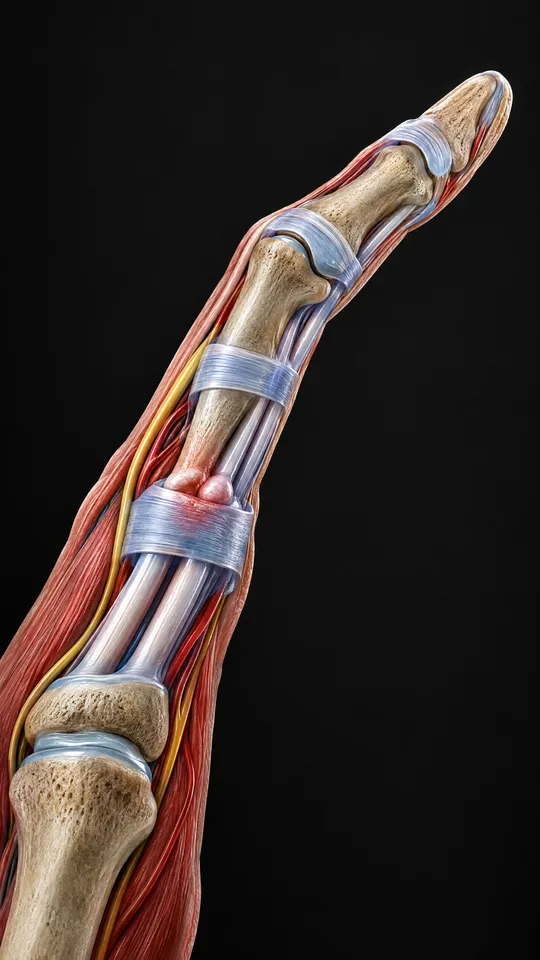
The tendons that bend your fingers run from muscles in your forearm, through your palm, to your fingertips. On the way, each one passes through a series of fibrous tunnels called pulleys. You can think of them like the guides on a fishing rod, keeping the line close to the rod.
In trigger finger, the fibrous wall of one of those tunnels thickens, so the tunnel gets too tight for the tendon running through it 1. The tendon gets inflamed, and a small lump, called a nodule, can form on it 1.
The finger then jams or stiffens, or straightens with a painful snap 1. Sometimes you need your other hand to push it straight 2. It's often worse first thing in the morning and during hand-intensive tasks, and the pain can sit in your palm as well as the finger 2.
What starts it isn't always known. Your risk is higher if you're over 40, or have diabetes or rheumatoid arthritis 2.
This one is usually diagnosed in the room. Your clinician talks through your symptoms and examines your hand, and X-rays or other tests typically aren't needed 6. The examination looks for tenderness over the tendon's tunnel in your palm, thickening or swelling at the base of the finger or thumb, and a click or catch as you bend and straighten it 6. Expect to be asked how the finger behaves first thing in the morning, too. Stiffness and locking tend to be worse after the hand has been still for a while 6.
We start by working out how established it is: does the finger free itself, need your other hand, or stay stuck? That changes what makes sense.
Manual therapy. We may use gentle hands-on work for stiffness around the hand. To be straight with you, none of the research behind this page tested manual therapy for trigger finger itself. We treat it as a supporting tool, not the main treatment.
Anti-inflammatory medication. Medicines such as ibuprofen are a non-surgical option 1,2. That's a conversation for your GP or pharmacist. We don't prescribe them.
Steroid injection. It treats the problem in up to 6 in 10 people, though more than one may be needed 1. Injections are outside a physiotherapist's scope of practice, so we don't give them. Splinting's short-term results have been described as comparable, without risks such as skin thinning or infection 3.
Surgery. Usually considered only when other treatments haven't worked, often after one or two injections 1,2. Risks include numbness, a tender scar, bowstringing (the tendon lifting away from the bone) and ongoing stiffness 1.
An honest note: most splinting studies are small and short term, success rates range from 27% to 97% 3,5, and long-term results still need research 3. Good evidence, not settled evidence.
Trigger finger care follows The Well Motion Recovery Path™. You move up a phase when the finger glides more freely, not because a set number of weeks has passed.
How long it usually takes. Splints in the research were worn for 6 to 12 weeks 3. In one group of 452 people followed for three weeks after a steroid injection, with no comparison group, 65.9% said the triggering had gone completely 9. After surgery, swelling and stiffness can take 4 to 6 months to settle 6. Nothing we found says how long an untreated finger takes.
Nobody has trialled a way to prevent trigger finger, and most cases have no clear cause 6. What has been measured is who gets it:
Trigger finger isn't dangerous, and it can get better without treatment 2. Book an assessment rather than waiting it out if:
None of that is cause for alarm. Early on, the options are simple ones: a splint, a change in how you use your hand, and time.
We start by listening: how it began, what makes it worse, and what it's stopping you from doing. Then we examine the area, explain what we find in plain English, and agree a plan with you. Your first visit is 40 minutes at Engadine and 30 minutes at our other clinics.
We see patients at Engadine, Mount Annan, Narellan and Appin, and at home through our mobile physiotherapy service. If you have private health cover, here's how health fund rebates work for physiotherapy.
Start conservatively: ease off aggravating activities and use pain relief 2. A splint worn for 6 to 12 weeks has the strongest conservative evidence in the short term 3. If that fails, a steroid injection from your doctor helps up to 6 in 10 people, and surgery comes after that 1,2. "Cure" oversells it, though. These work for many people, not everyone.
There isn't one. The mechanism is a thickened, too-tight tendon tunnel 1, but what sets that off often isn't known. Being over 40, diabetes and rheumatoid arthritis raise your risk 2.
It can get better without any treatment 2, but not always. If it hangs around, a splint is a well-supported next step 3.
Don't carry on with the gripping that sets it off as if nothing's wrong 2, and don't force a locked finger straight 1. And don't rely on exercises alone 4.
Sometimes. Easing off aggravating activities and pain relief is the recommended self-care 2, and early stretching may help 1. But in one trial, exercise alone resolved no one's triggering, while six weeks in a splint resolved it for just over half 4.
Numbness, tingling or pins and needles through your thumb, index and middle fingers, often worst overnight. It's a nerve compressed at the wrist, and there's usually plenty worth trying before surgery comes up.
Read morePain on the little-finger side of the wrist, often after a fall onto an outstretched hand, racquet sports, or repeated twisting and loading. Usually managed conservatively first.
Read moreWrist pain that started with a fall onto an outstretched hand and hasn't settled. Scaphoid fractures are commonly missed on an early X-ray, so it's taken seriously even when imaging looks clear.
Read moreAche, weakness or burning that builds through the day at a keyboard or on the tools. We see it across desk workers, tradies and new parents.
Read moreA wrist sprain means a ligament, one of the tough bands holding your wrist bones together, has been stretched or torn. It usually happens during sport, a sudden movement or a fall
Read moreA ganglion cyst is a benign (non-cancerous) collection of fluid on a joint or tendon. It's the most common lump on the hand, usually on the back of the hand or wrist
Read moreWith mallet finger, the tip of your finger stays bent and you can't straighten it yourself
Read more
How would you like to reach us?
Message us on WhatsAppFor bookings and enquiries. Please don't send medical details. Call (02) 8111 5633Request a call-back
Request sent
Thank you. We'll call you back on the number you gave us.
This is a preview, so nothing was actually sent.