Heat or ice.
Worth trying if it makes moving easier 2, an aid to staying active, not a fix.
It rarely arrives all at once. By mid-afternoon there's a dull ache between your shoulder blades. You roll your shoulders, sit up straighter for ten minutes, go back to the screen (or back to carrying the same load on the same side all day) and by knock-off it's a band of tightness that catches when you breathe in.
Someone has probably told you it's "just your posture," and left it there. That isn't much of a plan, and it isn't quite what the research says.
Your thoracic spine is the twelve vertebrae between your neck and the bottom of your ribs, each one attached to ribs 1. That attachment makes it a stiff, stable part of your spine: it anchors the rib cage and protects your heart and lungs, trading movement for stability 2,4.
Most ribs meet the spine at two small joints, and they let your rib cage swing up and out with every breath 4, which is why mid-back pain so often catches on a deep breath, a cough or a sneeze. Spine and ribs work as one unit, and your mid-back extends a little each time you lift both arms overhead 9. A stiff mid-back rarely stays a mid-back problem.
So what makes it sore? Usually not damage. This region resists injury well, and when pain turns up it's typically the muscles or joints around it overworking, most often from a prolonged position or a one-off strain 2. The non-specific causes listed are ordinary: sprains and strains, stress, anxiety or low mood, lack of exercise, extra weight, and posture 1.
Now, posture. The old poor-posture-and-backpacks story isn't well supported by the research, there's no single correct posture, and sitting too straight in one static position strains your spine much as slouching does 2. What shows up consistently is time: people who sit more than seven hours a day, or do under 150 minutes of activity a week, have more stiffness and pain here 2. The larger reviews list postural factors only as an association, and call the evidence limited 3. So the useful question is how long you stay in one position, not whether your posture is wrong.
How it feels varies: a sharp pain in one spot on or beside your spine, a broader ache across the area, or stiffness that quietly takes away normal movement 2. It's common, too, though estimates vary wildly, from around one in five people over a lifetime to study figures as far apart as 4 and 72 in 100 3.
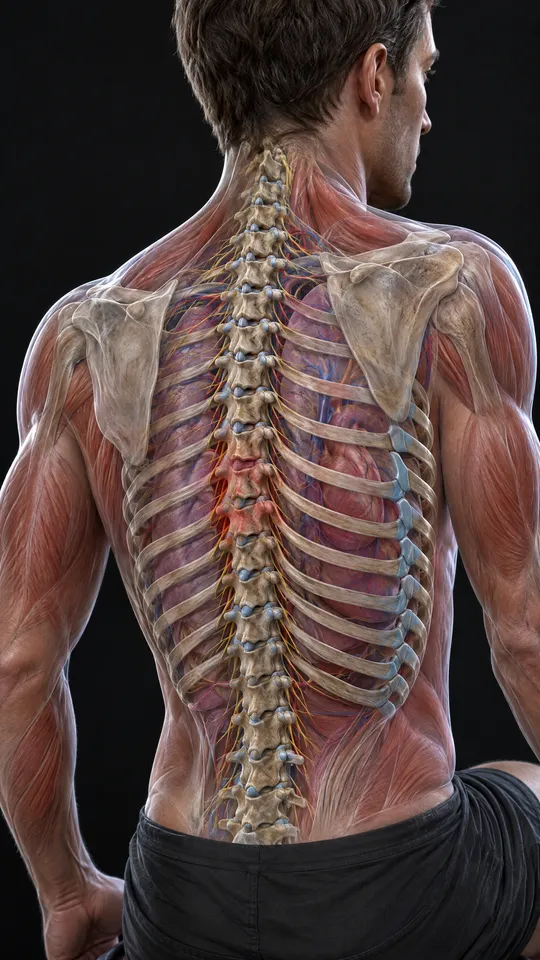
Pain from your spine, ribs or the muscles around them usually changes: it eases or bites with particular movements and positions, and it's often tender in a spot you can point to. Pain that doesn't change with movement or position is different, and it's on the list warranting proper assessment 2. Organs near this area can refer pain into your mid-back, including the stomach, pancreas, oesophagus and gallbladder 2, and pain on a deep breath, fever, or unexplained weight loss alongside back pain are reasons to see a doctor rather than book physiotherapy 1.
Diagnosing a kidney or organ problem isn't our job. If your pain doesn't behave like a movement problem, start with your GP. If it turns out to be musculoskeletal, we'll still be here.
Mid-back pain is usually worked out by talking to you and examining you. Your doctor asks about the pain, any other symptoms and your general health 1. Part of the job is checking the pain behaves like a spine problem: health professionals are trained to spot pain coming from an organ, which usually presents differently 2. If no cause turns up and there are no worrying features, you may hear it called non-specific back pain. That means a specific medical condition, illness or serious physical damage is unlikely 1.
Tests usually aren't needed, especially when there's an obvious trigger such as gardening you're not used to. An MRI can be useful if the pain doesn't settle as expected or worrying features develop, and your GP or physio can decide whether you need one 2.
The first job is working out what in your week is loading this area, not correcting you into a posture that doesn't exist. How long you hold positions, and how often you break them, is the part you can change.
Two things we won't tell you. There's no evidence that spinal pain is caused by a bone or joint being "out of place" 2. And where thoracic manipulation has been studied most, the evidence is rated very low to low quality: in people with neck pain, shoulder pain, headaches and jaw disorders, not mid-back pain 5. A 2025 review did find high-quality evidence of large short-term effects, again for a shoulder condition 6. It has better evidence for what it does to your shoulder and neck than for your mid-back.
Worth trying if it makes moving easier 2, an aid to staying active, not a fix.
Current evidence shows no benefit from collars or corsets here, short, medium or long term 2.
Usually not needed: X-ray, CT and MRI often aren't helpful for upper back pain 1, and findings like "spondylosis" or "degeneration" have no strong link to whether a person hurts 2. Imaging's real role is ruling out the specific causes below.
Outside what we do. Anti-inflammatories at the lowest dose for the shortest time, or paracetamol short term, are described as options 1; which one, if any, is a GP or pharmacist conversation.
With mid-back pain, The Well Motion Recovery Path™ means settling it, then building what your back can tolerate. You move up on what your back does, not on a date.
How long it usually takes. Weeks or months 2. In one cohort of 90 adults, 80% improved rapidly within a month and had minor pain or none at one year, while 20% had persistent moderate to severe pain 10. It had no comparison group, so it shows the course of the condition, not what treatment adds. Pain lasting over three months beforehand made the quicker course less likely 10.
Nobody has run a prevention trial on the mid-back alone, so the best evidence is borrowed from low back pain, plus one study of workers:
Most mid-back pain settles, and this region rarely hides anything sinister 1,2. Even after an injury it can take weeks or months, and normal movement is part of how it heals 2. Book an assessment, or see your doctor, if:
None of that is the common picture; the list is short so you know what to watch for, and can stop wondering about the rest.
We start by listening: how it began, what makes it worse, and what it's stopping you from doing. Then we examine the area, explain what we find in plain English, and agree a plan with you. Your first visit is 40 minutes at Engadine and 30 minutes at our other clinics.
We see patients at Engadine, Mount Annan, Narellan and Appin, and at home through our mobile physiotherapy service. If you have private health cover, here's how health fund rebates work for physiotherapy.
Pain that worsens over a few weeks or doesn't improve after two to four weeks of treatment; limited movement or unsteadiness; unexplained weight loss; fever or pain on taking a deep breath; severe night pain or night sweats; pain that doesn't change with movement or position; and new unexplained pain under 20 or over 50, or with a history of cancer, immunosuppression or long-term steroid use 1,2.
Keep moving, and don't stay in one position too long, the most consistently supported advice for this area 2. Heat or ice can make moving easier 2. Build in regular activity, since under 150 minutes a week is associated with more stiffness and pain here, and add targeted exercise; no one type is proven better than another, so pick what you'll keep doing 2. Managing stress and a healthy weight are on the list too 1.
Typically one of three patterns: a sharp pain in a single spot on or beside the spine, a broader ache across the area, or stiffness that removes some of your normal movement 2. It often catches on a deep breath or a cough: the rib joints work every time you breathe 4.
What tells them apart is how the pain behaves, not where you press. Musculoskeletal pain changes with movement and position; pain that stays the same regardless is on the list warranting proper assessment 2. Organs including the stomach, pancreas, oesophagus and gallbladder can refer pain here 2, and fever, pain on deep breathing or unexplained weight loss are reasons to see a doctor 1. That's a GP conversation.

How would you like to reach us?
Message us on WhatsAppFor bookings and enquiries. Please don't send medical details. Call (02) 8111 5633Request a call-back
Request sent
Thank you. We'll call you back on the number you gave us.
This is a preview, so nothing was actually sent.