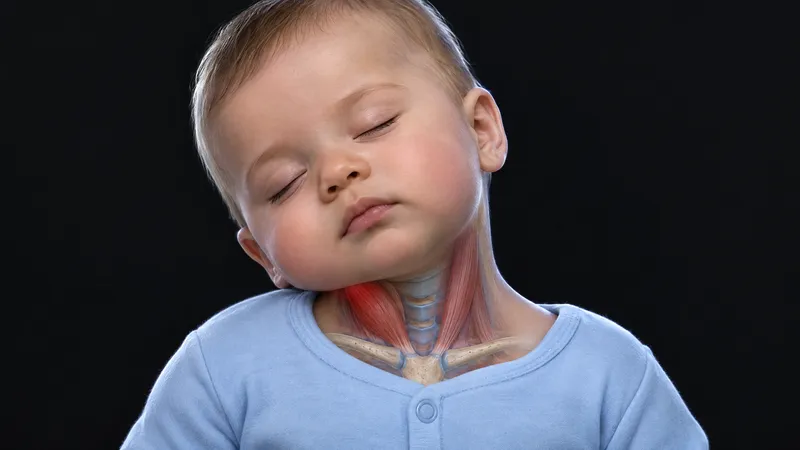
What torticollis is
Torticollis describes the position: the head is held tilted to one side. What's underneath it in a baby is usually one tight neck muscle.
That muscle is the sternocleidomastoid, which runs from behind the ear down to the collarbone. When it's shortened on one side, it produces a recognisable pattern: the head and ear tilt towards the affected side, while the chin turns away towards the other side 1. Some babies also have a firm lump you can feel within the muscle itself. That's part of the same picture, not a separate problem 1.
There are two versions of this, and the difference decides what happens next 1:
Muscular torticollis
the muscle itself is tight. You can feel it, and the neck won't turn fully when someone else gently moves it. This is the more common of the two.
Postural torticollis
your baby just prefers one head position, but there's no tightness and the neck moves fully in every direction when moved passively.
It's far more common than most parents expect. Estimates range from 3.9% to 16% of newborns 3, a wide range, because different studies screen for it in different ways. It's slightly more frequent in boys, and in babies exposed to opioids during pregnancy 3.
What causes it
The congenital form (the one present at or very near birth) is generally put down to the position your baby was lying in inside the uterus, birth trauma, or less commonly a problem with the spine 2. Risk factors identified in the research include an asymmetrical head or face at birth, a first pregnancy, a difficult birth, and the baby's length at birth 3.
But it doesn't have to start before birth. It can also develop in the days or months afterwards if a baby has limited tummy time, or settles into a strong preference for turning their head one way 2. Once that preference sets in, it tends to reinforce itself: the head stays turned, the muscle on one side stays short, and turning the other way becomes harder work.
None of this is something you caused. Babies arrive with a head position they've already held for weeks, and the newborn advice you were rightly given about back-sleeping doesn't come with an instruction manual for how to vary their head position while they're awake.
When it usually shows up
Congenital torticollis is usually diagnosed within the first month of life 1. The current physiotherapy guideline goes earlier still: it recommends that a baby's neck movement and any facial or skull asymmetry be assessed and documented within the first two days of birth, and that's its strongest-graded recommendation 3.
Diagnosis after six months is rare, and if it happens, other causes should be considered rather than assuming it's the muscular type 1.
The things worth noticing, especially in the first weeks 2:
- Your baby has difficulty feeding on one side.
- They consistently prefer turning their head to one side.
- There's visible asymmetry in their face or the shape of their head.
Why the timing matters more than anything else
This is the main reason we'd rather you booked an assessment than waited another month to see what happens.
Earlier physiotherapy isn't just slightly better. If it starts before one month of age, 98% of babies with congenital muscular torticollis reach near-normal neck range within about six weeks. Waiting until after one month stretches the episode of care to roughly six months. Waiting until after six months can mean nine to ten months of treatment, and progressively fewer babies reach that near-normal result at all 3.
The figures behind that, from the same guideline 3:
| Treatment started at | Babies with an excellent result | Average length of treatment |
|---|---|---|
| Before 1 month | 99% | about 1.5 months |
| 1–3 months | 89% | about 5.9 months |
| 3–6 months | 62% | about 7.2 months |
| 6–12 months | 19% | about 8.9 months |
"Excellent result" here means a specific thing: no remaining head tilt, and full passive neck rotation 3.
There's a plain mechanical reason for the pattern. Babies become harder to stretch as they get older and develop their own neck control 3: a three-week-old lets you move their head; a seven-month-old has opinions. The same guideline also notes that starting physiotherapy early reduces time to resolution compared with parents stretching at home alone, and that earlier intervention can remove the need for surgery later 3.
What treatment involves
Two things are true at once here. Mild cases are managed at home by the parent with simple stretching exercises. More severe cases are referred to physiotherapy, and rarely to orthopaedics 1.
The home side of it looks like this 1,2:
- Advice from your doctor or child health nurse on how you position your baby during feeding and sleeping.
- Supervised tummy time while your baby is awake; this one does a lot of work.
- Passive stretching, done around four to five times a day.
- Practical changes through the day: putting toys on the affected side so your baby has a reason to turn that way, and avoiding long stretches in a car seat.
- A follow-up with your GP within about four weeks to check it's shifting.
Where physiotherapy is involved, the first-choice program is broader than stretching alone. It includes passive neck movement, active neck and trunk movement, developing symmetrical movement generally, changes to your baby's daily environment and positioning, and teaching you how to do all of it between appointments 3,4.
A physiotherapy referral is recommended when 1:
- There's no improvement with home exercises by four to six weeks.
- The torticollis is severe: for example, less than 30 degrees of neck rotation at diagnosis.
- Your baby is older than three months at diagnosis with more than minimal torticollis.
- There's moderate-to-severe flattening of the head alongside it.
Two useful things about what isn't needed. If the examination supports congenital muscular torticollis, no further investigations are required, and routine neck imaging is not recommended 1. But hips should be checked: developmental hip dysplasia is a common association, and a hip ultrasound is recommended 1.
On the extras you'll read about. Techniques like microcurrent and kinesiology taping come up in searches. The guideline's position is plain: the evidence for them is weak, they sit alongside the first-choice program rather than replacing any of it, and they should only be delivered by a clinician specifically trained in that technique 3. They're not what we lead with, and we wouldn't want you choosing a provider on the basis of them.
What about the flat spot on their head?
Very often the flattening is what brings a parent in, not the head tilt itself. The two travel together for an obvious reason: a head that rests in the same position takes pressure in the same place, which is why moderate-to-severe flattening is itself a reason to refer a baby to physiotherapy 1.
The question that follows is almost always about helmets, so here's what the research found.
A randomised controlled trial followed 84 babies aged five to six months with moderate to severe positional skull flattening, comparing six months of helmet therapy against simply letting it take its natural course. There was no meaningful difference between the two groups. Full recovery occurred in 26% of the helmet group and 23% of the natural-course group, and every parent in the helmet group reported one or more side effects. The authors concluded that they discourage the use of a helmet as a standard treatment for healthy infants with moderate to severe skull deformation 5.
One caveat, because it would be easy to overstate that result: the trial deliberately excluded babies with muscular torticollis. It tells you about helmets for skull shape in general, not about helmets in torticollis specifically.
Either way, helmets sit outside what a physiotherapist supplies; that's a conversation for your GP or paediatrician. What physiotherapy addresses is the reason the pressure is landing in one place.
When to get it checked properly
Most of this settles. A majority of cases resolve after four to five months 1. But there are points where waiting stops being reasonable.
Take your baby for urgent medical care if any of these appear alongside a head tilt 2:
- Fever
- More drooling than usual
- Trouble breathing, or trouble swallowing
- A sore throat
- Changes in vision
- Changes in feeling or movement in the arms or legs
Book an assessment, rather than waiting it out, if there's been no improvement with home stretching and positioning by four to six weeks, if the head tilt is pronounced, or if your baby was already past three months when you noticed it 1.
And if there's been no significant improvement by six months of age, the diagnosis itself should be revisited, or your child referred on to a paediatric orthopaedic surgeon 1. That's rare. It's also the sort of thing that's better identified at six months than at two years.
Where physiotherapy fits
Most of the work in infant torticollis happens at home, in the ordinary moments: how you hold your baby while feeding, which side the cot faces, where the toys sit, how much awake tummy time they actually get. What a physiotherapist adds is knowing which of those matter for your baby's particular pattern, checking the neck is improving and not just looking like it is, and adjusting the program as your baby grows and gets stronger.
That's what our paediatric physiotherapy service is built around, and that page explains what an appointment involves and what to bring.
FAQs
Is torticollis in babies serious?
In most cases, no. A majority of cases resolve after four to five months, and mild ones are managed at home with simple stretching and positioning 1. What makes it worth taking seriously is what happens when it's left alone: untreated congenital torticollis can lead to a permanent head tilt and changes in the shape of the head and face, which in turn can contribute to delays in coordination and development, and problems with the spine, jaw and eyes 2. There's one other reason not to treat it as purely cosmetic: developmental dysplasia of the hip is a common association, so the hips should be checked too 1.
Do babies eventually grow out of torticollis?
Mostly yes, but the wording hides something. A majority of cases do resolve after four to five months 1, with home stretching and positioning being done, not with nothing happening. Physiotherapy started early reduces time to resolution compared with parents stretching alone, and babies become harder to stretch as they age and develop their own neck control 3. So "they'll grow out of it" is broadly true and still a poor reason to wait.
Is 4 months too late to fix torticollis?
No, but it is measurably harder, and worth starting now rather than next month. Where treatment starting before one month produces an excellent result in about 99% of babies over roughly six weeks, starting between three and six months produces that result in about 62%, over an average of around seven months of treatment 3. A baby older than three months at diagnosis with more than minimal torticollis is specifically listed as a reason to refer to physiotherapy 1. Four months is not too late. It's a reason to book, not a reason to give up.
What happens if torticollis is left untreated?
The realistic range runs from "resolves anyway" to "leaves a lasting change". Most do resolve within four to five months 1. But the documented consequences of leaving it untreated are a permanent head tilt and changes to head and face shape, with flow-on effects for coordination, development, and the spine, jaw and eyes 2. Earlier intervention can also remove the need for surgery later 3, and if there's no significant improvement by six months the diagnosis should be reconsidered or your child referred to a paediatric orthopaedic surgeon 1.
Is torticollis linked to autism?
We're not going to answer this one from guesswork. None of the clinical sources this page relies on (an Australian paediatric hospital guideline, Australian government health information, and the international physiotherapy guideline for this condition) addresses a link between torticollis and autism in either direction, so we're not going to claim one exists or that one doesn't. What those sources do establish is relevant if the underlying worry is your baby's development: the gross motor delays sometimes seen in these babies appear to be more strongly related to infrequent tummy time while awake, and resolve by preschool age, around three-and-a-half to five years 1. A neurological examination is also a standard part of assessing a baby with torticollis, to identify the rare non-muscular causes 1. If you have specific concerns about your child's development, that's a conversation for your GP or paediatrician, and it's a reasonable one to start early.