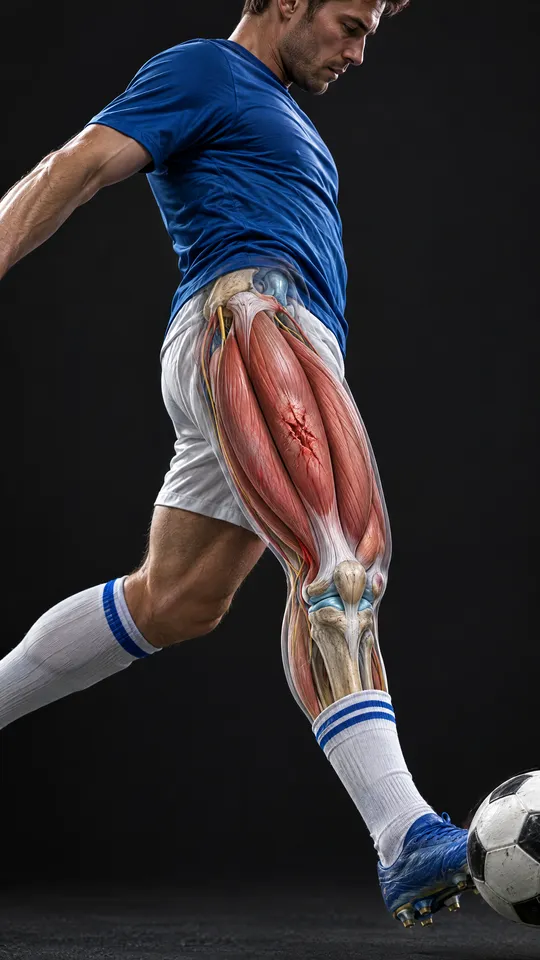
What's actually causing it
Your quadriceps are the four muscles at the front of your thigh. Their main job is straightening your knee, and one of them, rectus femoris, also helps lift your thigh towards your chest.
A strain is an injury to a muscle or tendon 2: stretching or tearing of the fibres themselves 3. A quad strain is the acute version: the muscle made to contract hard while it's lengthening, or stretched too far 1.
Soccer, rugby and football repeatedly ask the quadriceps to contract hard while lengthening, working to slow the knee bending rather than to shorten 1. Do that at speed, or tired, and fibres tear 1. Rectus femoris takes the hit most often: it crosses both the hip and the knee, is rich in fast-twitch fibres, and has complex tendon architecture 1. Multi-joint muscles are injured at far higher rates than single-joint ones 2.
Two timing quirks are worth knowing: the pain sometimes doesn't fully arrive until the end of a game, and bruising may not appear for a full 24 hours 1.
How bad is it? Severity is judged by what you can do, not by how much it hurts:
| What's torn | What it feels like | Strength |
|---|
| Grade 1 (mild) | Minor tearing of fibres 1 | Mild to moderate pain 1 | Minimal or no loss, no loss of range, no gap you can feel 1,2 |
| Grade 2 (moderate) | More severe disruption of the fibres 1 | Significant pain, and moderate limits on what you can do 1,2 | Moderate loss, sometimes a small defect you can feel 1 |
| Grade 3 (severe) | Complete tear of the muscle 1 | Severe pain, sometimes a visible deformity 1,2 | Usually complete loss, often a palpable gap 1 |
Australian guidance also uses an expanded Grade 0a to Grade 4 scale, adding ordinary post-exercise soreness at one end and a complete tear with visible deformity at the other 2.