Need urgent care? 24/7 Mobile & After-Hours Emergency Physiotherapy Call (02) 8111 5633 For life-threatening emergencies, always call 000
Thigh

Corked Thigh (Quadriceps Contusion)

5.0 average rating on Google
Registered NDIS Provider
SIRA Registered Provider

Someone's knee goes into the front of your thigh in a tackle. It stings, you shake it off, you finish the game. By the next morning the thigh is tight and hot, your heel won't come anywhere near your backside, and stairs have become a one-at-a-time job.

That's a corked thigh (a corky, if you grew up around footy). Along with strains, contusions make up most of the quadriceps injuries seen in sport 5. Corks are easy to underestimate, because from the outside they often don't look like much.

What's actually causing it

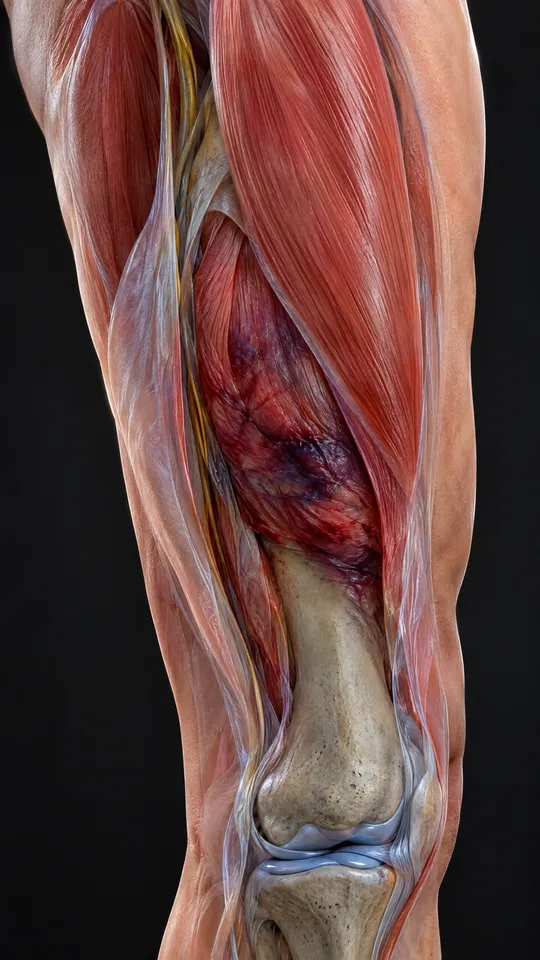
A knock on the arm is forgotten in a few days. A corky can cost you a month. The difference is what sits behind the muscle. When something hard hits the front of your thigh, the quadriceps has nowhere to go. It gets compressed against the femur, muscle tissue ruptures deep inside, and bleeding and inflammation follow 1.

An ordinary bruise is small blood vessels just under the skin leaking 2. A cork is the same process, far deeper and on a much larger scale, inside a muscle that can't expand to make room. That's why the thigh tightens over the following hours and the knee gradually stops bending. The harder the hit, the worse it is 1.

So the bruise fading isn't the same as the muscle being match-fit. A skin bruise typically clears in one to two weeks 2. The return-to-sport windows for a quadriceps contusion run from weeks to months 1. Two different clocks, and the one you can see is the less useful one.

Front of the thigh showing deep bruising in the quadriceps muscle where it sits against the thigh bone

Cork or quad strain? How to tell the difference

Both hurt at the front of the thigh, but they happen differently and the early management isn't the same.

Corked thigh (contusion)Quad strain
What happenedSomething hit you: a knee, a hip, a boot, a ballNothing touched you; the muscle gave way under its own effort
WhenOne moment of contact you can point toUsually mid-sprint, mid-kick or on an overstretch
Where it hurtsAt the point of impactAlong the muscle, sometimes towards the tendon

If you can name the collision, you're on the right page. If the pain arrived mid-sprint with nothing touching you, read our quad strain page instead. Not sure it's either? Start from the thigh injury guide.

How it's diagnosed

A corked thigh is diagnosed from your story and an examination. You usually won't need a scan 5. Most people can name the knock that did it. From there a clinician looks for swelling, bruising or any change in the thigh's shape, presses along the muscle to find where the damage sits, and compares your thigh strength with the other leg 5.

Imaging has a few specific jobs. An ultrasound or MRI helps if the front of your thigh hurts and you can't recall a knock. An X-ray is for when there's concern about the bone, or later on, if bone forming inside the muscle (myositis ossificans) is suspected 5.

How we treat it

1
We grade it by your knee, not the bruise. We measure how far your knee bends, watch how you walk and check how the thigh responds to pressure. Knee range measured 12 to 24 hours after the injury is what separates mild (more than 90°), moderate (45 to 90°) and severe (less than 45°) 3.
2
We get the early phase right. That means rest with the leg elevated, ice for about 20 minutes every two hours (never directly on the skin) and a compression bandage 1. The bandage should be firm but not tight, and it comes off at night 2. On top of that, No HARM: no heat, alcohol, running or massage 1. Our corked thigh recovery guide walks through the first few days step by step.
3
We rebuild bend and strength early, in the right order. Quad sets can start early. That means tensing the thigh without moving the knee. Strengthening typically begins two to seven days after the injury, depending on severity 1. That graded progression is the core of our exercise prescription and conditioning work, and your range sets the pace, not the calendar.
4
We build the return around your sport. Getting back to running and getting back to contact are different thresholds, and both are earned, not dated. That's the work our sports physiotherapy team does with you.

Other treatments we may use

Holding the knee bent early on.

Some protocols rest the injured leg with the knee bent rather than straight 3. One study held the knee at 120° for the first 24 hours and reported an average return to full activity of 3.5 days 4. That number needs context: a case series of 47 young naval cadets, no control group, compared only against other published reports, with treatment started within ten minutes of injury 4. Promising, not proven, and far less relevant if you're seeing us three days later.

Early stretching, for mild injuries only.

Gentle, pain-free holds of about ten seconds, three to five times a day, are recommended for mild contusions 1. For a moderate or severe cork, early stretching isn't the plan.

Ice, with realistic expectations.

Even Australian guidance varies on the dose: 20 minutes every two hours in one source 1, 10 minutes every two to four hours in another 2. It's protocol guidance, not trial evidence.

Hands-on treatment.

Once the bleeding phase has passed, manual therapy may help with lingering stiffness. We found no contusion-specific evidence that it speeds recovery. It sits alongside exercise, never in place of it.

Anti-inflammatory medication.

It appears in the literature as part of conservative management once myositis ossificans has developed 6. Its use in fresh soft-tissue injuries is contested, though. One widely used framework warns it may harm long-term tissue healing 7. We found no evidence that it prevents myositis ossificans. Either way, it's a question for your GP or pharmacist, because physiotherapists don't prescribe it.

Your recovery path: Reset, Rebuild, Return

A corked thigh is treated along The Well Motion Recovery Path™. Your knee bend and your strength decide when you step up a phase. The calendar does not.

  • Reset: the first few days, while the muscle is still bleeding. Rest, ice, compression and elevation under the No HARM rules, plus early quad sets 1. Expect the thigh to feel tighter the day after the knock. We move you on once the knee bend has stopped getting worse and you can walk without the pain building.
  • Rebuild: the longest phase. Graded strengthening through exercise prescription and conditioning, gentle stretching if the cork is mild 1, and manual therapy if stiffness lingers. Expect the bend to come back before the power does. We move you on when the knee bends far enough to run and the thigh takes load without pain.
  • Return: running first, then contact. We test sport-specific tasks and look for a pain-free thigh and a full knee bend 5. You leave with a conditioning and warm-up plan and advice on thigh padding 1,8.

How long it usually takes. Australian guidance puts return to sport at 2 to 3 weeks for a mild cork, at least 4 to 6 weeks for a moderate one and at least 8 weeks for a severe one 1. That is guidance, not trial data. If bone forms inside the muscle, recovery runs far longer 1.

Reducing the risk of it happening again

You can't take the collisions out of contact sport, but one part of this has been put to the test:

  • Wear thigh pads. An Australian study followed two elite under-18 Australian football teams for a season. The team in thigh protectors had no thigh haematomas (deep bruises). The team without had nine 8. It's one small study, and players found the pads uncomfortable in the heat 8, but padding also tops the Australian prevention list 1.
  • Don't go back early. In that study, two of the unpadded players tore a quad within four weeks of their cork 8. The usual return criteria are no pain, a knee that bends to 120 degrees with the hip straight, and sport-specific testing without limitation 5.
  • Stay conditioned and warm up. Poor muscle conditioning and an inadequate warm-up are both suspected risk factors 1.
  • Build training in steps. Raise intensity and duration gradually, and leave recovery time between sessions 1.

When to get it checked properly

Most corked thighs settle with good early management. Get yours assessed if:

  • The pain is severe, or you can't move the knee 2
  • Swelling or bruising comes on very quickly 2
  • You couldn't play on and you're limping, which is typical of a moderate cork 1
  • You're struggling to put weight through the leg, a feature of the most severe grade 1
  • The ache is lasting longer than a simple bruise should, there's localised swelling at the front of the thigh, or your knee is gradually losing range, not gaining it. That pattern points towards myositis ossificans 6

Seek urgent medical care if the leg looks twisted or bent, your skin feels cold or sweaty, or you have a fever of 38°C or higher 2.

On myositis ossificans: take it seriously, but don't panic about it. It's benign, mostly self-limiting and usually managed conservatively 6. In one cohort of young cadets with quadriceps contusions, it developed in 9% 3. A delay in treatment of more than three days was one of the risk factors identified 3. Bone formation usually stops after six to seven weeks. Reabsorption can take up to twelve months in severe cases, and nothing speeds it up 1.

Most corks never get anywhere near that. They settle with good early care and a return to sport that's paced to the knee.

Your first appointment

We start by listening: how it began, what makes it worse, and what it's stopping you from doing. Then we examine the area, explain what we find in plain English, and agree a plan with you. Your first visit is 40 minutes at Engadine and 30 minutes at our other clinics.

We see patients at Engadine, Mount Annan, Narellan and Appin, and at home through our mobile physiotherapy service. If you have private health cover, here's how health fund rebates work for physiotherapy.

FAQs

What does a corked thigh feel like?

Pain and reduced movement from the moment of impact, with the area swollen, tender to touch and often bruised. The harder the hit, the worse it is 1. A more useful gauge is how far your knee bends 12 to 24 hours later 3.

How long does a corked thigh last?

Australian guidance gives roughly 2 to 3 weeks for a mild cork, at least 4 to 6 weeks for a moderate one and at least 8 weeks for a severe one 1. One study of young cadets measured shorter average time off: 13, 19 and 21 days 3. They measure different things in different people. We plan to the Australian guidance and adjust to what your knee does.

Should you massage a corked thigh?

Not early on. Massage is on the No HARM list, alongside heat, alcohol and running, because it can add to the bleeding and swelling 1. Rubbing a fresh corky is a reliable way to make it worse.

I have a corked thigh but no bruising. Is this normal?

Yes, and it doesn't mean you got off lightly. An ordinary bruise comes from vessels just under the skin 2. The bleeding in a cork is deep in the muscle, where it was crushed against the bone 1. So the skin is a poor guide. Judge it by pain, swelling and how far your knee bends 3.

How can I speed up contusion healing?

Mostly by not slowing it down: good early management, No HARM, quad sets early and strengthening from day two to seven 1. Early knee-flexion positioning is promising but low-grade evidence 4. And don't wait, because a treatment delay of more than three days was linked to myositis ossificans 3.

More Thigh conditions

Thigh

Quad Strain

A pulled quad: torn fibres at the front of the thigh, from sprinting, kicking or overstretching. Sore to load, and slow to trust again.

Read more
Thigh

Meralgia Paresthetica

Burning, numbness or pins and needles down the outside of the thigh, with no injury behind it: a compressed nerve, not a torn muscle.

Read more
Thigh

Quadriceps Tendon Rupture

A tear of the tendon joining the quad muscles to the kneecap. Usually a sudden give-way on landing, after which straightening the knee is difficult.

Read more

If you've copped one this weekend, the useful window is now, not in a month when it still won't bend.

Book an appointment and we'll grade it properly, get the early management right, and plan your return around your season. Or head back to the thigh injury guide.

Book an Assessment
Ahmed Elsayed, Principal Physiotherapist
Reviewed by Ahmed Elsayed Principal Physiotherapist at Well Motion

References

  1. Sports Medicine Australia. Quadriceps Contusion (Cork Thigh): injury fact sheet. https://sma.org.au/resources/injury-fact-sheets/quadriceps-contusion-cork-thigh-2/
  2. healthdirect Australia. Bumps, knocks and bruises. Last reviewed November 2025. https://www.healthdirect.gov.au/bumps-knocks-and-bruises
  3. Ryan JB, Wheeler JH, Hopkinson WJ, Arciero RA, Kolakowski KR. Quadriceps contusions: West Point update. The American Journal of Sports Medicine, 1991;19(3):299-304. https://doi.org/10.1177/036354659101900316
  4. Aronen JG, Garrick JG, Chronister RD, McDevitt ER. Quadriceps contusions: clinical results of immediate immobilization in 120 degrees of knee flexion. Clinical Journal of Sport Medicine, 2006;16(5):383-7. https://doi.org/10.1097/01.jsm.0000244605.34283.94
  5. Kary JM. Diagnosis and management of quadriceps strains and contusions. Current Reviews in Musculoskeletal Medicine, 2010;3(1-4):26-31. https://doi.org/10.1007/s12178-010-9064-5
  6. Gullì C, Ferrara G, Ferravante E, et al. Revisiting Myositis Ossificans: A Comprehensive Stage-by-Stage Imaging Review. Muscles, 2026;5(2):27. https://doi.org/10.3390/muscles5020027
  7. Dubois B, Esculier JF. Soft-tissue injuries simply need PEACE and LOVE. British Journal of Sports Medicine, 2020;54(2):72-73. https://doi.org/10.1136/bjsports-2019-101253
  8. Mitchell B. Efficacy of thigh protectors in preventing thigh haematomas. Journal of Science and Medicine in Sport, 2000;3(1):30-4. Abstract via PubMed (PMID 10839226). https://doi.org/10.1016/s1440-2440(00)80045-6