Hands-on treatment.
Manual therapy can sit alongside the exercise. A review of groin pain treatments found moderate evidence that adding manual therapy shortens the time back to sport compared with exercise alone 6.
There was no moment you hurt it. The ache high on the inside of your thigh just built up over a few weeks, maybe after you trained more or started a new season. It eases once you're warmed up, then it's back after the game, and squeezing your knees together sets it off. Rest takes the edge off, but it returns as soon as you load it again.
That pattern fits adductor tendinopathy: the tendons where your inner thigh muscles attach have been asked to do more than they were ready for. What helps most is a gradual strengthening program. Rest on its own rarely fixes it 1,3.
Did it start suddenly, with one kick, stretch or change of direction? Then adductor strain grades and recovery is the better place to start.
The adductors are the group of muscles down your inner thigh. They start on the pubic bone, at the front of your pelvis, and their tendons take the strain every time you kick, plant your foot or cut sideways.
A tendinopathy develops when those tendons are loaded more, or more often, than they can currently handle. The name matters. When researchers examined overused tendons under the microscope, they found almost no inflammatory cells, so "tendinopathy" replaced the older word "tendinitis" 14. That work was done on other tendons, and the term is now used for overuse tendon pain in general.
Tendons don't all behave the same way. One widely used model treats tendon pain as a spectrum, which helps explain why some cases settle with simple changes and others take much longer 13.
It's most common in sports with running, kicking and quick changes of direction, such as football and ice hockey 1. In a study of 207 athletes with long-standing groin pain, the adductors were the main source in 58% 15. A previous groin injury, weaker hip muscles and sudden jumps in training load are all recognised risk factors 1.
A note on the name. An international group of sports medicine clinicians, meeting in Doha, chose the label "adductor-related groin pain" instead of "adductor tendinopathy" 2. You'll see both names in scan reports and research. In that system, "long-standing" only means the pain has been there a while. It says nothing about how it started 2.
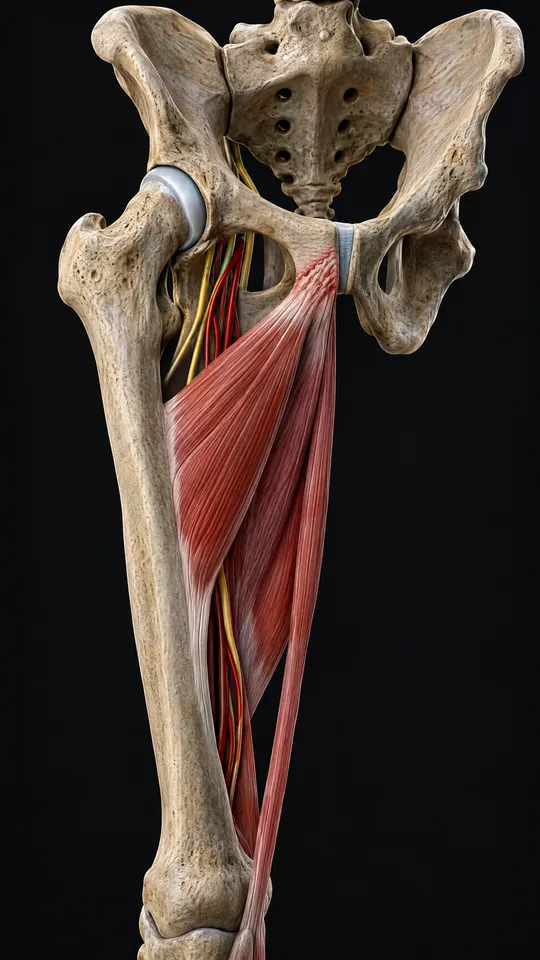
Groin pain can also come from the pubic bone, the hip flexor, the inguinal canal or the hip joint itself, and more than one can be involved at once 2. Pain centred on the pubic bone is covered under osteitis pubis. Pelvic pain in pregnancy is different again: see symphysis pubis dysfunction. Still unsure where yours is coming from? Start with what's causing your groin pain.
It's tested by hand, not by machine. Two findings together point to the adductors: tenderness when the muscles are pressed near the pubic bone, and your familiar pain when you squeeze your legs together against a physio's hands 2. We test the squeeze with your legs straight as well as bent, and score the pain out of 10 so there's a baseline to track 1.
Scans are less helpful than most people expect. In one MRI study, up to 71% of footballers with no groin pain at all had findings on their scans. Footballers without pain were also far more likely than other athletes to show adductor tendinopathy on MRI 9. So a report that says "adductor tendinopathy" describes what the tendon looks like, not necessarily what's causing your pain. Imaging earns its place when something else is suspected, such as a problem inside the hip joint 1.
Why lean on strengthening? In a randomised trial of 68 athletes who'd had groin pain for a median of 40 weeks, 23 of those given active strength and coordination training got back to sport without groin pain. Only 4 of those given physiotherapy without active training did 3.
The research base is small, and we'd rather you knew. A review of 72 groin pain studies rated only 4 as high quality 6. Active exercise still has the most support, so that's what we build on.
Manual therapy can sit alongside the exercise. A review of groin pain treatments found moderate evidence that adding manual therapy shortens the time back to sport compared with exercise alone 6.
Corticosteroid and platelet-rich plasma injections have been tried, and the evidence for both is conflicting 8. They're medical treatments, not something our physiotherapists provide. Your GP or a sports doctor can talk them through with you.
For pain that doesn't improve with a well-run program, an operation called adductor tenotomy is an option. Reviews report good results for many people, but most of the studies are low quality and include mixed groups of patients 6,7. Surgery is rarely needed, and when it is, it's added to a loading program, not used in place of one 1. That decision sits with a surgeon.
Adductor tendinopathy is worked through The Well Motion Recovery Path™. What moves you up a phase is what the tendon can take, not the week count.
How long it usually takes. For long-standing adductor pain, return to sport usually takes 3 to 4 months, and full recovery often comes later, 6 to 9 months in some cases 1. When the pubic bone is involved, recovery can take more than 6 months 1. Everyone's timeline is different, so treat these as a guide.
Book an assessment with us if:
Some groin symptoms point to a medical problem, not a tendon. Call triple zero (000) or go straight to an emergency department for sudden, severe pain and swelling in the scrotum, or a painful lump in the groin with nausea or vomiting 10. An emergency department is also the right place for groin pain with a fever, sharp pain with blood in your urine, or being unable to pass wind or a bowel motion 10.
Most adductor pain is none of those things. It's a tendon that needs the right load, and that's what a physiotherapy plan is for.
We start by listening: how it began, what makes it worse, and what it's stopping you from doing. Then we examine the area, explain what we find in plain English, and agree a plan with you. Your first visit is 40 minutes at Engadine and 30 minutes at our other clinics.
We see patients at Engadine, Mount Annan, Narellan and Appin, and at home through our mobile physiotherapy service. If you have private health cover, here's how private health insurance covers physiotherapy.
Long-standing adductor pain often lingers because rest calms the tendon down but doesn't rebuild what it can handle, so it flares again as soon as you return to full training 1,3. It can also be that more than one area is involved, such as the adductors and the hip flexor together 2,15. An assessment sorts out which structures are involved and what load they're ready for.
They describe the same pattern. "Tendonitis" suggests inflammation, but overused tendons show few inflammatory cells, so "tendinopathy" is the more accurate name 14. Research and scan reports may also call it adductor-related groin pain 2.
Often, yes, as long as the pain stays low. Our guide: up to 3 out of 10 is fine. At 4 or above, ease off and we adjust the plan. If running makes it build session after session, we cut back and rebuild before going again.
The urgent signs above apply to everyone. For groin pain that's ongoing but not sudden or severe, without swelling, nausea or vomiting, healthdirect advises seeing a doctor 10. Most adductor research has been done in men, so evidence for women is thin 1. Pelvic pain during pregnancy is a different condition, covered under symphysis pubis dysfunction.
Chronic pain at the front of the pelvis, most often in footballers and running athletes, that tends to get worse the longer it's played through.
Read morePregnancy-related pelvic joint pain, caused by increased ligament laxity and load through the pelvis.
Read moreA strain of the adductor muscles that pull the leg inward, common in sports with sudden changes of direction.
Read moreA strain of the inner-thigh muscles, closely related to a groin strain but specific to the adductor group.
Read moreHow would you like to reach us?
Message us on WhatsAppFor bookings and enquiries. Please don't send medical details. Call (02) 8111 5633Request a call-back
Request sent
Thank you. We'll call you back on the number you gave us.
This is a preview, so nothing was actually sent.